


In short ⚡
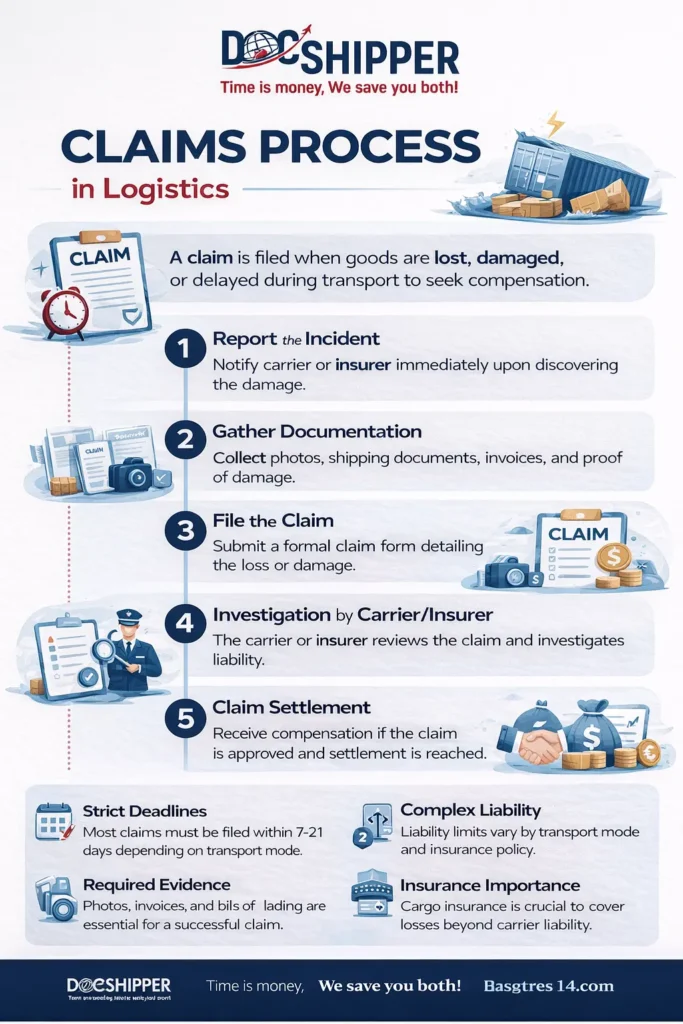
A claim is a formal request for compensation filed by a shipper or consignee when goods are lost, damaged, or delayed during transport. It initiates a legal process where the carrier or insurer must investigate the incident and determine liability based on the applicable transport convention and insurance coverage.
Introduction
Every international shipment carries risk. Containers fall overboard, pallets get crushed in warehouses, and delays cause perishable goods to spoil. When these incidents occur, shippers face a critical question: how do I recover my losses?
The claim mechanism exists precisely for this purpose. It transforms an operational failure into a structured compensation process. Understanding how claims work is essential for any business engaged in import/export operations.
Key characteristics of logistics claims:
- Time-sensitive: Most transport conventions impose strict filing deadlines (often 9-12 months)
- Evidence-dependent: Success requires thorough documentation of damage or loss
- Convention-governed: Rules vary by transport mode (CMR for road, Montreal for air, Hague-Visby for sea)
- Liability-limited: Carriers typically face capped compensation unless gross negligence is proven
- Insurance-linked: Cargo insurance often provides broader coverage than carrier liability
Claim Process & Legal Framework
Filing a successful claim requires understanding both procedural steps and the legal framework governing carrier liability. The process typically unfolds in five distinct phases.
Initial notification must occur immediately upon discovering damage or loss. Most transport conventions require written notice within specific timeframes: 7 days for apparent damage, 21 days for concealed damage. Failure to notify within these windows can forfeit your right to compensation.
Documentation assembly forms the backbone of any claim. Essential documents include the original bill of lading or air waybill, commercial invoice, packing list, survey reports from independent inspectors, photographs of damaged goods, and correspondence with the carrier. At DocShipper, we systematically guide clients through this documentation phase to ensure no critical evidence is overlooked.
Liability determination depends on which international convention applies. The CMR Convention governs road transport in Europe, limiting liability to 8.33 SDR per kilogram. Maritime transport falls under Hague-Visby Rules (666.67 SDR per package or 2 SDR per kilogram). Air transport follows the Montreal Convention (22 SDR per kilogram for cargo).
Valuation methodology varies by jurisdiction but generally follows one of three approaches: actual cash value (replacement cost minus depreciation), replacement cost (current market price for equivalent goods), or agreed value (pre-declared in shipping documents). The burden of proof always rests with the claimant to demonstrate the goods’ value.
Negotiation and settlement typically occur before litigation. Carriers or their insurers will review the claim, potentially requesting additional evidence or independent surveys. Settlement offers may be lower than claimed amounts due to liability limitations or contributory negligence arguments. Understanding these dynamics helps shippers set realistic expectations.
Practical Examples & Key Data
Real-world claim scenarios illustrate how theory translates into practice. The following examples demonstrate common situations and their financial implications.
Comparative Claim Outcomes by Transport Mode
| Transport Mode | Liability Limit | Typical Claim Duration | Success Rate |
|---|---|---|---|
| Sea Freight | 2 SDR/kg or 666.67 SDR/package | 6-12 months | 45-60% |
| Air Freight | 22 SDR/kg | 3-6 months | 60-75% |
| Road Transport (CMR) | 8.33 SDR/kg | 2-4 months | 70-85% |
| Rail Freight (CIM) | 17 SDR/kg | 4-8 months | 55-70% |
Use Case: Electronics Shipment Damage
Scenario: A French importer receives a container of laptops from China. Upon unpacking, 120 units (out of 500) show water damage from container condensation.
Claim calculation:
- Invoice value per unit: €800
- Damaged units: 120
- Total loss: €96,000
- Shipment weight: 2,500 kg (total), damaged portion: 600 kg
- Carrier liability (Hague-Visby): 2 SDR/kg × 600 kg = 1,200 SDR ≈ €1,400
- Insurance coverage (all-risk policy at 110% invoice value): €105,600
Outcome: Without cargo insurance, the importer would recover only €1,400 from the carrier—a 98.5% loss. With insurance, full compensation is received minus the deductible (typically €500-1,000). This example demonstrates why cargo insurance is essential for high-value shipments.
Key Claim Statistics
- 68% of claims are settled for less than the initially claimed amount
- Average settlement ratio: 72% of claimed value across all transport modes
- Documentation deficiencies cause 40% of claim rejections
- Late filing accounts for 25% of rejected claims
- Contributory negligence (improper packaging) reduces settlements in 30% of cases
Conclusion
The claim process transforms logistics incidents into recoverable business losses. Success depends on timely action, thorough documentation, and understanding the legal framework governing carrier liability. Given the complexity and limited carrier liability, cargo insurance remains the most reliable protection for international shipments.
Need expert guidance on filing a claim or protecting your shipments? Contact DocShipper for comprehensive logistics and insurance solutions tailored to your supply chain.
📚 Quiz
Test Your Knowledge: Cargo Claims
Q1 — What is a "claim" in the context of international logistics?
Q2 — A shipper receives a container of laptops with water damage worth €96,000. The carrier's liability under Hague-Visby Rules covers only ~€1,400. What does this scenario primarily illustrate?
Q3 — A consignee discovers concealed damage to their goods 15 days after delivery. Under most transport conventions, what is the correct course of action?
🎯 Your Result
📞 Free Quote in 24hFAQ | Claim: Definition, Process & Practical Examples in Logistics
Deadlines vary by transport mode: 9 months for sea freight (Hague-Visby), 2 years for air freight (Montreal Convention), and 1 year for road transport (CMR). Always file as soon as damage is discovered.
Yes, but only if the delay causes direct financial loss and you can prove the carrier's negligence. Liability for delay is typically limited to freight charges or a multiple thereof, depending on the applicable convention.
SDR stands for Special Drawing Rights, an international reserve asset created by the IMF. It's used in transport conventions to standardize liability limits across currencies. 1 SDR ≈ €1.17 or $1.30 (rates fluctuate).
While not always mandatory, an independent survey report significantly strengthens your claim by providing objective evidence of damage, its cause, and extent. Most insurers require surveys for claims exceeding €5,000.
Carrier liability is the legal responsibility of the transport company, limited by international conventions. Cargo insurance is optional coverage you purchase to protect against losses exceeding carrier liability limits.
Improper packaging typically constitutes contributory negligence, which can reduce or eliminate your claim. Carriers must prove packaging deficiency caused the damage. Always follow industry packaging standards and document your methods.
Provide the commercial invoice, purchase orders, and price lists. For manufactured goods, include production cost breakdowns. Market valuation reports from independent appraisers strengthen high-value claims.
You can escalate through arbitration (if stipulated in the transport contract), mediation, or litigation. Many transport conventions specify jurisdiction and applicable law. Legal action should be a last resort due to costs and duration.
Yes, partial losses (damage to some units in a shipment) are claimable. Calculate the claim based on the damaged portion's weight or value, depending on how liability limits apply under the relevant convention.
Generally no, as claims are a normal part of logistics operations. However, frequent claims may prompt carriers to request additional packaging requirements or increase scrutiny of your shipments.
Yes, if you can prove the carrier failed to maintain required temperature conditions and you specified these requirements in the shipping contract. Temperature data loggers provide crucial evidence for such claims.
Retain all transport documents (bill of lading, CMR, airway bill), commercial invoices, packing lists, pre-shipment inspection reports, photographs of packaging and goods, and all correspondence with the carrier for at least 2 years.
Need Help with
Logistics or Sourcing ?
First, we secure the right products from the right suppliers at the right price by managing the sourcing process from start to finish. Then, we simplify your shipping experience - from pickup to final delivery - ensuring any product, anywhere, is delivered at highly competitive prices.


Fill the Form
Prefer email? Send us your inquiry, and we’ll get back to you as soon as possible.
Contact us




