



In short ⚡
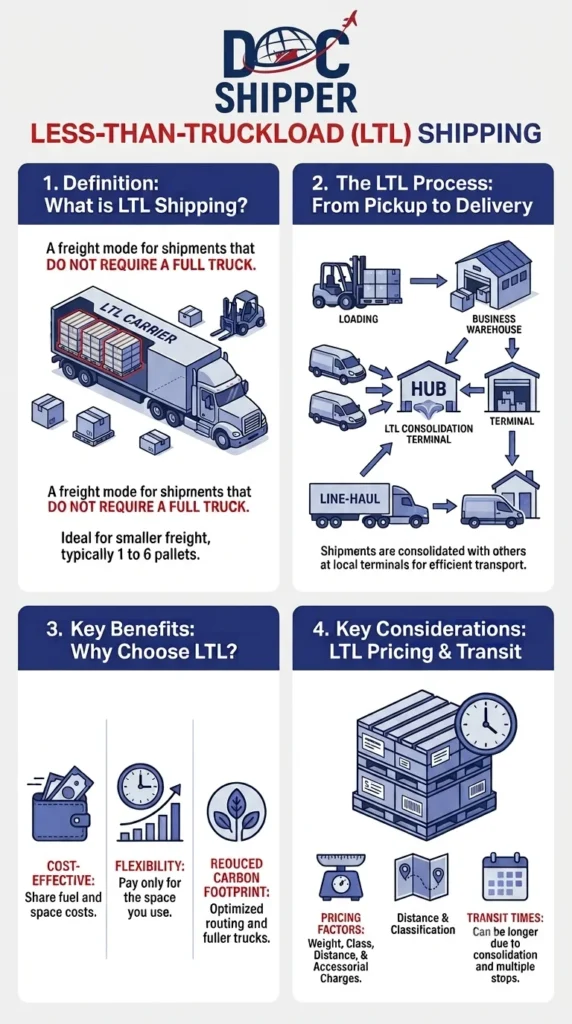
Less Than Truckload (LTL) is a freight shipping method for cargo that doesn't require a full truck's capacity, typically between 150 and 15,000 pounds. Multiple shippers share trailer space, reducing costs while maintaining scheduled transit times. This solution bridges the gap between parcel shipping and Full Truckload (FTL) transportation.Introduction
Many businesses struggle with an inefficient middle ground: their shipments are too large for standard parcel carriers but too small to justify renting an entire truck. This dilemma often leads to overpaying for unused trailer space or accepting longer delivery windows.
Less Than Truckload shipping emerged as the optimal solution for mid-volume freight in international and domestic supply chains. By consolidating shipments from multiple customers, LTL carriers maximize trailer utilization while offering cost-effective rates that scale with actual cargo volume.
Understanding LTL logistics is essential for optimizing transportation budgets and delivery schedules. Key characteristics include:
- Weight-based pricing: Rates calculated using freight class, weight, and distance
- Terminal networks: Hub-and-spoke systems where freight is consolidated and deconsolidated
- Freight classification: NMFC codes determining handling requirements and pricing tiers
- Accessorial charges: Additional fees for liftgate service, inside delivery, or residential drop-offs
- Transit time variability: Multiple stops increase delivery windows compared to FTL direct routes
LTL Mechanics & Logistics Expertise
The LTL shipping process operates through a sophisticated network of consolidation terminals. When a carrier accepts your freight, it travels to an origin terminal where workers sort and combine it with other shipments heading in similar directions. This hub-and-spoke model creates economies of scale but introduces handling touchpoints that FTL shipments avoid entirely.
Freight classification under the National Motor Freight Classification (NMFC) system determines your shipping costs more than weight alone. The NMFC assigns classes from 50 to 500 based on four factors: density, stowability, handling requirements, and liability. A dense, compact pallet of steel parts might qualify as Class 50, while lightweight but bulky furniture could fall into Class 250—dramatically affecting per-pound rates.
Understanding dimensional weight pricing prevents billing surprises. Carriers calculate dimensional weight by multiplying length × width × height (in inches) and dividing by a carrier-specific divisor, typically 139-194. If dimensional weight exceeds actual weight, you pay the higher figure. This formula incentivizes efficient packaging and penalizes wasted trailer cube.
The Bill of Lading (BOL) serves as your legal contract and receipt in LTL transactions. According to U.S. Federal Motor Carrier Safety Administration regulations, accurate BOL documentation protects both shipper and carrier by establishing liability limits and service expectations. Discrepancies between declared and actual freight details can void insurance coverage or trigger reweigh fees.
At DocShipper, we audit freight classifications before shipment to eliminate costly reclassification disputes. Our logistics specialists verify NMFC codes and optimize packaging density, ensuring your freight class matches carrier expectations from the outset. This proactive approach has reduced billing adjustments by 40% for our mid-volume shippers.
Concrete Examples & Comparative Data
Consider a manufacturer shipping 8 pallets of electronic components from Chicago to Atlanta—a typical LTL scenario. The shipment weighs 4,200 pounds with a freight class of 85. Here’s how costs compare across transportation modes:
| Shipping Method | Transit Time | Cost Estimate | Best For |
|---|---|---|---|
| LTL Carrier | 3-5 business days | $850-$1,200 | Standard mid-volume shipments |
| Full Truckload (FTL) | 1-2 business days | $2,400-$3,000 | Time-sensitive or full trailer volumes |
| Parcel (Multiple) | 4-6 business days | $1,800-$2,500 | Shipments under 150 lbs per piece |
| Volume LTL | 2-4 business days | $1,100-$1,600 | 6+ pallets, guaranteed space |
In this scenario, LTL shipping delivers savings of 64-71% compared to FTL while maintaining acceptable transit times. The cost efficiency becomes even more pronounced for lighter shipments or shorter distances.
Use Case: Cross-Border LTL Optimization
A Quebec-based furniture retailer needed to ship 12 pallets (9,800 lbs, Class 150) to warehouses in Texas and California. By consolidating into a single LTL shipment with terminal splitting, they achieved:
- Base rate: $2,340 for Chicago-to-Texas leg (primary destination)
- Terminal split charge: $180 for California rerouting
- Customs clearance coordination: $125 (broker fees)
- Total cost: $2,645 versus $5,200 for two separate FTL shipments
- Carbon footprint reduction: 38% lower emissions per pound shipped
Industry data reveals that LTL shipments have grown 22% annually since 2020, driven by e-commerce distribution needs and inventory decentralization strategies. The average LTL shipment now weighs 1,247 pounds—down from 1,540 pounds in 2018—as businesses prioritize frequent, smaller replenishments over bulk storage.
Critical pricing factors beyond base rates include:
- Fuel surcharges: Fluctuating weekly, typically 18-26% of base rate
- Liftgate delivery: $75-$150 per pickup/delivery without dock access
- Residential delivery: $95-$175 premium for non-commercial addresses
- Limited access fees: $50-$100 for schools, churches, construction sites
- Reclass/reweigh penalties: Retroactive charges if freight inspection reveals inaccuracies
Conclusion
Less Than Truckload shipping represents the most cost-effective solution for mid-volume freight, balancing affordability with reliable transit times through shared trailer space. Mastering freight classification, dimensional pricing, and accessorial charges transforms LTL from a basic shipping option into a strategic supply chain advantage.
Need expert guidance on LTL logistics or help optimizing your freight classifications? Contact DocShipper today for tailored shipping solutions that reduce costs and streamline your international logistics.
📚 Quiz
Test Your Knowledge: Less Than Truckload (LTL)
What is the primary weight range that qualifies for Less Than Truckload (LTL) shipping?
How does the National Motor Freight Classification (NMFC) system affect LTL pricing?
A manufacturer needs to ship 8 pallets (4,200 lbs) from Chicago to Atlanta. Based on the comparative data, which statement is correct?
🎯 Your Result
📞 Free Quote in 24hFAQ | Less Than Truckload (LTL): Definition, Calculation & Concrete Examples
LTL typically accommodates shipments between 150 and 15,000 pounds (68-6,800 kg). Below 150 lbs, parcel carriers offer better rates; above 15,000 lbs, Full Truckload becomes more economical. The sweet spot for maximum LTL savings falls between 1,000-10,000 pounds, where shared trailer space delivers significant cost advantages without sacrificing service quality.
The NMFC assigns 18 freight classes (50-500) based on density, stowability, handling, and liability. Lower classes cost less per pound—Class 50 items like steel plates might cost $0.45/lb, while Class 400 items like ping-pong balls could reach $2.80/lb. Accurate classification prevents costly reclassification fees that average 15-30% of the original quote when carriers inspect and disagree with declared classes.
Most modern LTL carriers provide tracking through BOL numbers, PRO numbers, or PO references. However, real-time GPS tracking is less common than in parcel shipping due to multiple terminal stops. Expect location updates at origin pickup, terminal arrivals/departures, and final delivery. Premium services offer enhanced visibility, but standard LTL tracking typically shows 4-8 hour update intervals rather than continuous monitoring.
Beyond base freight rates, expect fees for: liftgate service ($75-$150), inside delivery ($95-$165), residential addresses ($95-$175), limited access locations ($50-$100), appointment scheduling ($45-$85), and notification services ($15-$35). Reweigh or reclassification fees apply when declared weights/dimensions differ from carrier measurements, typically adding 20-40% to the original quote. Always request a detailed quote including potential accessorials.
Measure your pallet's length × width × height in inches, then divide by your carrier's dim factor (usually 139-194). If this dimensional weight exceeds actual weight, you're charged for the higher figure. Example: A 48×40×48" pallet weighing 300 lbs has a dimensional weight of 419 lbs at factor 139 (92,160÷139), so you'd pay for 419 lbs. Compact, dense packaging minimizes this impact.
Volume LTL (also called Volume Truckload) occupies 6-18 linear feet of trailer space—roughly 6-12 pallets or 5,000-15,000 lbs. It offers guaranteed space at premium rates with fewer handling touchpoints than standard LTL but costs less than FTL. Volume LTL suits shipments too large for standard LTL efficiency but insufficient to fill an entire 53-foot trailer, providing middle-ground pricing at 15-30% above regular LTL rates.
Standard LTL transit ranges from 1-5 business days for regional shipments (under 750 miles) and 3-7 days for cross-country routes. Multiple terminal stops add 1-2 days versus direct FTL routing. Guaranteed LTL services reduce this by 30-40% for 15-25% premium pricing. Factors like weather, customs clearance (international), and origin/destination accessibility affect timelines. Always add 1-2 buffer days for critical shipments.
Yes, LTL works excellently for cross-border shipments between the US, Canada, and Mexico under USMCA agreements. Carriers handle customs documentation, though you'll pay border crossing fees ($75-$150) and potential customs broker charges ($125-$250). For overseas international shipping, LTL typically applies only for inland legs—ocean or air freight handles the international portion, with LTL managing origin pickup or final destination delivery domestically.
Freight must be palletized (48×40" standard), shrink-wrapped, and stackable unless marked otherwise. Maximum single-piece weight typically caps at 2,500 lbs without special handling arrangements. Overhang beyond pallet edges risks damage and rejection. Non-stackable freight incurs surcharges since it wastes vertical trailer space. Proper packaging prevents the 14% of LTL claims attributed to insufficient protection, with average claim values reaching $1,840 per incident.
Absolutely—especially with consistent shipping volumes. Carriers offer tiered discounts based on annual spend commitments: 5-10% off for $50K+ annually, 10-18% for $150K+, and 18-30% for $500K+ contracts. Freight brokers and third-party logistics providers leverage aggregate volumes for 12-25% better rates than individual shippers secure. Contract negotiations work best with 3+ months of shipping data demonstrating predictable volumes and lanes.
Carriers maintain standard liability of $0.50-$0.60 per pound unless you purchase declared value coverage. File claims within 9 months (US) by submitting the original BOL, delivery receipt noting damage, repair estimates, and photos. Carriers resolve 70% of claims within 60-90 days. Inspect freight at delivery and note any damage on the delivery receipt—concealed damage claims filed later face 40% higher rejection rates than those documented upon receipt.
Guaranteed LTL costs 15-30% more but ensures on-time delivery with refund provisions for delays—ideal for time-sensitive freight or just-in-time inventory systems. Standard LTL provides estimated delivery windows without penalties for delays, suitable for 80% of shipments with flexible receiving schedules. Calculate the cost of late delivery (lost sales, production delays, customer penalties) against the guaranteed service premium. If delay costs exceed the premium by 3x or more, guaranteed service justifies the investment.
Need Help with
Logistics or Sourcing ?
First, we secure the right products from the right suppliers at the right price by managing the sourcing process from start to finish. Then, we simplify your shipping experience - from pickup to final delivery - ensuring any product, anywhere, is delivered at highly competitive prices.


Fill the Form
Prefer email? Send us your inquiry, and we’ll get back to you as soon as possible.
Contact us




:%20Definition,%20Calculation%20&%20Concrete%20Examples)