



In short ⚡
Linked Distributed Systems are interconnected networks of autonomous computing nodes that coordinate data processing and storage across multiple geographic locations, enabling resilient, scalable infrastructure for global logistics operations. These systems ensure real-time information synchronization, fault tolerance, and seamless integration across supply chain participants without relying on centralized control.Introduction
Modern international logistics faces a persistent challenge: how can multiple stakeholders across continents coordinate shipment data, inventory status, and customs documentation in real-time without bottlenecks or single points of failure? Traditional centralized systems create vulnerabilities where network disruptions or server failures can paralyze entire supply chains.
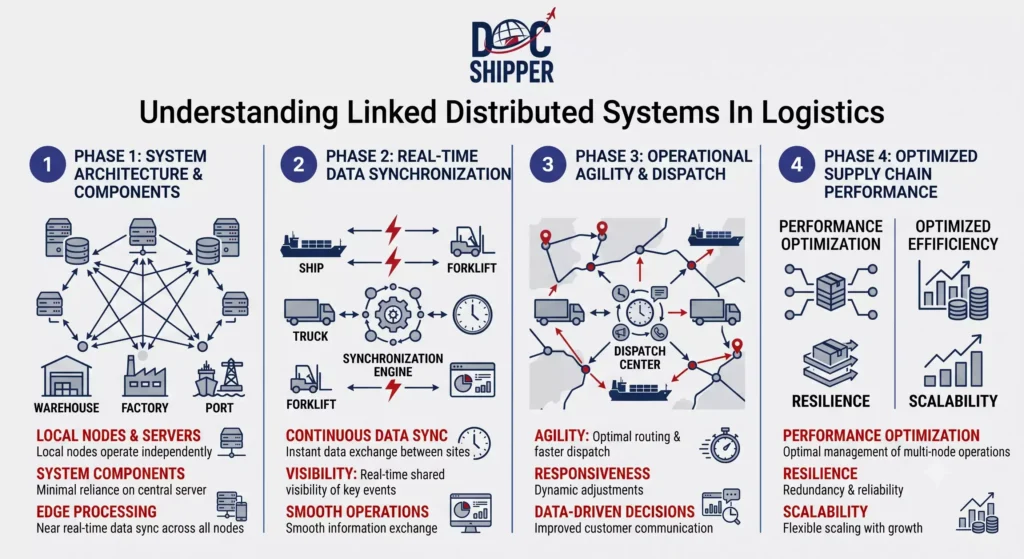
Linked Distributed Systems address this by distributing processing power and data storage across independent nodes that communicate through standardized protocols. Each node operates autonomously yet remains synchronized with the network, creating redundancy that prevents operational collapse.
In import/export operations, these systems enable:
- Real-time tracking synchronization across carrier, freight forwarder, customs, and shipper systems
- Decentralized document verification where multiple parties validate authenticity simultaneously
- Resilient data accessibility ensuring information remains available despite regional outages
- Scalable infrastructure that adapts to fluctuating trade volumes without performance degradation
- Enhanced security through distributed ledger technologies and encryption protocols
The architecture fundamentally transforms how logistics networks manage information flow, replacing fragile hub-and-spoke models with mesh topologies where every node contributes to system integrity.
Architecture & Technical Expertise
Understanding Linked Distributed Systems requires examining their core architectural components and operational principles. Unlike monolithic platforms, these systems distribute computational tasks across peer-to-peer networks where each node maintains partial or complete data replicas.
Consensus mechanisms form the backbone of coordination. Nodes employ algorithms like Paxos, Raft, or Byzantine Fault Tolerance to agree on data states without central authority. In logistics contexts, this ensures that when a shipment status updates in Shanghai, nodes in Rotterdam and Los Angeles reflect identical information within milliseconds.
Data partitioning strategies determine how information distributes across nodes. Horizontal sharding divides datasets by logical segments (e.g., shipments by origin region), while vertical partitioning separates data types (tracking events versus commercial invoices). Smart partitioning minimizes cross-node queries that introduce latency.
The CAP theorem governs design trade-offs: systems can guarantee only two of three properties—Consistency, Availability, or Partition tolerance. Logistics platforms typically prioritize availability and partition tolerance, accepting eventual consistency where brief data discrepancies self-resolve through synchronization protocols.
API gateway architectures enable legacy system integration. Many customs authorities and carriers operate monolithic databases, so distributed systems employ middleware that translates requests between modern microservices and traditional SOAP/EDI interfaces. At DocShipper, we implement gateway layers that bridge clients’ ERP systems with distributed tracking networks, ensuring seamless data flow without requiring infrastructure overhauls.
Security in distributed environments relies on cryptographic verification and access control lists. Each transaction receives digital signatures from originating nodes, creating immutable audit trails. Hash-chained data structures prevent tampering, while role-based permissions ensure only authorized parties access sensitive commercial documents.
For regulatory compliance, distributed systems must address EU GDPR requirements regarding data sovereignty. Geofencing techniques restrict sensitive information to nodes within specific jurisdictions, while encryption ensures cross-border transmissions meet protection standards.
Practical Examples & Data
Real-world implementations demonstrate how Linked Distributed Systems optimize logistics operations. Consider container tracking across ocean freight: A shipment departing Shenzhen generates tracking events at terminal gates, vessel loading, and customs checkpoints. Each event propagates through distributed nodes operated by the shipping line, port authorities, and customs agencies.
| System Architecture | Data Latency | Failure Recovery Time | Infrastructure Cost |
|---|---|---|---|
| Centralized Database | 15-45 seconds | 2-6 hours | High (redundant servers) |
| Linked Distributed Systems | 0.5-3 seconds | Automatic (under 30 seconds) | Moderate (distributed nodes) |
| Blockchain-Based Systems | 10-600 seconds | N/A (no single point of failure) | Very High (computational overhead) |
A 2023 study by the International Maritime Organization found that ports implementing distributed tracking systems reduced container dwell time by 28% compared to centralized platforms. The improvement stems from parallel data validation—multiple stakeholders verify shipment credentials simultaneously rather than sequentially.
Use Case: Cross-Border E-Commerce Distribution
An electronics retailer ships 50,000 units monthly from Vietnam to EU markets. Their distributed system architecture includes:
- Manufacturing node in Hanoi generating production completion events
- Logistics node at Haiphong port tracking container movements
- Customs node interfacing with EU TRACES-NT for phytosanitary checks
- Distribution nodes across Hamburg, Rotterdam, and Antwerp coordinating last-mile delivery
When customs flags a shipment for inspection, the distributed system instantly notifies all downstream nodes. The Hamburg distribution center automatically reroutes inventory allocation to Rotterdam and Antwerp, maintaining delivery schedules despite the 48-hour inspection delay. Centralized systems would require manual intervention and create 72-96 hour delivery lags.
Performance metrics from this deployment show 99.7% system uptime versus 94.2% for the previous centralized platform. Query response times average 1.2 seconds across all nodes, compared to 8-15 seconds for centralized database queries during peak periods.
At DocShipper, we architect distributed systems that integrate clients’ order management platforms with carrier networks, customs interfaces, and warehouse management systems. Our node deployment strategy ensures geographic redundancy—if one regional node experiences downtime, adjacent nodes assume its processing load without client-facing disruptions.
Key Implementation Considerations
- Node placement strategy: Position nodes near data generation points to minimize latency (manufacturing sites, border crossings, consolidation centers)
- Bandwidth allocation: Ensure sufficient network capacity for synchronization traffic—typically 10-15% of total data volume
- Monitoring infrastructure: Deploy distributed tracing tools that aggregate performance metrics from all nodes
- Disaster recovery protocols: Implement automated failover where surviving nodes redistribute workload within 30 seconds
- Compliance automation: Build geofencing logic that prevents data residency violations across jurisdictions
Conclusion
Linked Distributed Systems represent the infrastructure evolution necessary for resilient, scalable global logistics networks. By eliminating single points of failure and enabling parallel data processing, these architectures reduce operational risks while improving responsiveness to supply chain disruptions.
Need expert guidance on implementing distributed systems for your logistics operations? Contact DocShipper for tailored architecture consulting and integration services.
📚 Quiz
Test Your Knowledge: Linked Distributed Systems
What is the primary architectural characteristic that defines Linked Distributed Systems?
According to the CAP theorem governing distributed system design, which combination do logistics platforms typically prioritize?
A shipping company experiences a network partition where its Asian nodes lose connectivity with European nodes during a transpacific shipment. What happens in a properly designed distributed system?
🎯 Your Result
📞 Free Quote in 24hFAQ | Linked Distributed Systems: Definition, Architecture & Practical Examples
While cloud platforms centralize resources in provider-controlled data centers, Linked Distributed Systems distribute processing across independent nodes owned by different stakeholders. Cloud solutions offer infrastructure-as-a-service, whereas distributed systems provide decentralized coordination where no single entity controls the network. Logistics operations benefit from distributed models when multiple competing organizations must share data without trusting a central intermediary.
Network partitions occur when communication breaks between node groups—common in maritime environments with limited connectivity. Systems employ partition tolerance strategies where isolated nodes continue processing locally using cached data. Once connectivity restores, conflict resolution algorithms reconcile divergent states. For time-sensitive operations like customs deadlines, systems flag partition-induced uncertainties for manual review rather than auto-committing potentially conflicting data.
Initial deployment ranges from $150,000 to $800,000 depending on node count, geographic distribution, and integration complexity. Annual operational costs average 15-20% of deployment value, covering node maintenance, bandwidth, and security updates. Cost advantages emerge at scale—enterprises processing over 10,000 shipments monthly typically achieve ROI within 18-24 months through reduced downtime and improved processing efficiency compared to centralized alternatives.
Yes, through API gateway middleware that translates between distributed system protocols and legacy customs interfaces. Most customs authorities still use centralized databases with EDI or XML-based data exchange. Gateway layers convert distributed system messages into compliant formats, submit them to customs systems, and propagate responses back through the network. This approach preserves existing customs integrations while modernizing internal data management.
Eventual consistency models dominate logistics applications, where strict real-time consistency across continents is unnecessary. Systems employ vector clocks or version vectors that timestamp data changes at each node. When conflicts arise (two nodes updating the same shipment status simultaneously), conflict resolution rules determine precedence—typically favoring the most recent timestamp or deferring to authoritative nodes like customs systems. Critical transactions requiring immediate consistency use quorum-based writes where operations complete only after majority node confirmation.
Primary risks include unauthorized node access, data interception during inter-node communication, and Byzantine faults where compromised nodes transmit false information. Mitigation strategies combine transport layer encryption (TLS 1.3+), mutual authentication certificates for node verification, and Byzantine fault-tolerant consensus algorithms that detect and isolate malicious nodes. Regular security audits and intrusion detection systems monitoring abnormal node behavior provide additional protection layers.
Well-architected systems experience zero visibility loss from single-node failures due to data replication across multiple nodes. If a port authority node fails, shipping line and customs nodes maintain complete shipment records. Systems typically replicate critical data across 3-5 nodes to ensure availability. Automated health monitoring detects node failures within seconds, triggering failover procedures that redirect queries to healthy replicas. Complete visibility restoration occurs within 30-60 seconds for properly configured deployments.
Minimum requirements depend on transaction volume and data replication strategy. A distribution center processing 1,000 shipments daily typically needs 50-100 Mbps dedicated bandwidth for node synchronization. High-volume operations (10,000+ daily transactions) require 500 Mbps to 1 Gbps. Synchronization traffic generally consumes 10-15% of total data volume as nodes exchange state updates and consensus messages. Asymmetric connections suffice—upload speeds matter more than download for nodes primarily generating events.
Smaller operators benefit most through participation in industry consortiums that operate shared distributed networks rather than deploying private infrastructure. Organizations like the Blockchain in Transport Alliance offer node access to members, distributing costs across participants. Providers handling 100-500 shipments monthly can integrate via API without managing underlying infrastructure. The model resembles cloud services but with decentralized governance—no single provider controls the platform or dictates terms.
Compliance mechanisms include geographic node restrictions that prevent data replication outside permitted jurisdictions. For EU operations under GDPR, systems configure nodes to refuse synchronization requests from non-EU locations for personal data. Encryption further protects cross-border transmissions when regulations permit international data flow with adequate safeguards. Smart contracts or policy engines automatically enforce jurisdiction-specific rules, blocking transactions that would violate local laws.
Effective monitoring requires distributed tracing platforms like Jaeger, Zipkin, or Prometheus that aggregate metrics from all nodes into unified dashboards. Key performance indicators include inter-node latency, consensus round duration, replication lag, and node availability percentages. Logistics-specific monitoring adds supply chain metrics like average shipment status update propagation time and document validation completion rates. Alert systems trigger notifications when performance degrades beyond defined thresholds, enabling proactive intervention before operational impacts occur.
Phased implementations span 6-18 months depending on complexity. Phase one (months 1-3) covers architecture design, node placement planning, and pilot deployment with limited scope. Phase two (months 4-9) extends to full production with comprehensive stakeholder integration. Phase three (months 10-18) optimizes performance, adds redundancy, and completes disaster recovery testing. Accelerated timelines of 3-6 months are possible when leveraging existing platform frameworks, though customization for specific logistics workflows extends duration. Change management and stakeholder training typically consume 25-30% of total implementation effort.
Need Help with
Logistics or Sourcing ?
First, we secure the right products from the right suppliers at the right price by managing the sourcing process from start to finish. Then, we simplify your shipping experience - from pickup to final delivery - ensuring any product, anywhere, is delivered at highly competitive prices.


Fill the Form
Prefer email? Send us your inquiry, and we’ll get back to you as soon as possible.
Contact us




