


In short ⚡
An Independent Trading Exchange (ITE) is a neutral digital platform facilitating transparent trade transactions between global buyers and sellers without direct ownership or inventory involvement. ITEs operate as intermediaries, providing standardized documentation, secure payment mechanisms, and dispute resolution services while maintaining independence from both parties involved in international commerce.
Introduction
In cross-border trade, buyers and sellers frequently face trust deficits, payment disputes, and documentation inconsistencies. Traditional trading methods often lack transparency, creating friction in global supply chains. Independent Trading Exchanges emerged to solve these exact problems through neutral platforms.
These platforms are particularly crucial for SMEs entering international markets without established trading relationships. Unlike commodity exchanges or marketplaces that take ownership of goods, ITEs function purely as transaction facilitators and trust brokers.
Key characteristics include:
- Neutrality: No financial stake in transaction outcomes
- Standardization: Pre-defined documentation and process templates
- Security: Escrow services and verified participant registries
- Transparency: Real-time transaction tracking and audit trails
- Compliance: Built-in regulatory framework alignment
Technical Framework & Operational Structure
Independent Trading Exchanges operate through multi-layer verification systems that authenticate participants before transaction initiation. Each registered entity undergoes KYC (Know Your Customer) procedures aligned with international trade compliance standards.
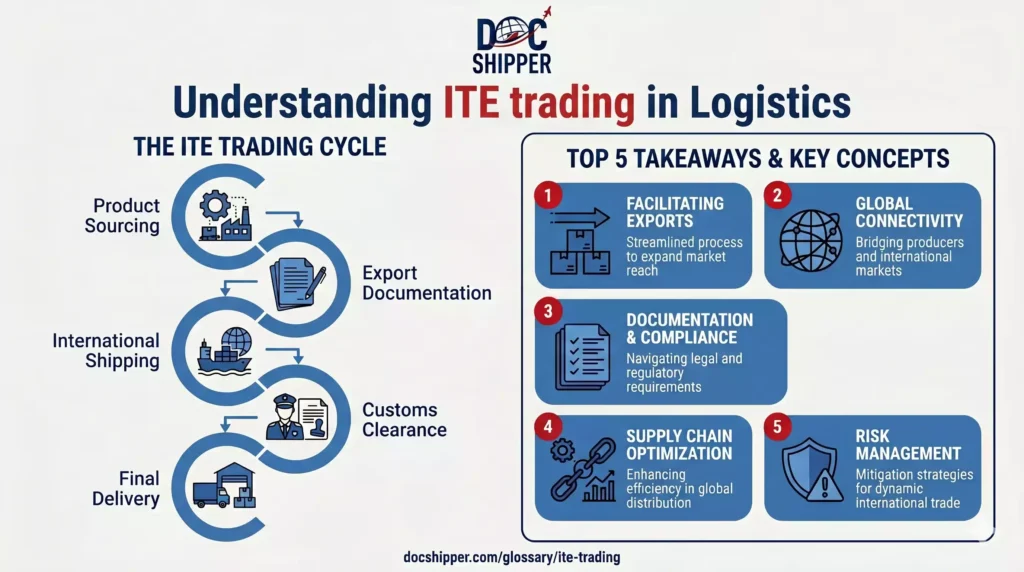
The platform architecture typically includes five operational components. First, the participant registry maintains verified profiles with financial ratings and transaction histories. Second, the transaction module standardizes offer creation, negotiation, and contract finalization. Third, payment gateways integrate escrow mechanisms releasing funds only upon delivery confirmation.
Fourth, the documentation engine auto-generates trade documents conforming to Incoterms and customs requirements. Finally, the dispute resolution system provides mediation services when conflicts arise. At DocShipper, we frequently integrate with ITE platforms to streamline our clients’ documentation workflows and reduce clearance delays.
Legal frameworks governing ITEs vary by jurisdiction. The UNCITRAL Model Law on Electronic Commerce provides foundational principles for digital trade transactions. European platforms must comply with GDPR for data handling, while US-based exchanges follow SEC regulations if facilitating securities-backed trades.
From a technical perspective, modern ITEs leverage blockchain technology for immutable transaction records. Smart contracts automate payment releases based on predefined conditions like shipment tracking updates or inspection reports. This reduces dependency on manual verification and accelerates settlement cycles from weeks to days.
Concrete Examples & Market Data
Consider a German automotive parts manufacturer sourcing components from a Vietnamese supplier. Without prior relationship, both parties face significant risk. Through an ITE, the transaction follows this structure:
| Transaction Stage | Traditional Process | ITE Process |
|---|---|---|
| Partner Verification | Manual due diligence (2-3 weeks) | Pre-verified registry access (24 hours) |
| Contract Negotiation | Email exchanges, legal review (1-2 weeks) | Standardized template with digital signatures (2-3 days) |
| Payment Security | Letter of Credit (€500-1500 fees, 5-7 days) | Escrow service (€200-400 fees, instant) |
| Documentation | Manual preparation, potential errors | Auto-generated, compliance-checked |
| Dispute Resolution | Legal proceedings (months, €10k+ costs) | Platform mediation (2-4 weeks, included) |
Market data reveals 62% reduction in transaction completion time when using ITEs versus traditional methods for first-time international partnerships. A 2023 industry survey showed 78% of ITE users reported increased confidence in cross-border transactions.
Real-world application extends beyond manufacturing. Agricultural commodity traders utilize ITEs for grain contracts, ensuring quality certification verification and phytosanitary compliance before payment release. Textile exporters leverage these platforms for LC-alternative payment solutions, reducing banking fees by approximately 40-60%.
For SMEs specifically, ITEs provide access to previously inaccessible markets. A Brazilian coffee exporter with annual revenue under $500k can now directly reach Korean specialty roasters without intermediary trading houses, retaining 15-20% higher margins. The platform’s standardized grading systems and third-party inspection integrations eliminate quality disputes that historically plagued such arrangements.
From a risk management perspective, ITEs maintain insurance integration modules allowing automatic cargo insurance purchase aligned with shipment value and Incoterms. This bundled approach reduces administrative overhead while ensuring comprehensive coverage from origin to destination.
Conclusion
Independent Trading Exchanges represent a fundamental evolution in international trade infrastructure, addressing trust gaps and efficiency bottlenecks through neutral, technology-driven platforms. Their standardized frameworks reduce transaction costs while increasing accessibility for businesses of all sizes.
Need guidance navigating digital trade platforms or optimizing your cross-border transaction workflows? Contact DocShipper for expert support tailored to your supply chain requirements.
📚 Quiz
Test Your Knowledge: Independent Trading Exchange (ITE)
What is the primary role of an Independent Trading Exchange in international commerce?
Which statement correctly describes ITE payment mechanisms compared to traditional Letters of Credit?
A Brazilian coffee exporter wants to sell directly to a Korean roaster without prior relationship. Which ITE feature addresses their primary risk concern?
🎯 Your Result
📞 Free Quote in 24hFAQ | ITE (Independent Trading Exchange): Definition, Structure & Practical Examples
ITEs function as transaction facilitators without taking ownership of goods or influencing pricing. B2B marketplaces like Alibaba often operate merchant models, purchasing inventory and reselling. ITEs provide neutral infrastructure for direct buyer-seller contracts with standardized processes and dispute resolution, focusing on transaction security rather than product assortment.
Yes, provided they comply with electronic signature regulations like the ESIGN Act (US) or eIDAS (EU). Customs authorities accept digitally generated commercial invoices, packing lists, and certificates of origin when created through compliant platforms. The key requirement is audit trail integrity and signatory verification, which reputable ITEs provide as core functionality.
ITE escrow services typically charge 0.5-1.5% of transaction value with flat processing fees of $100-500. Traditional LCs cost 1-3% plus banking charges ($500-2000), making ITEs 40-70% more economical for transactions under $250,000. However, LCs may still be preferred for very high-value shipments requiring bank guarantees or for trade finance purposes.
Most ITEs employ tiered verification systems. New participants undergo enhanced due diligence but can access the platform with transactional limits initially. As trading history accumulates and positive ratings build, limits increase. Some platforms offer mentorship programs connecting inexperienced traders with established users, accelerating credibility development.
ITEs implement inspection protocols before payment release. Buyers can request third-party surveys at destination, with costs typically shared. If discrepancies exist, the platform's dispute resolution mechanism engages. Funds remain in escrow until resolution, protecting both parties. Common outcomes include partial payment, replacement shipment agreements, or arbitrated settlements based on evidence provided.
Advanced ITEs integrate with supply chain finance providers, allowing invoice discounting and purchase order financing. Some platforms offer embedded financing where pre-approved credit lines become available based on transaction history. However, traditional forfaiting or factoring requires additional documentation beyond ITE-generated records, necessitating coordination with financial institutions.
Most platforms partner with forex providers offering competitive rates embedded in the payment gateway. Buyers pay in their local currency while sellers receive funds in theirs, with conversion happening transparently. Multi-currency escrow accounts allow holding funds in transaction currency until release, protecting against exchange rate volatility during shipping periods.
Leading platforms use distributed ledgers for immutable transaction records and smart contracts for automated payment releases tied to IoT tracking data. NFT-based certificates of authenticity are emerging for luxury goods and specialty products. However, full blockchain implementation remains limited due to scalability challenges and regulatory uncertainty in certain jurisdictions.
Advanced platforms support complex trade structures where goods ship directly from manufacturer to end buyer while payment flows through an intermediary trader. The ITE manages documentation routing and payment splits according to pre-agreed percentages. This capability proves valuable for drop-shipping models and agency-based trade arrangements common in commodity sectors.
Platforms implement role-based access controls where transaction parties view full details while regulators or auditors access anonymized datasets. Encryption protects commercial terms and pricing from unauthorized viewing. GDPR-compliant ITEs allow data portability and deletion rights while maintaining transaction integrity through cryptographic hashing of deleted records.
Reputable platforms maintain offline backup systems and failover servers ensuring continuous operation. Escrow funds are held in segregated accounts with traditional financial institutions, remaining accessible even if the platform becomes inoperative. Terms of service typically define liability limits and alternative dispute resolution procedures for platform-related issues, though such incidents remain rare with established providers.
Both exist. Generalized platforms handle diverse product categories with standardized workflows, suitable for manufactured goods and general merchandise. Specialized ITEs focus on sectors like agriculture, metals, or energy, incorporating commodity-specific features such as quality grading systems, warehouse receipt management, or futures contract integration. Choice depends on transaction complexity and industry-specific requirements.
Need Help with
Logistics or Sourcing ?
First, we secure the right products from the right suppliers at the right price by managing the sourcing process from start to finish. Then, we simplify your shipping experience - from pickup to final delivery - ensuring any product, anywhere, is delivered at highly competitive prices.


Fill the Form
Prefer email? Send us your inquiry, and we’ll get back to you as soon as possible.
Contact us




:%20Definition,%20Structure%20&%20Practical%20Examples)