


In short ⚡
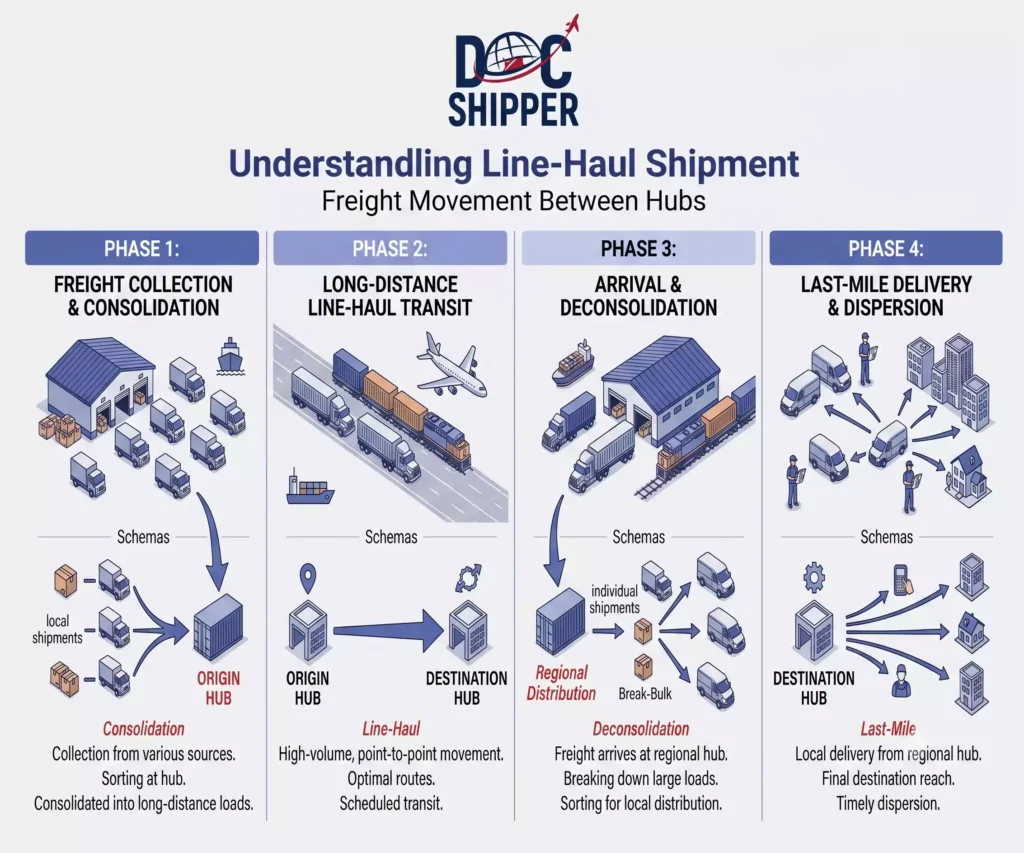
Line-haul shipment refers to the long-distance transportation of goods between major terminals or distribution hubs, typically covering hundreds or thousands of miles. This represents the backbone of freight logistics, moving consolidated cargo between cities, regions, or countries using trucks, trains, ships, or aircraft before final local delivery.
Introduction
Many businesses struggle to understand why their shipping costs spike dramatically once cargo leaves the local terminal. The answer lies in line-haul operations, which account for 40-60% of total transportation expenses in domestic and international logistics.
Unlike last-mile delivery focused on individual addresses, line-haul shipment handles bulk movement between strategic points in the supply chain. This distinction determines routing efficiency, transit times, and ultimately, your landed cost calculations.
Key characteristics of line-haul transportation include:
- Consolidated loads: Multiple shipments combined to maximize vehicle capacity and reduce per-unit costs
- Hub-to-hub routing: Movement between major distribution centers rather than direct door-to-door delivery
- Long-distance focus: Typically distances exceeding 100 miles, often crossing state or national borders
- Scheduled service: Regular departure times and defined transit windows between fixed terminals
- Modal flexibility: Can utilize trucks, rail, ocean vessels, or air freight depending on distance and urgency
Line-Haul Operations & Strategic Importance
The efficiency of line-haul operations directly impacts your supply chain velocity and inventory holding costs. Carriers organize these movements through sophisticated hub-and-spoke networks, where regional terminals feed into major consolidation points.
In road freight, line-haul typically employs full truckload (FTL) or less-than-truckload (LTL) configurations. FTL line-hauls offer faster transit since cargo moves directly between terminals without intermediate sorting. LTL services require additional handling at cross-dock facilities, adding 1-2 days but significantly reducing costs for smaller shipments.
Rail line-haul provides cost advantages for heavy bulk cargo traveling over 500 miles. Intermodal containers moving via rail between coastal ports and inland distribution centers can reduce transportation expenses by 30-40% compared to truck-only routes, according to the Intermodal Association of North America.
For international shipments, ocean line-haul represents the primary leg between origin and destination countries. Container vessels follow scheduled service routes connecting major ports, with transit times ranging from 7 days (Asia-West Coast US) to 35+ days (Asia-Europe via Suez Canal).
Air freight line-haul serves time-sensitive cargo, operating between airport hubs with significantly higher costs but transit times of 1-3 days globally. Express carriers like DHL and FedEx maintain dedicated aircraft fleets for overnight line-haul services within continental regions.
At DocShipper, we optimize line-haul routing by selecting carriers with the most efficient terminal networks for your specific origin-destination pairs, minimizing unnecessary touches and reducing total transit time by 15-25% compared to default carrier routing.
Cost Analysis & Practical Examples
Understanding line-haul economics helps you make informed decisions about shipping modes and carrier selection. The primary cost drivers include distance, weight, dimensional factors, fuel surcharges, and accessorial charges for special handling.
| Transport Mode | Distance Range | Typical Transit Time | Cost per Mile (20ft Container) | Best Use Case |
|---|---|---|---|---|
| Truck LTL | 100-1,500 miles | 2-5 days | $2.50-$4.00 | Small shipments, flexible delivery |
| Truck FTL | 100-3,000 miles | 1-4 days | $1.80-$3.20 | Full loads, direct routing |
| Rail Intermodal | 500-3,000 miles | 4-7 days | $1.20-$2.00 | Heavy cargo, cost sensitivity |
| Ocean FCL | 3,000-12,000 miles | 15-45 days | $0.15-$0.40 | International bulk shipments |
| Air Freight | 500-8,000 miles | 1-3 days | $12.00-$25.00 | Time-critical, high-value goods |
Use Case: Electronics Manufacturer (Shenzhen to Chicago)
A manufacturer needs to move 15 pallets (8,500 lbs) of consumer electronics from Shenzhen, China to a distribution center in Chicago, Illinois. Comparing line-haul options:
- Ocean + Rail Intermodal: $3,200 total, 28-day transit (Shanghai port to LA, rail to Chicago)
- Ocean + Truck: $4,100 total, 24-day transit (Shanghai to LA, FTL truck to Chicago)
- Air Freight Direct: $18,500 total, 4-day transit (Shenzhen airport to Chicago O’Hare)
The optimal choice depends on inventory carrying costs and stockout risk. If holding costs exceed $200/day and the product has high demand volatility, air freight’s premium may be justified despite the 5.7x cost difference.
Domestic Line-Haul Scenario: Textile Distributor (Los Angeles to New York)
Moving 18,000 lbs of fabric rolls across the continental US presents these line-haul options:
- Truck FTL: $4,800, 4-day transit, dedicated vehicle, minimal handling
- Rail Intermodal: $3,100, 7-day transit, requires drayage at both ends, eco-friendly
- LTL Carrier: $6,200, 6-day transit, multiple terminal touches, flexible pickup/delivery
Rail intermodal delivers 35% cost savings but requires coordination with drayage partners for first/last mile. DocShipper handles this coordination seamlessly, ensuring your line-haul savings aren’t eroded by inefficient local transportation.
Conclusion
Mastering line-haul logistics means understanding the economic and operational tradeoffs between speed, cost, and reliability across different transportation modes. Strategic carrier selection and route optimization can reduce your total landed costs by 20-30% while maintaining service levels.
Need expert guidance on optimizing your line-haul operations? Contact DocShipper for a customized logistics assessment tailored to your shipping volumes and delivery requirements.
📚 Quiz
Test Your Knowledge: Line-Haul Shipment
What is the primary defining characteristic of line-haul shipment?
Which statement correctly describes line-haul cost structure?
A manufacturer needs to ship 8,500 lbs of electronics from China to Chicago within 4 days. Which line-haul option is most appropriate?
🎯 Your Result
📞 Free Quote in 24hFAQ | Line-Haul Shipment: Definition, Operations & Real-World Examples
Line-haul covers long-distance transportation between major hubs or terminals, typically hundreds or thousands of miles. Last-mile delivery refers to the final leg from a local distribution center to the end customer's address, usually under 50 miles. Line-haul uses consolidated loads and scheduled routes; last-mile focuses on individual deliveries with flexible routing.
Carriers base line-haul pricing on distance, weight, freight class (density and handling characteristics), fuel surcharges, and capacity demand. FTL rates typically use a per-mile calculation, while LTL uses a hundredweight (CWT) system considering both weight and dimensional factors. Seasonal demand, lane balance, and volume commitments also affect pricing significantly.
Yes, most modern carriers provide real-time tracking through GPS-enabled equipment and regular checkpoint scans. FTL shipments offer continuous GPS tracking, while LTL and intermodal shipments provide scan updates at each terminal or transfer point. Air and ocean line-haul typically update at departure/arrival ports with estimated arrival times based on vessel schedules.
Common delay factors include weather disruptions (especially for truck and rail), mechanical breakdowns, driver hours-of-service restrictions, customs clearance for international shipments, congestion at major terminals, and capacity constraints during peak seasons. Ocean line-haul faces additional risks from port labor issues and vessel scheduling changes.
Standard carrier liability is limited (typically $0.50-$2.00 per pound for domestic shipments), making additional cargo insurance essential for high-value goods. Insurance covers loss, damage, and theft during line-haul transit. For international shipments, marine cargo insurance protects against risks like vessel sinking, container overboard, and general average contributions.
Line-haul transit time directly impacts safety stock requirements and reorder points. Longer transit times necessitate higher inventory buffers to prevent stockouts. Companies using ocean line-haul (20-40 days) typically maintain 60-90 days of inventory, while air line-haul users (2-5 days) can operate with 30-45 days of stock, reducing holding costs.
Domestic line-haul requires a bill of lading (BOL), packing list, and sometimes hazmat documentation for regulated materials. International line-haul adds commercial invoice, certificate of origin, customs declarations, and potentially phytosanitary certificates or import licenses. Proper documentation prevents delays at transfer points and border crossings.
Absolutely—this is called intermodal transportation. Common combinations include ocean-to-rail (Asia to US interior markets), truck-to-air (for expedited international shipments), and rail-to-truck (for final positioning). Each modal transfer adds handling time and cost but can optimize the overall speed-cost balance for specific lanes.
Fuel surcharges (FSC) are variable fees adjusting for diesel price fluctuations, typically calculated as a percentage of base freight charges. Truck and air line-haul are most sensitive to fuel costs, with FSC ranging from 15-30% of base rates. Rail and ocean modes have lower FSC percentages (8-18%) due to greater fuel efficiency per ton-mile.
Carbon emissions per ton-mile vary significantly: ocean produces 10-15g CO2, rail 20-30g, truck 60-90g, and air freight 500-700g. Companies pursuing sustainability goals often choose rail intermodal for domestic line-haul and ocean for international, accepting longer transit times. Some carriers now offer carbon offset programs for all line-haul modes.
Booking timelines depend on mode and season. Truck FTL typically requires 3-7 days advance notice, though same-day is possible at premium rates. Rail intermodal needs 5-10 days. Ocean line-haul booking should occur 2-4 weeks before sailing, especially during peak season (August-October). Air freight can be booked 2-5 days ahead for standard service.
Immediately document damage with photos and file a claim with the carrier within specified timeframes (typically 9 months for domestic, 60 days for international under Montreal Convention for air). Preserve damaged goods and packaging for carrier inspection. Having cargo insurance expedites compensation, as carrier liability limits often don't cover full replacement value.
Need Help with
Logistics or Sourcing ?
First, we secure the right products from the right suppliers at the right price by managing the sourcing process from start to finish. Then, we simplify your shipping experience - from pickup to final delivery - ensuring any product, anywhere, is delivered at highly competitive prices.


Fill the Form
Prefer email? Send us your inquiry, and we’ll get back to you as soon as possible.
Contact us




