


In short ⚡
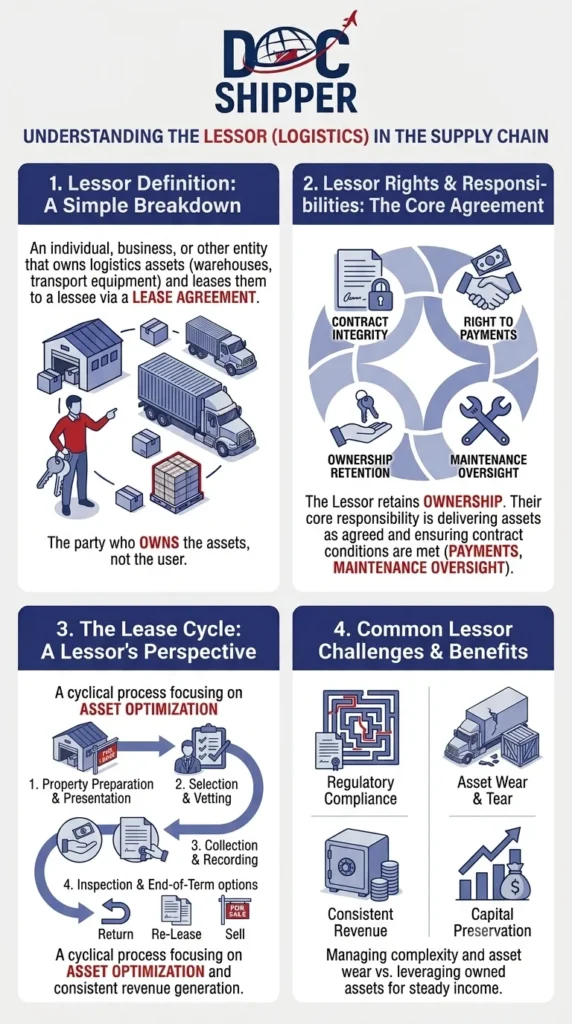
A lessor is the legal owner of an asset who grants temporary usage rights to another party (lessee) in exchange for regular payments, while retaining ownership. In international logistics, lessors provide critical equipment like containers, trucks, aircraft, or warehouses under structured lease agreements, enabling businesses to access resources without capital expenditure.
Introduction
Many importers and exporters struggle to understand the financial and legal implications of leasing logistics assets. The confusion often arises from overlapping terms like “owner,” “operator,” and “lessor” in shipping and warehousing contracts.
In global supply chains, the lessor plays a pivotal role by providing essential infrastructure without requiring upfront capital from the lessee. This arrangement allows businesses to maintain liquidity while accessing high-value equipment necessary for freight operations.
Key characteristics of a lessor in logistics include:
- Legal ownership retention: The lessor maintains title to the asset throughout the lease period
- Revenue generation: Income derives from lease payments, not asset utilization
- Risk management: Lessors assume depreciation and maintenance responsibilities depending on lease structure
- Contractual flexibility: Lease terms range from short-term operational leases to long-term finance leases
- Asset recovery rights: Lessors can reclaim equipment upon default or lease expiration
Legal Framework & Operational Mechanics
The lessor-lessee relationship is governed by contract law and varies significantly across jurisdictions. In maritime logistics, for instance, container lessors operate under standardized agreements regulated by the International Chamber of Commerce (ICC) guidelines, while warehouse leasing follows local commercial property regulations.
Two primary lease structures dominate logistics operations. Operating leases allow lessees to use assets for shorter periods without ownership transfer, with the lessor bearing maintenance costs and residual value risk. Finance leases function as disguised purchase agreements where the lessee assumes ownership benefits and risks, with the lessor essentially acting as a financing entity.
In international trade, equipment interchange receipts (EIRs) document the condition of leased containers during transfer between parties. The lessor remains liable for structural integrity, while operational damage typically falls to the lessee under standard master lease agreements.
Tax treatment varies critically between jurisdictions. In the United States, lessors can claim depreciation deductions and pass tax benefits to lessees through reduced lease rates. The European Union applies VAT differently depending on whether the lease constitutes a supply of goods or services under the Place of Supply Directive.
Risk allocation represents another crucial dimension. Maintenance provisions specify whether the lessor provides full-service leasing (including repairs) or net leasing (lessee assumes all costs). Insurance requirements typically mandate that lessees maintain comprehensive coverage naming the lessor as loss payee. Default remedies allow lessors to repossess assets, but enforcement across borders requires careful navigation of international commercial law.
At DocShipper, we routinely advise clients on lessor obligations when coordinating container movements, particularly regarding demurrage charges and equipment condition disputes that can arise from unclear lease terms.
Practical Examples & Comparative Data
Container leasing represents the largest segment of logistics lessor activity. Companies like Triton International and Textainer operate fleets exceeding 4 million TEU combined, leasing standard dry containers, refrigerated units, and specialized equipment to shipping lines and freight forwarders worldwide.
Consider a practical comparison between leasing and purchasing a 40-foot high-cube refrigerated container:
| Cost Factor | Purchase Option | 5-Year Operating Lease |
|---|---|---|
| Initial Capital | $32,000 | $0 |
| Monthly Cost | Depreciation + Financing | $185/month |
| Maintenance Responsibility | Owner (you) | Lessor (included) |
| Total 5-Year Cost | $32,000 + maintenance | $11,100 |
| Residual Value Risk | Owner bears | Lessor bears |
In trucking operations, lessors like XTRA Lease provide commercial vehicles under full-service maintenance leases, where 92% of operational costs become predictable monthly expenses. This model particularly benefits small and medium freight forwarders who lack dedicated maintenance facilities.
A recent case study from DocShipper involved a pharmaceutical client requiring temperature-controlled warehousing in Belgium. Rather than constructing a facility, they engaged a specialized lessor offering GDP-compliant cold storage under a triple-net lease, reducing their project timeline from 18 months to 6 weeks while eliminating construction risk.
Aircraft leasing demonstrates the lessor model at its largest scale. Approximately 50% of the global commercial aircraft fleet operates under lease agreements, with cargo carriers like DHL and FedEx utilizing operating leases to maintain fleet flexibility during seasonal demand fluctuations. This arrangement allows cargo airlines to return aircraft during low-demand periods without asset depreciation exposure.
The key comparative advantages of working with lessors include: immediate asset access without procurement delays, predictable cash flow through fixed monthly payments, reduced balance sheet liability under operating lease accounting, flexibility to upgrade equipment as technology advances, and transferred maintenance burden in full-service arrangements.
Conclusion
The lessor-lessee relationship forms a critical financing mechanism in international logistics, enabling businesses to access essential equipment while preserving capital and operational flexibility. Understanding lease structures and contractual obligations directly impacts supply chain efficiency and financial performance.
Need guidance on equipment leasing arrangements or contract negotiation for your logistics operations? Contact DocShipper for expert assistance.
📚 Quiz
Test Your Knowledge: Lessor
What is the primary characteristic that defines a lessor in logistics operations?
In an operating lease for container equipment, who typically bears the residual value risk and structural maintenance costs?
A pharmaceutical company needs GDP-compliant cold storage in Belgium. Based on the lessor model advantages, which approach would optimize their market entry timeline and risk exposure?
🎯 Your Result
📞 Free Quote in 24hFAQ | Lessor: Definition, Role & Practical Examples in Logistics
The lessor owns the asset (container, vessel, equipment) and grants usage rights, while the lessee rents and uses the asset in exchange for periodic payments. In container shipping, the lessor maintains ownership and handles major repairs, while the lessee pays for operational damage and daily usage.
Yes, but repossession rights depend on the master lease agreement terms and local jurisdiction laws. Most container lease agreements include default clauses allowing repossession after payment failure, though practical enforcement requires coordination with port authorities and may involve legal proceedings in the container's current location.
Leased equipment requires specific documentation showing the lessor as the legal owner. Customs authorities typically require a lease agreement copy during temporary importation procedures. The lessee must demonstrate they have legitimate use rights, and ATA Carnets or temporary admission bonds may apply depending on the lease duration and jurisdiction.
Operating lease payments are generally fully deductible as business expenses in the year incurred. Finance leases are treated as asset purchases for tax purposes, allowing depreciation deductions over the asset's useful life. The specific treatment varies by country, with some jurisdictions offering accelerated depreciation for leased logistics equipment.
The lessee (typically the shipper or freight forwarder) bears demurrage charges for delayed container return. These charges are separate from lease payments and accrue daily once the free time period expires. Lessors set demurrage rates in the master lease agreement, and failure to pay can result in equipment repossession and legal action.
Responsibility depends on the lease type and damage cause. In operating leases, the lessor covers normal wear and tear, while the lessee pays for operational damage exceeding normal use. The equipment interchange receipt (EIR) documents condition at transfer points, establishing liability. Most lease agreements require comprehensive insurance naming the lessor as loss payee.
Container operating leases typically require minimum periods of 3-5 years, while master lease agreements with shipping lines often extend 7-12 years. Vehicle leases range from short-term rentals (daily) to long-term operating leases (3-7 years). Finance leases generally match the asset's useful life, often 10-15 years for trucks and 20-25 years for aircraft.
Lease rates reflect asset purchase cost, financing expenses, expected residual value, maintenance costs, administrative overhead, and market demand. Container lease rates fluctuate based on global trade volumes and new-build prices, typically ranging from 0.5% to 1.2% of asset value monthly. Lessors adjust rates quarterly based on market conditions and utilization rates.
Most master lease agreements include assignment clauses requiring lessor consent for transfer. The original lessee typically remains liable unless the lessor agrees to novation (full responsibility transfer). Subletting is generally prohibited in equipment leases, though some warehouse leases allow subletting with prior written approval and the lessor's continued involvement.
Lessors require comprehensive coverage including physical damage, third-party liability, and loss-of-use protection. Container lessors mandate all-risk marine cargo insurance with the lessor named as loss payee. Vehicle lessors require commercial auto liability exceeding regulatory minimums, typically $1-5 million per occurrence. Warehouse lessors demand property and general liability coverage with additional insured endorsements.
Leasing eliminates the capital barrier to equipment ownership, allowing small operators to access professional-grade assets. Predictable monthly costs simplify budgeting, while maintenance-included leases reduce operational complexity. Equipment flexibility enables forwarders to scale capacity with demand fluctuations without long-term ownership commitments, improving cash flow and competitive positioning.
Operating leases typically offer three options: return the equipment to the lessor, extend the lease at reduced rates, or purchase at fair market value. Finance leases usually include a purchase option at a predetermined price or nominal amount. Container leases may allow conversion to different equipment types within the lessor's fleet to accommodate changing business needs.
Need Help with
Logistics or Sourcing ?
First, we secure the right products from the right suppliers at the right price by managing the sourcing process from start to finish. Then, we simplify your shipping experience - from pickup to final delivery - ensuring any product, anywhere, is delivered at highly competitive prices.


Fill the Form
Prefer email? Send us your inquiry, and we’ll get back to you as soon as possible.
Contact us




