


In short ⚡
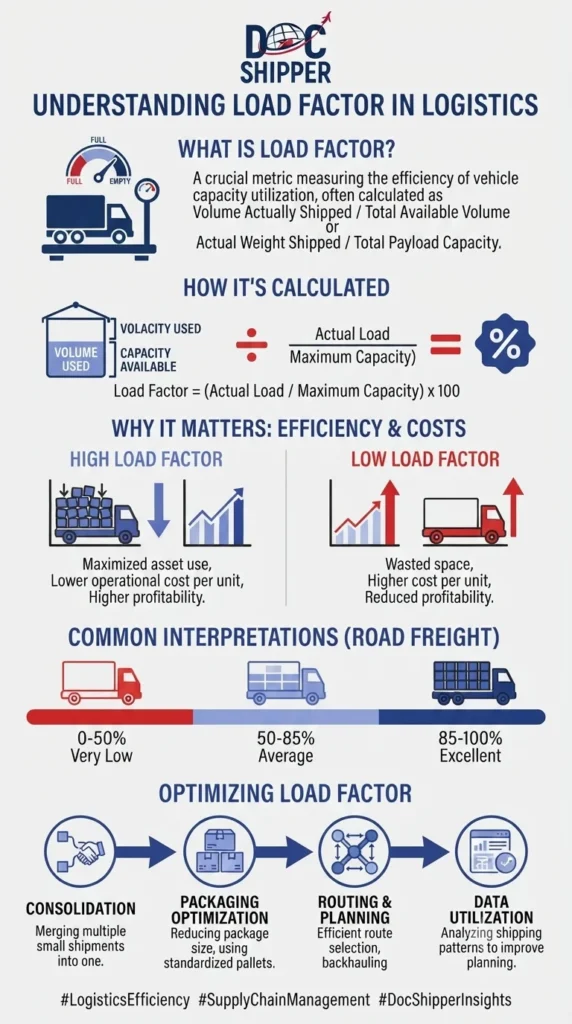
The Load Factor is a key performance indicator (KPI) measuring the percentage of cargo space or capacity utilized in a transport unit—whether a container, vessel, aircraft, or truck. It directly impacts transportation costs, operational efficiency, and environmental sustainability in international logistics.
Introduction
Many businesses struggle with hidden transportation costs due to inefficient space utilization. A partially filled container costs nearly the same as a full one, yet many shippers don’t track how efficiently they use available capacity.
In import/export operations, the Load Factor determines profitability margins. Understanding and optimizing this metric separates cost-effective logistics from wasteful spending. It influences freight negotiations, carrier selection, and warehouse planning.
- Cost Efficiency: Higher load factors reduce per-unit transportation costs
- Environmental Impact: Better utilization means fewer trips and lower carbon emissions
- Competitive Advantage: Optimized loading improves delivery timelines and pricing
- Carrier Relationships: Consistent high load factors strengthen negotiating power
- Regulatory Compliance: Some regions impose penalties for inefficient space usage
In-Depth Analysis & Expertise
The Load Factor calculation varies by transport mode but follows a universal principle: actual capacity used divided by total available capacity, expressed as a percentage. For maritime shipping, this typically references container cube utilization. In air freight, it measures both weight and volume against aircraft limits.
Three critical dimensions affect load factor optimization: weight capacity, volumetric space, and dimensional constraints. A container might reach its weight limit before filling volumetric space, or vice versa. Professional freight forwarders analyze cargo density to maximize both simultaneously.
Regulatory frameworks impact load factor strategies. The World Trade Organization promotes efficiency standards, while regional customs authorities may inspect cargo distribution for safety compliance. Unbalanced loads can trigger additional inspections or rejection.
The formula for basic load factor calculation is: Load Factor = (Actual Load / Maximum Capacity) × 100. However, advanced logistics operations use revenue load factor (considering billable weight) and dimensional weight factor (accounting for space versus weight ratios).
At DocShipper, we systematically analyze load factors during the booking phase to recommend optimal container types and consolidation opportunities. Our clients typically achieve 15-25% cost savings through improved capacity utilization strategies.
Modern technology enables real-time load factor tracking. Transportation Management Systems (TMS) now calculate optimal loading configurations automatically, considering factors like stacking limits, fragility requirements, and customs inspection accessibility. This reduces manual errors and improves planning accuracy.
Concrete Examples & Data
Industry benchmarks reveal significant variations across sectors. According to 2024 logistics data, average load factors are 72% for ocean freight, 68% for air cargo, and 78% for road transport. Leading companies consistently achieve 85-90% through strategic planning.
Case Study: Electronics Manufacturer
A European electronics importer shipping from Shenzhen initially achieved only 63% load factor in 40-foot containers. After optimizing packaging dimensions and implementing mixed-SKU loading strategies, they increased their load factor to 87%. This reduced their annual container requirements from 240 to 173 units, saving approximately $335,000 in freight costs.
The calculation breakdown:
- Container internal volume: 67.7 m³
- Original utilization: 42.7 m³ (63%)
- Optimized utilization: 58.9 m³ (87%)
- Cost per container: $5,000
- Annual savings: 67 containers × $5,000 = $335,000
| Transport Mode | Industry Average | Best Practice | Key Constraint |
|---|---|---|---|
| Ocean (FCL) | 72% | 85-90% | Volume vs. Weight Balance |
| Air Cargo | 68% | 80-85% | Dimensional Weight |
| Road Transport | 78% | 88-92% | Axle Weight Limits |
| Rail Freight | 75% | 83-88% | Container Positioning |
Practical Calculation Example:
A 20-foot container has a maximum payload of 28,200 kg and 33.2 m³ volume. Your shipment weighs 21,000 kg and occupies 27 m³.
- Weight Load Factor: (21,000 / 28,200) × 100 = 74.5%
- Volume Load Factor: (27 / 33.2) × 100 = 81.3%
- Effective Load Factor: Lower of the two = 74.5%
This shipment could accommodate an additional 7,200 kg if compatible cargo with similar density were consolidated, potentially reducing per-unit costs by 25%.
Conclusion
The Load Factor remains one of the most actionable metrics in international logistics. Improving it by even 10-15 percentage points translates directly to cost savings, faster transit times, and reduced environmental impact.
Need expert guidance on optimizing your cargo load factors? Contact DocShipper for a customized logistics audit and efficiency recommendations.
📚 Quiz
Test Your Knowledge: Load Factor
What does the Load Factor primarily measure in transportation logistics?
A 20-foot container has 28,200 kg capacity and 33.2 m³ volume. Your cargo weighs 21,000 kg and occupies 27 m³. What is the effective load factor?
Your business ships electronics with consistent 65% load factor. What immediate strategy would most effectively improve this metric?
🎯 Your Result
📞 Free Quote in 24hFAQ | Load Factor: Definition, Calculation & Concrete Examples
A good load factor for ocean freight typically ranges between 80-85%. However, this varies by industry—high-density goods may achieve 90%+, while bulky items might target 70-75%. The key is maximizing both weight and volume capacity simultaneously without exceeding container limits.
Load factor measures capacity usage in a single transport unit (container, truck), while utilization rate tracks how often those units are deployed. A company might have 90% load factor but only 60% utilization rate if vehicles sit idle frequently. Both metrics are crucial for complete efficiency assessment.
Yes, through better cargo planning and consolidation strategies. Mixed-product loading, strategic pallet arrangement, and cargo sequencing can increase load factors by 10-20% without redesigning packaging. Software tools now simulate optimal loading configurations before physical packing begins.
Aircraft have strict weight and volume constraints. Dimensional weight (volume × density factor) ensures shippers pay fairly for space consumed. A large, lightweight package occupies valuable cubic space that could transport denser cargo, so airlines charge based on whichever is greater: actual weight or dimensional weight.
Common causes include poor packaging design, failure to consolidate shipments, irregular order patterns, lack of freight visibility, and insufficient planning time. Many businesses also ship partial loads due to just-in-time inventory strategies without considering consolidation opportunities across product lines.
Customs authorities require accessible inspection points, which may limit optimal stacking patterns. Mixed commodity shipments need clear separation for documentation purposes. Some countries mandate specific loading sequences for hazardous materials. Professional freight forwarders balance optimization with compliance requirements.
Indirectly, yes. Higher load factors mean fewer shipments for the same cargo volume, reducing overall exposure and insurance premiums. However, densely packed containers may increase damage risk if not properly secured. Insurers consider both load factor efficiency and cargo protection measures when calculating premiums.
Modern Transportation Management Systems (TMS), 3D load planning software, and IoT weight sensors provide real-time load factor data. These tools simulate multiple loading configurations, considering weight distribution, fragility, and access requirements. Cloud-based platforms now offer AI-powered optimization recommendations.
Peak seasons (like pre-holiday retail) often see increased cargo volumes but also higher competition for space. Companies with consistent load factor optimization secure better carrier relationships and priority booking. Off-peak periods offer consolidation opportunities to maintain efficiency despite lower individual shipment volumes.
Absolutely. Higher load factors mean fewer trips to transport the same cargo volume. A 10% load factor improvement can reduce carbon emissions by 8-12% for that cargo. Many sustainability-focused companies now track load factor as a key environmental performance indicator alongside traditional cost metrics.
Freight class (based on density, handling, liability) directly impacts achievable load factors. High-density, low-class freight (machinery) typically achieves better load factors than low-density, high-class goods (electronics). Understanding your cargo's freight class helps set realistic load factor targets.
Always optimize for the limiting factor—whichever reaches capacity first. For dense goods like metals, weight limits constrain load factor. For bulky items like furniture, volume is the constraint. Professional logistics planning analyzes cargo characteristics to determine the priority optimization dimension.
Need Help with
Logistics or Sourcing ?
First, we secure the right products from the right suppliers at the right price by managing the sourcing process from start to finish. Then, we simplify your shipping experience - from pickup to final delivery - ensuring any product, anywhere, is delivered at highly competitive prices.


Fill the Form
Prefer email? Send us your inquiry, and we’ll get back to you as soon as possible.
Contact us




