


In short ⚡
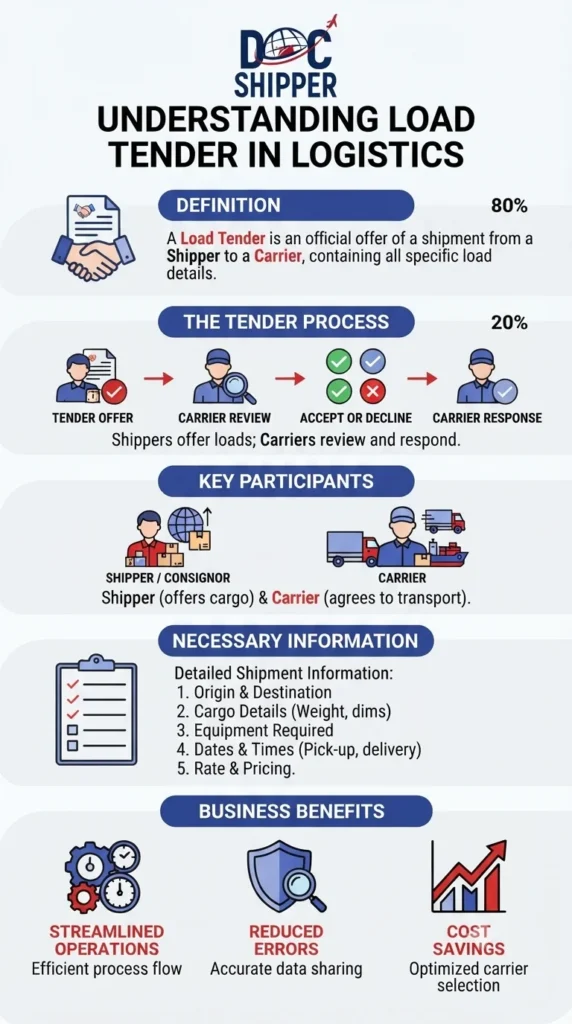
A Load Tender (or Pick-Up Request) is a formal communication issued by a shipper or freight forwarder to a carrier, requesting the collection and transportation of goods from a specific origin to destination. It contains critical details including pickup location, delivery address, cargo specifications, required equipment, and timeline constraints. This document initiates the carrier selection and booking process in international logistics operations.
Introduction
In international freight management, confusion often arises between booking confirmations, shipping orders, and load tender requests. Many shippers mistakenly assume verbal agreements suffice for carrier commitment, leading to missed pickups and supply chain disruptions.
The load tender serves as the contractual foundation for transportation services. It bridges the gap between logistics planning and physical execution, ensuring all parties operate with synchronized information. This document becomes particularly crucial when managing multi-modal shipments or coordinating with third-party logistics providers.
- Initiates carrier selection: Provides essential data for competitive bidding or direct assignment
- Establishes service parameters: Defines equipment type, pickup windows, and handling requirements
- Creates audit trail: Documents agreed terms before contract execution
- Enables rate negotiation: Allows carriers to assess feasibility and propose pricing
- Triggers capacity allocation: Prompts carriers to reserve appropriate resources
Load Tender Mechanics & Legal Framework
The load tender operates within a structured workflow governed by commercial transportation law. When a shipper issues a tender, carriers typically have 1-4 hours to accept or decline, depending on contractual agreements. This response window prevents capacity hoarding while allowing carriers to verify equipment availability.
Under common carrier obligations, regulated transportation providers may face legal requirements to accept reasonable tenders unless justified exceptions apply (capacity constraints, hazardous material restrictions, or geographic limitations). The EU Mobility Package regulations further standardize tender acceptance protocols for intra-European transport.
The document must include cargo classification details to ensure regulatory compliance. Dangerous goods require UN numbers and proper shipping names, while temperature-controlled freight needs specific thermal range specifications. Omitting these details exposes shippers to carrier rejection or liability claims.
Electronic tender systems have transformed traditional paper-based processes. Platforms like SAP TM, Oracle Transportation Management, and specialized TMS solutions automate tender distribution across carrier networks. These systems track acceptance rates, response times, and tender rejection patterns to optimize future routing decisions.
At DocShipper, we validate every load tender against customs requirements and destination restrictions before carrier transmission. This pre-screening reduces tender rejections by approximately 40% and accelerates pickup scheduling. Our clients benefit from integrated compliance verification that prevents last-minute logistical complications.
The tender acceptance rate serves as a key performance indicator in carrier relationship management. Industry benchmarks suggest rates below 85% indicate misaligned expectations, inadequate rate structures, or operational incompatibilities. Persistent rejections from preferred carriers often signal the need for contract renegotiation or service level adjustments.
Practical Scenarios & Comparative Data
Understanding load tender dynamics requires examining real-world applications across different shipping modes. The following comparative analysis illustrates how tender parameters vary based on transportation type and cargo characteristics.
| Transport Mode | Typical Response Window | Key Tender Elements | Acceptance Rate |
|---|---|---|---|
| Full Truckload (FTL) | 1-2 hours | Equipment type, dock access, loading time requirements | 88-92% |
| Less-Than-Truckload (LTL) | 4-6 hours | Freight class, pallet count, stackability specifications | 75-82% |
| Ocean Container | 24-48 hours | Container size/type, chassis availability, port cut-off times | 65-78% |
| Air Freight | 30 minutes-1 hour | Dimensional weight, security screening, flight connections | 82-89% |
Use Case: Automotive Parts Distribution
A German automotive supplier needs to transport 18 pallets of engine components (total weight: 14,200 kg) from Stuttgart to a Czech assembly plant within 36 hours. The load tender specifies:
- Equipment: Curtain-side trailer with lift gate capability
- Pickup window: Wednesday 06:00-08:00 CET
- Delivery requirement: Thursday before 14:00 CET
- Special handling: Moisture-sensitive packaging requiring covered loading
- Documentation: EUR1 movement certificate for customs clearance
Three carriers receive the tender. Carrier A accepts within 45 minutes, offering €1,340 based on established contract rates. Carrier B declines due to equipment unavailability. Carrier C proposes €1,180 but requires a 10:00 pickup time, which the shipper rejects to maintain production schedules. The tender acceptance process concludes in 87 minutes, demonstrating efficient carrier coordination.
Digital Tender Optimization: Companies using automated tender management systems report 23% faster carrier assignment compared to manual processes. Automated systems instantly distribute tenders to pre-qualified carriers, track responses in real-time, and apply decision algorithms based on historical performance metrics. This acceleration proves critical during peak shipping seasons when carrier capacity tightens.
Conclusion
The load tender serves as the operational catalyst transforming logistics planning into executed transportation. Mastering its structure, legal implications, and digital optimization directly impacts shipment reliability and cost efficiency.
Need expert assistance optimizing your tender management process? Contact DocShipper for tailored freight coordination solutions.
📚 Quiz
Test Your Knowledge: Load Tender
What is the primary purpose of a Load Tender in international logistics?
A shipper believes that once they verbally agree with a carrier, the transportation is guaranteed. What is the correct understanding?
Your company ships automotive parts requiring moisture protection from Stuttgart to Prague. The tender specifies a 06:00-08:00 pickup window. Carrier C offers a lower rate but requests 10:00 pickup. What should you do?
🎯 Your Result
📞 Free Quote in 24hFAQ | Load Tender (Pick-Up Request): Definition, Process & Practical Examples
A load tender is a request for transportation service sent to carriers before booking confirmation, while a shipping order is the finalized instruction issued after a carrier accepts and the contract is established. The tender precedes the order in the logistics workflow and allows for carrier selection and rate negotiation.
In spot market transactions, carriers generally can decline tenders without penalty during the response window. However, under contracted freight agreements, repeated rejections may trigger service failure clauses or affect future tender priority. Common carrier regulations impose acceptance obligations unless valid exemptions apply (capacity, safety, or regulatory restrictions).
Standard response windows range from 1-4 hours for domestic ground transportation, extending to 24-48 hours for international ocean freight. Urgent shipments may require 30-minute responses. The appropriate timeframe depends on shipment complexity, equipment availability, and contractual service level agreements between shipper and carrier.
Essential elements include pickup and delivery locations with complete addresses, scheduled dates and time windows, cargo description with weight and dimensions, required equipment type, special handling instructions, and relevant documentation requirements. Omitting critical details increases rejection probability and delays pickup scheduling.
Digital tender systems simultaneously broadcast requests to multiple carriers, automate response tracking, apply intelligent routing algorithms, and maintain historical performance data. These capabilities reduce manual coordination time by 60-70% and enable real-time capacity visibility across carrier networks, particularly valuable during high-demand periods.
The shipper must revise tender parameters—typically adjusting pickup times, increasing offered rates, or modifying equipment requirements. Persistent rejections signal market capacity constraints or unrealistic service expectations. Shippers may need to access backup carrier networks, consider alternative transport modes, or delay shipment until capacity becomes available.
The tender itself is not a binding contract but an invitation to negotiate. Legal obligation arises when a carrier formally accepts the tender terms and both parties confirm the arrangement. The acceptance creates an enforceable transportation contract governed by applicable commercial law and the terms specified in master service agreements.
Peak shipping seasons (pre-holiday periods, harvest seasons) typically depress acceptance rates by 15-25% as carrier capacity tightens. During low-demand periods, acceptance rates increase and shippers gain negotiating leverage. Sophisticated shippers adjust tender timing and rate offerings based on predictable seasonal capacity patterns to maintain service reliability.
Contract freight tenders typically reference established rate agreements, while spot market tenders may request carrier quotes. Including rate expectations can accelerate the process but may limit competitive pricing opportunities. Best practice involves stating whether rates are pre-negotiated or require carrier proposals within the tender documentation.
Post-acceptance modifications require mutual agreement and may trigger rate adjustments. Minor changes (contact person updates, slight time shifts) typically proceed without issue, but material alterations (destination changes, equipment modifications) often necessitate tender reissuance. Frequent modifications damage carrier relationships and reduce future acceptance rates.
Hazardous materials, oversized freight, and temperature-sensitive goods require specialized carriers with proper certifications and equipment. These classifications narrow the available carrier pool and typically extend response windows. Accurate classification in the initial tender prevents last-minute rejections when carriers discover special requirements during confirmation.
Modern TMS platforms automate tender creation from shipment data, manage multi-carrier distribution, track response metrics, and optimize carrier selection based on performance history and cost parameters. Integration with ERP systems enables seamless information flow from order management through final delivery confirmation, reducing manual data entry and improving accuracy.
Need Help with
Logistics or Sourcing ?
First, we secure the right products from the right suppliers at the right price by managing the sourcing process from start to finish. Then, we simplify your shipping experience - from pickup to final delivery - ensuring any product, anywhere, is delivered at highly competitive prices.


Fill the Form
Prefer email? Send us your inquiry, and we’ll get back to you as soon as possible.
Contact us




:%20Definition,%20Process%20&%20Practical%20Examples)