


In short ⚡
Loose cargo refers to goods transported without packaging or containerization, loaded individually into a vessel's hold, truck bed, or aircraft. This shipping method requires specialized handling equipment, presents higher risk of damage, and is typically used for bulk commodities, oversized items, or shipments to destinations lacking containerization infrastructure.
Introduction
Many businesses face confusion when choosing between containerized and loose cargo shipping. The wrong decision can lead to damaged goods, inflated costs, and customs complications. Understanding loose cargo becomes essential for companies dealing with non-standard shipments or emerging markets.
In international logistics, loose cargo represents a traditional yet still relevant shipping method. Despite containerization dominating global trade, certain goods and routes necessitate loose cargo solutions. The method impacts everything from insurance premiums to loading times.
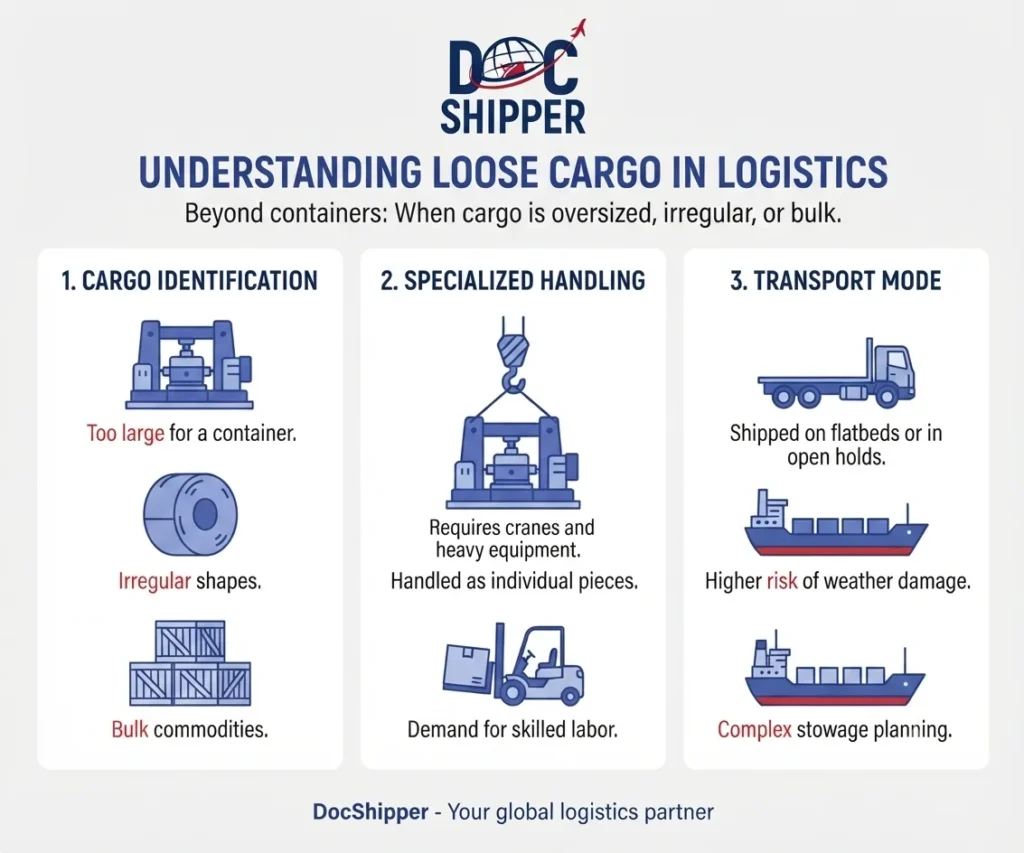
Key characteristics of loose cargo include:
- Individual handling: Each piece loaded separately using cranes, forklifts, or manual labor
- Direct vessel contact: Goods placed directly in ship holds without intermediate containers
- Flexible sizing: Accommodates oversized or irregularly shaped items
- Higher labor intensity: Requires more stevedores and longer port times
- Specialized documentation: Demands detailed cargo manifests and handling instructions
Deep Dive & Expertise
Loose cargo operations involve complex logistics far beyond simple loading. The cargo securing regulations under the International Maritime Organization (IMO) mandate specific lashing, dunnage, and separation techniques to prevent shifting during transit. Non-compliance can result in vessel instability or complete cargo loss.
Three primary loose cargo categories exist: break bulk (large individual items like machinery), neo-bulk (unitized goods on pallets), and dry bulk (granular materials loaded via conveyor). Each requires distinct handling protocols. Break bulk demands heavy-lift equipment and precise weight distribution calculations.
The legal framework differs significantly from containerized shipping. According to IMO guidelines, shippers bear responsibility for accurate weight declarations and proper packaging. The Hague-Visby Rules apply different liability limits for loose cargo versus containerized goods, affecting insurance coverage.
Port infrastructure determines loose cargo feasibility. Facilities require specialized equipment: gantry cranes for heavy lifts, ro-ro ramps for wheeled cargo, and adequate storage yards. Ports lacking containerization often handle loose cargo exclusively, particularly in developing regions or island nations.
Damage rates for loose cargo exceed containerized shipments by 15-30%. Stowage planning becomes critical—heavier items positioned low, fragile goods separated by dunnage, and incompatible materials isolated. At DocShipper, we conduct pre-shipment surveys to identify loose cargo risks and implement mitigation strategies before goods leave origin facilities.
The customs clearance process for loose cargo involves enhanced scrutiny. Without container seals, customs authorities perform more thorough physical inspections. Documentation must detail each piece individually, including dimensions, weight, and value. This increases clearance times by 40-60% compared to sealed containers.
Concrete Examples & Data
Consider a construction equipment shipment from Germany to West Africa. A mining company needs to transport five excavators weighing 25 tons each. Containerization proves impossible due to dimensions exceeding standard 40ft container capacity.
| Shipping Method | Transit Time | Cost per Unit | Damage Risk |
|---|---|---|---|
| Loose Cargo (Break Bulk) | 28 days | $8,500 | Medium-High |
| Flat Rack Container | 22 days | $12,300 | Low-Medium |
| Air Freight (Disassembled) | 5 days | $45,000 | Low |
In this scenario, loose cargo offers 31% cost savings versus flat rack containers, though with 23% longer transit. The company accepts higher damage risk in exchange for budget optimization. Comprehensive marine insurance adds $1,200 per excavator but remains economical.
Real-world data points:
- Steel coils from Asia to Middle East: 65% of shipments use loose cargo due to weight concentration
- Project cargo for infrastructure: $2.3 billion annual market relies on break bulk vessels
- Island nations: 80% of imports arrive as loose cargo in small Pacific states
- Loading efficiency: Loose cargo achieves 12-18 tons per gang hour versus 25-30 for containers
- Port dwell time: Averages 7.2 days for loose cargo versus 3.1 days for containers
A pharmaceutical company shipping temperature-sensitive raw materials from India to Brazil faced a critical decision. Standard containers risked quality degradation during 35-day transit. They opted for refrigerated loose cargo in specialized reefer holds, maintaining 2-8°C throughout. Cost increased 40% but eliminated $180,000 in potential spoilage losses.
DocShipper recently coordinated a loose cargo project involving wind turbine blades measuring 73 meters. No container solution existed. We arranged dedicated break bulk vessel space, engineered custom lashing systems, and secured specialized port cranes at destination. The shipment required 14 days of planning versus 2 days for standard containers, demonstrating the expertise loose cargo demands.
Conclusion
Loose cargo remains indispensable for oversized, heavy, or destination-specific shipments where containerization proves impractical or cost-prohibitive. Success requires meticulous planning, specialized handling knowledge, and comprehensive risk management. While labor-intensive and slower, loose cargo provides essential flexibility in global logistics networks.
Need expert guidance on loose cargo solutions? Contact DocShipper for customized shipping strategies tailored to your cargo requirements.
📚 Quiz
Test Your Knowledge: Loose Cargo
What is the primary characteristic that defines loose cargo?
A client asks: "Isn't loose cargo just another name for bulk cargo?" How would you correctly respond?
A manufacturer needs to ship five 25-ton excavators from Germany to West Africa. The equipment exceeds standard container dimensions. Which shipping solution would you recommend?
🎯 Your Result
📞 Free Quote in 24hFAQ | Loose Cargo: Definition, Handling & Practical Examples
Oversized machinery, construction equipment, steel products, project cargo, and vehicles commonly ship as loose cargo. Items exceeding container dimensions or requiring direct vessel access benefit most. Agricultural equipment, mining machinery, and infrastructure components like bridge sections also qualify. The method suits low-value bulk goods where packaging costs outweigh damage risks.
Loose cargo typically requires higher premiums due to increased handling and exposure. Policies demand detailed pre-shipment surveys and photographic documentation. Coverage often excludes inherent vice unless specifically endorsed. Deductibles average 2-5% of cargo value versus 0.5-1% for containers. Insurers may mandate cargo superintendents for high-value loose shipments to verify proper stowage and securing.
Ocean freight constitutes 40-50% of total costs, followed by loading/unloading charges at 20-25%. Port handling fees, stevedoring, and specialized equipment rental add 15-20%. Documentation, customs clearance, and cargo surveys comprise 5-10%. Dunnage materials, lashing, and securing equipment account for 3-5%. Insurance and contingency reserves complete the budget at 5-10% of declared value.
Loose cargo typically adds 30-50% to transit times. Loading operations require 3-5 days versus 1 day for containers. Fewer vessels accept loose cargo, reducing sailing frequency. Port congestion affects loose cargo more severely as container terminals receive priority. From Asia to Europe, containers average 25-30 days while loose cargo extends to 35-45 days including port handling.
Bill of Lading with detailed cargo description, dimensions, and weight for each piece. Packing list itemizing all components. Certificate of Origin and commercial invoice. Stowage plan approved by vessel's chief officer. Material Safety Data Sheets for hazardous goods. Export licenses if applicable. Insurance certificate covering all-risks or Institute Cargo Clauses. Customs declarations with HS codes for each item.
Yes, modern multipurpose vessels accommodate both. Container stacks occupy deck areas while loose cargo fills holds. Segregation prevents contamination and allows efficient space utilization. However, scheduling complexity increases as loading sequences must prevent cargo interference. Port operations become more time-intensive, potentially delaying departure. Combined shipments work best for long-haul routes with stable schedules.
Physical damage from improper securing leads claims. Cargo shifting during rough seas causes vessel instability. Theft and pilferage rates exceed containerized goods by 40%. Weather exposure during loading/unloading risks water damage. Inadequate dunnage results in scratching or crushing. Delayed customs clearance due to individual inspections creates demurrage charges. Incorrect weight declarations may violate vessel stability limits, causing loading refusal.
Measure length, width, and height in meters for each piece. Multiply dimensions to obtain cubic meters (CBM). Add 15-20% void space allowance for irregular shapes. Carriers apply either weight (metric tons) or volume pricing, choosing whichever yields higher revenue. Calculate revenue ton as maximum of actual weight or CBM × 1,000 kg. Multiply revenue tons by freight rate to determine base ocean freight charges.
Loose cargo consists of individually countable pieces loaded separately, like machinery or crates. Bulk cargo comprises homogeneous materials loaded in aggregate without packaging, such as grain or coal. Loose cargo requires piece-by-piece handling while bulk cargo uses conveyors or pumps. Documentation differs—loose cargo needs itemized manifests, bulk cargo specifies only total tonnage. Insurance and liability frameworks also vary substantially between categories.
Vessel hold dimensions impose primary constraints, typically 25-40 meters length and 12-18 meters width. Hatch opening sizes limit vertical clearance to 10-15 meters. Weight per lift point usually caps at 150-250 tons depending on vessel's gear capacity. Port crane capacities range from 40 to 1,200 tons for specialized heavy-lift terminals. Road transport restrictions from port to final destination may further constrain dimensions and weight.
Ports with dedicated break bulk terminals reduce handling time by 40-60%. Facilities lacking proper equipment require floating cranes at premium rates. Congested multi-purpose ports increase dwell time and storage charges. Remote destinations with limited infrastructure may necessitate lightering operations, adding 20-30% to costs. Ports offering direct rail or road connections minimize inland transportation expenses. Choosing strategically located ports can reduce total logistics costs by 15-25%.
Freight forwarders coordinate vessel booking, cargo surveys, and stowage planning. They arrange specialized handling equipment and supervise loading operations. Documentation preparation includes detailed cargo manifests and customs paperwork. Forwarders negotiate freight rates and consolidate smaller shipments when possible. They manage insurance placement and claims processing. For complex loose cargo, experienced forwarders provide engineering support and regulatory compliance guidance, reducing risks by 30-50%.
Need Help with
Logistics or Sourcing ?
First, we secure the right products from the right suppliers at the right price by managing the sourcing process from start to finish. Then, we simplify your shipping experience - from pickup to final delivery - ensuring any product, anywhere, is delivered at highly competitive prices.


Fill the Form
Prefer email? Send us your inquiry, and we’ll get back to you as soon as possible.
Contact us




