


In short ⚡
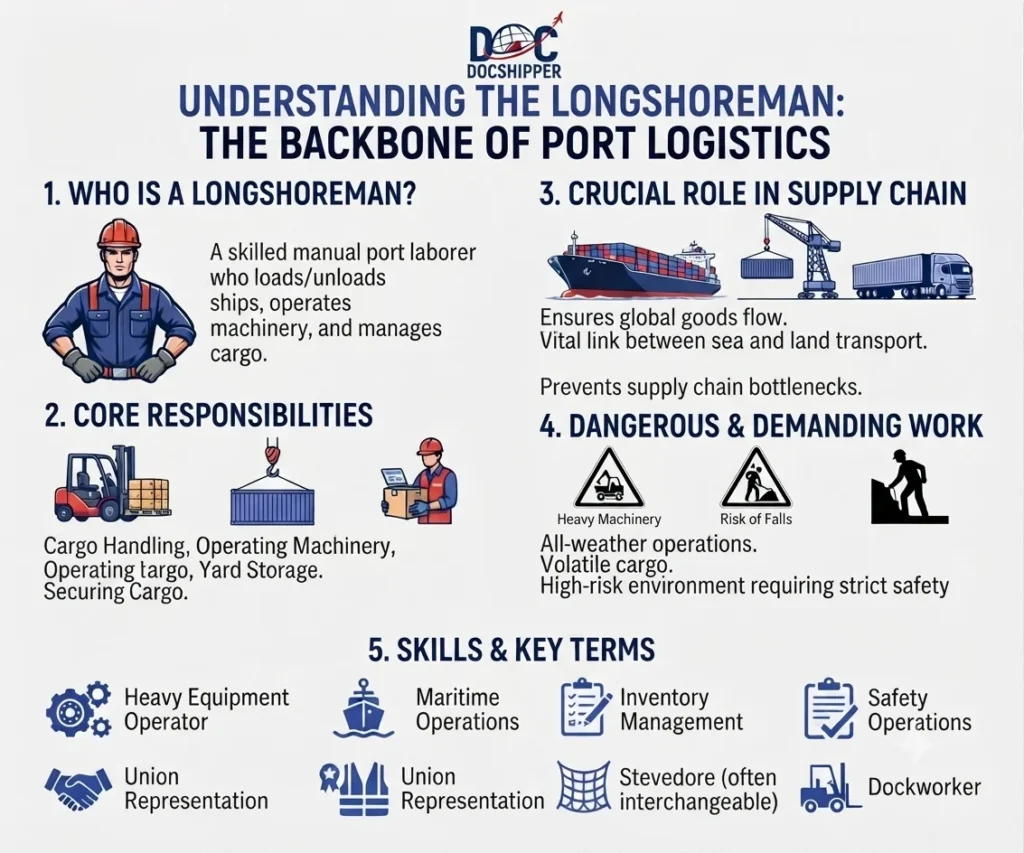
A longshoreman is a port worker specialized in loading and unloading cargo from ships. Also known as dock workers or stevedores, they handle containers, bulk cargo, and breakbulk freight using specialized equipment. Their work is essential to maintaining efficient supply chains in international trade.
Introduction
When a container ship docks at a port, a critical question emerges: who ensures the safe and rapid transfer of thousands of containers? The answer lies with longshoremen—the backbone of maritime logistics.
Without these specialized workers, global trade would face significant bottlenecks. Every imported product you purchase has likely been handled by a longshoreman at least twice during its journey.
Their role encompasses:
- Cargo handling: Loading and unloading ships using cranes, forklifts, and manual labor
- Equipment operation: Managing gantry cranes, reach stackers, and container handlers
- Safety compliance: Following OSHA regulations and port-specific safety protocols
- Documentation verification: Ensuring cargo matches shipping manifests and customs declarations
- Stowage planning: Organizing cargo placement for vessel stability and efficient unloading
Expertise & Port Operations
The profession of longshoreman requires specialized training and technical expertise beyond simple physical labor. Modern port operations demand workers who understand complex logistics systems and operate sophisticated machinery.
Equipment mastery represents a core competency. Longshoremen operate ship-to-shore cranes that lift containers weighing up to 70 tons. These massive gantry cranes require precision—a single error can delay an entire vessel’s departure and cost shipping lines thousands of dollars per hour.
The union system governs most longshoreman employment in major ports. In the United States, the International Longshore and Warehouse Union (ILWU) on the West Coast and the International Longshoremen’s Association (ILA) on the East Coast regulate hiring, wages, and working conditions. According to the U.S. Bureau of Labor Statistics, union longshoremen earn median wages significantly above the national average.
Safety protocols are non-negotiable in port environments. OSHA regulations mandate specific procedures for confined space entry, fall protection, and hazardous material handling. Longshoremen must complete regular safety training and wear personal protective equipment (PPE) including hard hats, steel-toed boots, and high-visibility vests.
Shift work patterns define the profession’s lifestyle. Ports operate 24/7 to accommodate vessel schedules. Longshoremen work rotating shifts including nights, weekends, and holidays. The unpredictable nature of shipping schedules means workers must often remain on call.
At DocShipper, we coordinate closely with longshoreman teams to ensure optimal loading sequences for our clients’ cargo. Our port agents verify that handling procedures meet international standards, reducing the risk of damage during vessel operations.
Practical Examples & Industry Data
Understanding longshoreman operations becomes clearer through concrete scenarios and industry metrics. Let’s examine real-world applications and current data.
Comparative Analysis: Manual vs. Automated Port Operations
| Factor | Traditional (Longshoreman-Heavy) | Semi-Automated |
|---|---|---|
| Containers/Hour/Worker | 25-30 moves | 40-50 moves |
| Average Hourly Wage | $35-45 USD | $40-55 USD (specialized operators) |
| Injury Rate (per 100 workers) | 6.2 incidents | 3.1 incidents |
| 24-Hour Vessel Turnaround | 48-60 hours | 36-42 hours |
| Workforce Flexibility | High (shift adjustments) | Moderate (equipment constraints) |
Use Case: Container Ship Unloading at Los Angeles Port
A large container vessel arrives carrying 8,000 TEU (Twenty-foot Equivalent Units). The port assigns 24 longshoremen across three shifts to work with six gantry cranes.
Key operational metrics:
- Unloading target: 3,500 containers in 36 hours
- Crane productivity: 25-32 container moves per hour per crane
- Labor cost: Approximately $40,320 for the complete operation (24 workers × 36 hours × $42/hour average)
- Equipment coordination: Each gantry crane operator works with 4 ground personnel managing container placement
- Quality checks: Longshoremen inspect containers for damage and verify seal numbers against shipping documents
This operation demonstrates why experienced longshoremen command premium wages. A delay of just 2 hours can cost the shipping line $15,000 in port fees and schedule disruptions.
DocShipper works with port authorities to reserve longshoreman teams during peak seasons, ensuring our clients’ cargo receives priority handling. This coordination reduces dwell time and accelerates customs clearance processes.
Conclusion
Longshoremen remain indispensable to global supply chains despite increasing automation. Their expertise in cargo handling, equipment operation, and safety compliance ensures that international trade flows efficiently through the world’s ports.
Need assistance coordinating port operations or managing your international shipments? Contact DocShipper for expert logistics support tailored to your supply chain needs.
📚 Quiz
Test Your Knowledge: Longshoreman
What is the primary role of a longshoreman in port operations?
Which statement correctly describes the relationship between longshoremen and stevedores?
When high winds exceed 35-40 mph at a port, what is the correct operational response regarding longshoreman crane operations?
🎯 Your Result
📞 Free Quote in 24hFAQ | Longshoreman: Definition, Role & Concrete Examples in Port Operations
While often used interchangeably, "longshoreman" typically refers to the individual worker, whereas "stevedore" can refer to either the worker or the company that employs dock workers. In some regions, stevedore specifically denotes the company contracting labor services to shipping lines, while longshoremen are the actual workers performing cargo operations.
Compensation varies significantly by port and union contract. In major U.S. ports, experienced longshoremen earn between $80,000 and $150,000 annually, with senior workers and crane operators potentially exceeding $180,000 when including overtime. Entry-level casual workers start at $30-35 per hour but work fewer guaranteed hours.
Requirements vary by port authority and union. Most positions require high school completion, passage of physical fitness tests, and completion of union-sponsored training programs lasting 2-6 months. Training covers safety protocols, equipment operation, cargo handling procedures, and maritime regulations. Some ports require commercial driver's licenses (CDL) for certain equipment.
Partial automation is occurring in major ports, particularly for container handling. However, complete replacement remains unlikely due to the complexity of cargo operations. Breakbulk cargo, vessel lashing, equipment maintenance, and supervisory roles still require human expertise. The profession is evolving toward equipment operation and system management rather than manual labor.
Primary hazards include falling containers or cargo, equipment accidents involving cranes or forklifts, falls from height when accessing vessel holds, confined space hazards, and exposure to hazardous materials. Despite safety improvements, longshoremen face injury rates higher than the national average for all occupations, making strict adherence to safety protocols essential.
Longshoremen employ specialized techniques based on cargo type. Containerized cargo uses standardized lifting equipment and stacking procedures. Breakbulk requires custom rigging and securing methods. Bulk cargo involves conveyor systems or grab cranes. Roll-on/roll-off (RoRo) cargo demands vehicle operation skills. Hazardous materials require certified handling and documentation procedures per IMDG Code regulations.
Port strikes create immediate supply chain disruptions. A one-week strike at major U.S. ports can delay over 200,000 containers, affecting inventory levels, production schedules, and retail operations. The 2002 West Coast port lockout cost the U.S. economy an estimated $1-2 billion daily. Modern supply chains' just-in-time models amplify strike impacts, making labor negotiations critically important.
Longshoremen primarily work on commercial cargo vessels including container ships, bulk carriers, breakbulk freighters, and RoRo vessels. They typically do not handle cruise ships (except for provisions) or military vessels, which often use specialized personnel. Tanker operations involve different skill sets and are usually managed by separate crews with specialized training in liquid cargo handling.
Weather significantly impacts port operations. High winds (typically above 35-40 mph) halt crane operations due to safety risks. Heavy rain reduces visibility and creates slip hazards. Extreme cold affects equipment performance and worker endurance. Fog delays vessel arrivals. Lightning requires immediate work cessation. These interruptions can cascade into multi-day delays affecting scheduled vessel rotations.
Contemporary longshoremen interact with Terminal Operating Systems (TOS) for container tracking, GPS-guided equipment for precise positioning, RFID systems for cargo identification, and digital communication devices for coordination. Crane operators use computer-assisted controls with collision avoidance systems. Mobile devices provide real-time updates on vessel manifests and stowage plans, integrating physical work with digital logistics management.
Absolutely. While historically male-dominated, the profession increasingly includes women, particularly in equipment operation roles that emphasize technical skills over physical strength. Modern anti-discrimination laws and union policies support equal opportunity hiring. Women now represent approximately 5-8% of the longshoreman workforce in major ports, with percentages steadily increasing as automation reduces physical labor requirements.
Longshoremen work within a regulated framework overseen by customs and port authorities. They verify seal numbers on containers, report discrepancies to customs officials, and ensure cargo placement allows inspection access. They cannot break customs seals without authorization. Their documentation accuracy directly affects customs clearance speed. This coordination role requires attention to detail and understanding of import/export regulations beyond physical cargo handling.
Need Help with
Logistics or Sourcing ?
First, we secure the right products from the right suppliers at the right price by managing the sourcing process from start to finish. Then, we simplify your shipping experience - from pickup to final delivery - ensuring any product, anywhere, is delivered at highly competitive prices.


Fill the Form
Prefer email? Send us your inquiry, and we’ll get back to you as soon as possible.
Contact us




