


In short ⚡
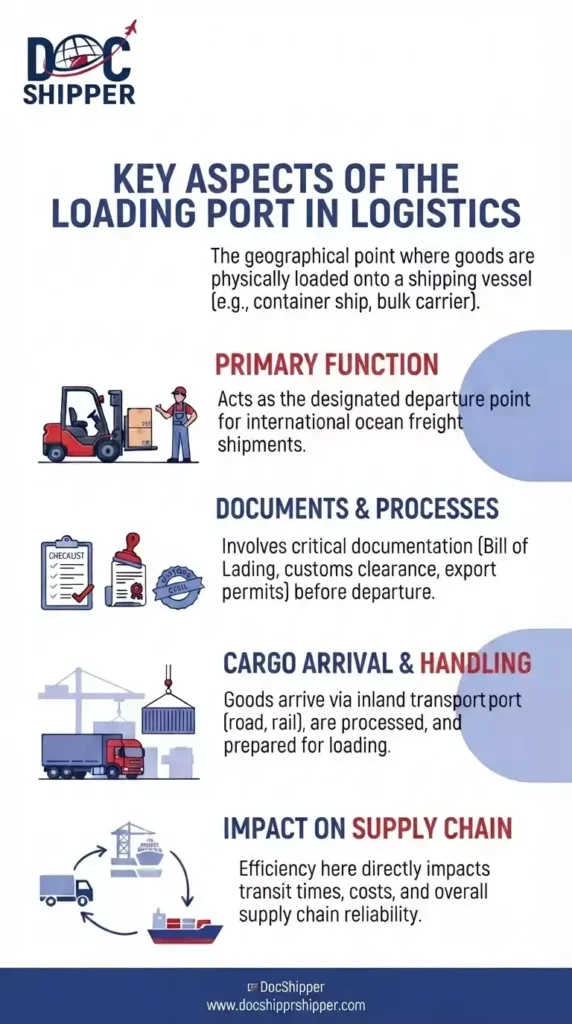
The loading port is the maritime or inland terminal where cargo is loaded onto a vessel for international transport. It represents the physical departure point of goods in the supply chain, determining freight rates, transit times, and customs clearance procedures. Selecting the optimal loading port directly impacts logistics costs and delivery reliability.
Introduction
Many importers assume all ports offer equivalent service levels and pricing structures. This misconception leads to 15-30% unnecessary cost increases in international freight operations. The loading port decision influences not only transportation expenses but also container availability, vessel schedules, and regulatory compliance requirements.
In global trade, the loading port serves as the critical junction between inland logistics and maritime transport. This choice affects the entire International Maritime Organization documented shipping process, from bill of lading issuance to cargo insurance coverage.
Key characteristics of loading port operations include:
- Container handling capacity: Determines vessel berthing times and congestion risk
- Customs infrastructure: Affects export clearance speed and documentary requirements
- Shipping line connectivity: Defines available routes and frequency of departures
- Hinterland access: Impacts pre-carriage costs from production sites to port terminals
- Free time policies: Influences demurrage and detention charge exposure
Strategic Role & Port Selection Criteria
The loading port designation appears as the Port of Loading (POL) field in all shipping documents, including the Master Bill of Lading, commercial invoice, and certificate of origin. This specification triggers specific World Customs Organization harmonized procedures and determines applicable Incoterms obligations.
Five critical factors govern loading port selection in professional freight forwarding:
Geographic proximity to the manufacturing location minimizes inland transportation costs and reduces transit time variability. A factory located 80 km from Port A versus 420 km from Port B generates $300-800 savings per container in pre-carriage charges alone.
Vessel frequency directly impacts inventory carrying costs and supply chain responsiveness. Major hubs like Shanghai or Rotterdam offer daily departures to primary trade lanes, while secondary ports may provide weekly or bi-weekly services. At DocShipper, we systematically analyze sailing schedules to optimize your shipment timing and avoid unnecessary storage fees.
Infrastructure quality encompasses both physical equipment (gantry cranes, reefer plugs, dangerous goods facilities) and digital systems (port community platforms, electronic data interchange). Ports with advanced cargo tracking systems reduce documentation errors by approximately 40%.
Regulatory environment varies significantly between jurisdictions. Export processing times range from 2 hours in Singapore to 5 days in certain developing markets. Understanding local customs requirements prevents shipment delays and penalty exposure.
Cost structure transparency includes terminal handling charges (THC), wharfage fees, security surcharges, and documentation costs. Hidden charges at inefficient ports can inflate total landed costs by 8-12%. DocShipper conducts comprehensive cost audits to identify optimal routing configurations for your specific trade lanes.
Practical Examples & Cost Analysis
Understanding loading port implications requires examining real-world scenarios with quantified financial impacts. The following comparative analysis demonstrates how port selection affects total logistics expenditure across different shipping configurations.
Comparative Scenario: Electronics Shipment from China to Germany
| Criterion | Shanghai Port | Ningbo Port | Qingdao Port |
|---|---|---|---|
| Ocean Freight (40′ HC) | $2,800 | $2,650 | $3,100 |
| Terminal Handling Charges | $210 | $195 | $230 |
| Pre-carriage (Factory-Port) | $420 | $280 | $680 |
| Transit Time (Days) | 28 | 30 | 32 |
| Vessel Frequency | Daily | 3x/week | 2x/week |
| Total Cost | $3,430 | $3,125 | $4,010 |
In this configuration, Ningbo offers the most cost-effective solution due to proximity to the manufacturer’s facility, despite slightly longer transit times. The $305 savings per container translates to $15,250 annually for an importer shipping 50 containers per year.
Use Case: Textile Shipment from Bangladesh
A European fashion retailer sources garments from Dhaka. The choice between Chittagong Port and Mongla Port illustrates infrastructure quality impact:
Chittagong Port (primary loading port): Handles 92% of Bangladesh’s container traffic. Offers direct services to European destinations with 22-25 day transit. Container dwell time averages 6 days due to congestion. Total logistics cost: $1,850 per TEU.
Mongla Port (alternative): Processes only 8% of national volume. Requires transshipment in Singapore or Colombo, adding 7-10 days transit time. However, dwell time is just 2 days, and THC charges are 30% lower. Total logistics cost: $1,920 per TEU with extended delivery window.
The optimal choice depends on the shipper’s inventory management strategy. Fast-fashion retailers prioritizing speed select Chittagong despite congestion. Budget-conscious importers with flexible timelines prefer Mongla’s reduced handling costs.
At DocShipper, we maintain real-time congestion monitoring across 180+ loading ports worldwide. Our logistics coordinators proactively adjust routing to avoid port strikes, terminal backlogs, and seasonal capacity constraints that could delay your shipments.
Conclusion
The loading port selection represents a strategic logistics decision with multi-dimensional financial implications extending beyond simple freight rate comparisons. Optimal port choice requires analyzing infrastructure capacity, regulatory efficiency, geographic positioning, and service frequency in relation to your specific supply chain requirements.
Need expert guidance on loading port optimization for your trade lanes? Contact DocShipper for a customized routing analysis that reduces costs while maintaining service reliability.
📚 Quiz
Test Your Knowledge: Loading Port
What is the primary function of a loading port in international shipping?
According to the article, what percentage of unnecessary cost increases can result from poor loading port selection?
In the comparative China-to-Germany electronics shipment scenario, which loading port offered the most cost-effective solution?
🎯 Your Results
📞 Free Quote in 24hFAQ | Loading Port: Definition, Function & Practical Examples in International Shipping
The loading port is typically specified in the sales contract and agreed upon during Incoterms negotiation. Under FOB terms, the seller chooses the loading port within their country. Under EXW or FCA terms, the buyer determines this through their freight forwarder. The commercial invoice and letter of credit must reflect this designation to ensure documentary compliance and payment release.
Port changes post-booking incur amendment fees ranging from $50-150 and require vessel space availability at the new location. Changes must be requested at least 48-72 hours before cargo gate-in. Container repositioning charges may apply if equipment was already allocated to the original port. Early communication with your freight forwarder minimizes disruption and additional costs.
Marine insurance premiums vary by loading port based on theft risk, handling standards, and regional security ratings. High-risk ports may carry 0.15-0.35% additional premium loads. The Institute Cargo Clauses reference the port of loading for determining coverage inception. Certain underwriters exclude specific ports entirely from standard policies, requiring specialized facultative coverage at increased rates.
The loading port appears on the Bill of Lading (POL field), Commercial Invoice, Packing List, Certificate of Origin, and Customs Export Declaration. Documentary credits require exact matching across all documents. Discrepancies trigger letter of credit rejections and payment delays. Verified Gross Mass (VGM) certificates must also specify the port where weighing occurred before vessel loading.
Not all ports maintain reefer infrastructure. Specialized terminals with sufficient reefer plugs and monitoring systems handle temperature-controlled cargo. Secondary ports may require pre-cooling arrangements and generator sets for containers awaiting vessel loading. Verify reefer capacity during booking to avoid temperature excursions that could spoil perishable goods worth thousands of dollars.
Free time for container gate-in ranges from 3-7 days before vessel departure. Major Asian ports typically offer 5 days, while European terminals provide 3-4 days. Exceeding free time triggers demurrage charges of $50-150 per container per day. Understanding port-specific policies prevents unnecessary storage fees that erode profit margins on tight-margin shipments.
Congested loading ports experience vessel delays of 3-14 days, cascading through subsequent port calls and delivery schedules. Container dwell times exceeding 7 days indicate systemic congestion requiring alternative routing. Real-time port performance data enables proactive decision-making. Persistent congestion at your primary loading port justifies evaluating nearby alternatives despite slightly higher inland transport costs.
Terminal handling charges (THC) vary significantly by country and terminal operator. Asian ports charge $80-250 per TEU, European terminals $150-350, and North American facilities $200-400. Export documentation fees, security screening, and VGM submission carry separate charges. Request detailed cost breakdowns from freight forwarders to compare all-in expenses rather than ocean freight rates alone.
Only certified terminals handle IMDG Class cargo with proper segregation areas, emergency response equipment, and trained personnel. Ports lacking dangerous goods approval reject hazardous shipments, forcing costly re-routing. Declaration accuracy is critical—undeclared dangerous goods discovered at loading trigger fines up to $25,000 and potential criminal liability. Verify port certifications before booking hazmat cargo.
A single Bill of Lading covers one loading port only. Consolidating cargo from multiple origin points requires either separate Bills of Lading or transshipment through a central hub. Some carriers offer "switch Bill of Lading" services where containers loaded at different ports receive a unified document at a transshipment hub, simplifying documentation for buyers receiving multi-origin shipments.
Force majeure events like typhoons or hurricanes triggering port closures allow carriers to invoke exception clauses. Alternative arrangements may include: (1) waiting for port reopening with potential demurrage, (2) diverting to nearby operational ports with amendment fees, or (3) declaring the booking void under frustration of contract. Comprehensive cargo insurance with delay coverage protects against resulting financial losses.
Port labor disruptions can delay container handling by days or weeks. Carriers typically invoke force majeure clauses absolving liability for strike-related delays. Shippers face choices between waiting, re-routing to unaffected ports (incurring additional trucking and amendment costs), or switching to air freight for time-sensitive cargo. Monitoring labor negotiation calendars enables proactive risk mitigation through advance shipment scheduling.
Need Help with
Logistics or Sourcing ?
First, we secure the right products from the right suppliers at the right price by managing the sourcing process from start to finish. Then, we simplify your shipping experience - from pickup to final delivery - ensuring any product, anywhere, is delivered at highly competitive prices.


Fill the Form
Prefer email? Send us your inquiry, and we’ll get back to you as soon as possible.
Contact us




