


In short ⚡
Machine downtimes refer to periods when production equipment is unavailable or non-operational, disrupting manufacturing workflows and supply chain efficiency. In international logistics, unplanned downtimes directly impact shipment schedules, inventory management, and delivery commitments. Understanding and minimizing these interruptions is critical for maintaining continuous production flow and meeting customer expectations in global trade operations.
Introduction
A single hour of unexpected production stoppage can cascade into missed shipment deadlines, penalty fees, and strained customer relationships. In global supply chains where just-in-time manufacturing dominates, machine downtimes represent one of the most significant operational risks.
Whether managing a textile factory in Bangladesh or an electronics assembly line in Vietnam, understanding the causes and consequences of equipment failures is essential for logistics professionals coordinating international shipments.
Key characteristics of machine downtimes include:
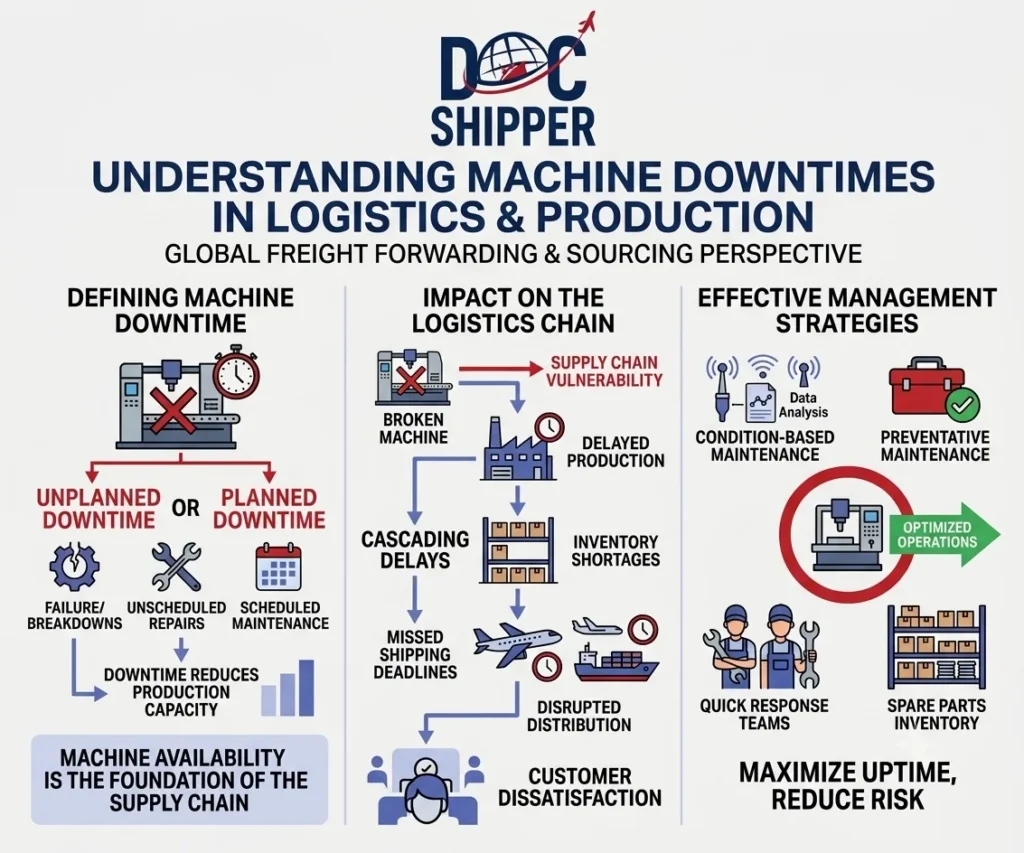
- Planned downtimes: Scheduled maintenance, upgrades, or changeovers that are anticipated and managed.
- Unplanned downtimes: Unexpected breakdowns, material shortages, or quality issues causing sudden stoppages.
- Operational impact: Direct effect on production capacity, output volumes, and delivery schedules.
- Financial consequences: Lost revenue, overtime costs, expedited shipping fees, and potential contract penalties.
- Supply chain ripple effects: Delays affecting downstream partners, inventory shortages, and increased buffer stock requirements.
In-Depth Analysis & Expert Insights
Machine downtimes are categorized into several distinct types, each requiring different management approaches. Breakdown downtimes occur when equipment fails unexpectedly due to mechanical wear, electrical faults, or component failures. These are the most disruptive because they happen without warning and often require emergency repairs.
Setup and changeover downtimes happen when production lines transition between different products or configurations. While technically planned, poor optimization of these processes can significantly reduce overall equipment effectiveness. Modern manufacturers apply SMED principles (Single-Minute Exchange of Die) to minimize these intervals.
Another critical category involves material shortage downtimes, where machines sit idle waiting for raw materials, components, or packaging supplies. In international logistics, these delays often stem from customs clearance issues, transportation disruptions, or supplier reliability problems. According to the Supply Chain Quarterly, material shortages account for approximately 15-20% of all unplanned downtimes in manufacturing facilities.
The financial impact extends beyond immediate production losses. Opportunity costs include lost sales, diminished market share, and damaged customer relationships. Expedited air freight to compensate for delays can multiply logistics costs by 5-10 times compared to standard ocean shipping.
At DocShipper, we work closely with manufacturers to build contingency plans that account for typical downtime patterns, ensuring backup inventory strategies and flexible shipping arrangements minimize disruption to international delivery schedules. Our approach includes real-time monitoring of production status to trigger alternative logistics solutions when downtimes threaten critical shipment windows.
Measurement metrics for downtimes include Mean Time Between Failures (MTBF), Mean Time To Repair (MTTR), and Overall Equipment Effectiveness (OEE). Industry best practices target OEE scores above 85%, with world-class facilities achieving 90% or higher through preventive maintenance programs and rapid response systems.
Concrete Examples & Industry Data
Consider a practical scenario: An electronics manufacturer in Shenzhen experiences a 6-hour unplanned downtime on their SMT (Surface Mount Technology) line producing smartphone components destined for European buyers.
| Impact Category | Measurement | Financial Consequence |
|---|---|---|
| Lost Production Units | 18,000 units (3,000/hour capacity) | $54,000 in revenue (at $3/unit) |
| Overtime Labor Costs | 12 hours extended shift | $8,400 additional wages |
| Expedited Shipping | Air freight vs. ocean freight | $22,000 premium cost |
| Repair/Replacement Parts | Emergency component procurement | $5,600 |
| Total Impact | 6-hour downtime | $90,000 |
Industry research reveals significant variations across sectors. Automotive manufacturing experiences average downtimes of 4-6% of total production time, while pharmaceutical facilities typically maintain stricter uptime requirements, limiting downtimes to under 2% due to regulatory compliance and product value considerations.
A comparative analysis of downtime causes shows:
- Mechanical failures: 35-40% of total downtime incidents (bearings, motors, hydraulics)
- Material/supply issues: 20-25% (customs delays, supplier problems, quality rejections)
- Operator-related issues: 15-18% (training gaps, procedural errors)
- Planned maintenance: 12-15% (preventive servicing, calibration)
- External factors: 8-10% (power outages, natural events, regulatory inspections)
Real-world case: A Vietnamese garment exporter reduced unplanned downtimes by 43% over 18 months by implementing predictive maintenance sensors on critical sewing and cutting equipment. This improvement translated to improved on-time delivery rates from 87% to 96%, significantly strengthening their competitive position with European fashion retailers.
From a logistics perspective, manufacturers with downtime contingency protocols maintain safety stock buffers at strategic warehouses. DocShipper assists clients in calculating optimal buffer inventory levels based on historical downtime patterns, lead time variability, and customer service level agreements.
Conclusion
Machine downtimes represent a critical vulnerability in international supply chains, where production delays immediately translate to shipment disruptions and customer dissatisfaction. Effective management requires both proactive maintenance strategies and responsive logistics planning to minimize business impact.
Need expert assistance managing production continuity and logistics flexibility for your international operations? Contact DocShipper today to develop customized solutions that protect your supply chain from downtime disruptions.
📚 Quiz
Test Your Knowledge: Machine Downtimes
Machine downtimes primarily refer to:
Which statement about planned vs. unplanned downtimes is correct?
A 6-hour unplanned downtime at an electronics manufacturer forces you to switch from ocean freight to air freight for a European shipment. This decision is justified because:
🎯 Your Result
📞 Free Quote in 24hFAQ | Machine Downtimes: Definition, Calculation & Concrete Examples
Planned downtimes are scheduled in advance for maintenance, upgrades, or changeovers, allowing production teams to prepare alternative arrangements. Unplanned downtimes occur unexpectedly due to equipment failures, material shortages, or unforeseen issues, creating immediate disruption to production schedules and shipment commitments. The latter typically carries 3-5 times higher financial impact due to emergency response costs and expedited logistics requirements.
Production delays from machine downtimes compress the available time window for manufacturing, quality control, and logistics preparation. This often forces companies to switch from economical ocean freight to expensive air freight, upgrade to expedited customs clearance services, or face late delivery penalties. In just-in-time supply chains, even 24-hour production delays can trigger missed vessel departures, adding 1-2 weeks to overall delivery timelines.
OEE measures manufacturing productivity by multiplying three factors: availability (uptime percentage), performance (speed efficiency), and quality (defect-free output). World-class manufacturers target OEE scores above 85%. For logistics professionals, higher OEE scores indicate more reliable production partners with predictable output, reducing the need for safety stock and enabling tighter delivery commitments to end customers.
Effective strategies include implementing preventive maintenance schedules, installing predictive sensors that detect early failure signs, maintaining critical spare parts inventory, cross-training operators for rapid troubleshooting, and establishing supplier partnerships for expedited component delivery. Digital maintenance management systems can reduce unplanned downtimes by 20-30% through data-driven scheduling and failure prediction algorithms.
Customs delays represent a significant cause of material shortages that halt production. Incomplete documentation, incorrect HS code classification, compliance issues, or random inspections can detain shipments for days or weeks. Working with experienced customs brokers like DocShipper ensures proper documentation preparation, compliance verification, and expedited clearance processes to minimize supply interruption risks.
Safety stock calculations should incorporate both demand variability and supply variability from production downtimes. A common formula adds buffer inventory equal to (average daily sales) × (average downtime duration in days) × (safety factor 1.5-2.0). For critical products with high service level requirements, companies typically maintain 2-4 weeks of additional inventory to cover typical downtime scenarios.
MTBF measures the average operational time between equipment breakdowns. Calculated by dividing total operational hours by the number of failures over a period, higher MTBF values indicate more reliable equipment. For logistics planning, knowing supplier MTBF data helps assess production reliability and determine appropriate lead time buffers for international orders.
Beyond direct revenue loss from reduced output, downtimes generate overtime labor costs (typically 1.5-2x standard wages), emergency repair expenses, expedited parts procurement at premium prices, increased scrap rates when restarting production, and potential contractual penalties for late deliveries. Total cost per downtime hour often reaches 4-6 times the value of lost production alone.
Business interruption insurance covers revenue losses and ongoing expenses during extended downtimes, though policies typically include waiting periods (48-72 hours) before coverage activates. Equipment breakdown insurance covers repair costs and sometimes consequential losses. For international supply chains, cargo insurance and trade disruption policies can protect against shipment delays caused by supplier production failures.
While predictive maintenance significantly reduces unplanned downtimes—often by 30-50%—it cannot eliminate them entirely. Sudden external factors (power surges, operator errors, material defects) can still cause unexpected failures. However, sensor-based monitoring detects 70-80% of potential failures in advance, allowing scheduled repairs during planned downtime windows rather than emergency shutdowns during critical production periods.
Transparent, proactive communication is essential. Best practices include immediate notification when downtimes occur, realistic revised timeline estimates, explanation of mitigation steps being taken, and regular status updates until normal operations resume. Providing customers with alternative options—such as partial shipments or substitute products—demonstrates commitment to service continuity despite production challenges.
Modern manufacturing execution systems (MES), IoT sensor networks, and cloud-based monitoring platforms provide real-time visibility into equipment status, performance metrics, and early warning indicators. These systems enable remote diagnostics, predictive failure alerts, and automated maintenance scheduling. For international buyers, supplier portals with production status dashboards facilitate proactive logistics adjustments when downtimes threaten delivery commitments.
Need Help with
Logistics or Sourcing ?
First, we secure the right products from the right suppliers at the right price by managing the sourcing process from start to finish. Then, we simplify your shipping experience - from pickup to final delivery - ensuring any product, anywhere, is delivered at highly competitive prices.


Fill the Form
Prefer email? Send us your inquiry, and we’ll get back to you as soon as possible.
Contact us




