


In short ⚡
MRP-II (Manufacturing Resource Planning) is an integrated information system that synchronizes all manufacturing resources—materials, machinery, labor, and finances—to optimize production planning, inventory management, and delivery schedules. Unlike its predecessor MRP-I, which focused solely on materials, MRP-II encompasses enterprise-wide resource coordination to enhance operational efficiency and profitability.
Introduction
Many businesses struggle with disconnected systems where production, inventory, and financial data exist in silos. This fragmentation leads to costly delays, overstocking, and missed delivery windows—particularly critical in international trade where timing impacts customs clearance and shipping schedules.
MRP-II emerged in the 1980s as a holistic solution to integrate manufacturing operations with financial and commercial planning. For companies engaged in import/export, this integration ensures that production schedules align with shipping timelines, regulatory requirements, and cash flow management.
Key characteristics of MRP-II systems include:
- Closed-loop planning: Continuous feedback between planning and execution phases
- Capacity requirements planning (CRP): Validates production schedules against available resources
- Financial integration: Links manufacturing costs directly to accounting systems
- Sales and operations planning (S&OP): Aligns demand forecasts with production capabilities
- Shop floor control: Real-time tracking of work orders and labor utilization
Technical Framework & Strategic Implementation
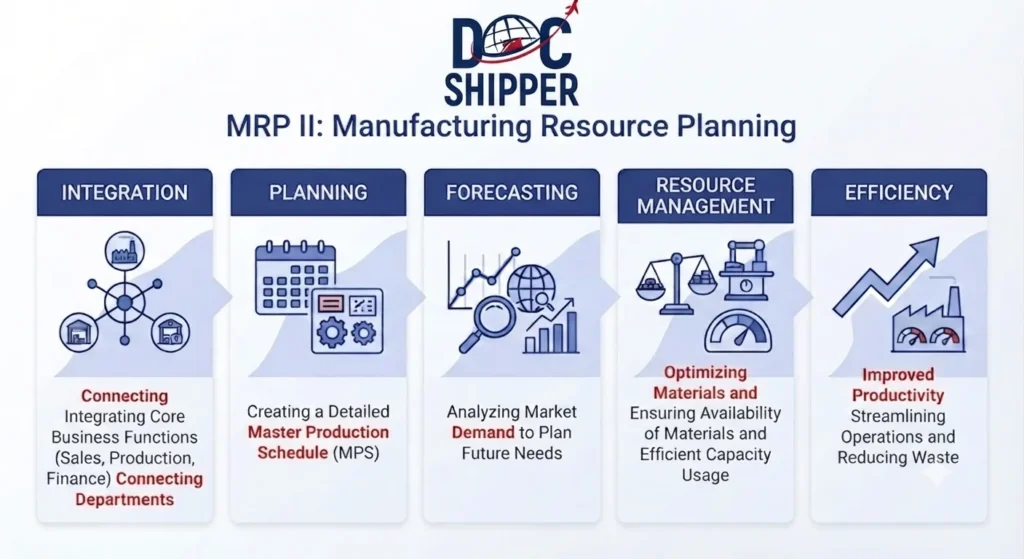
MRP-II operates through five integrated planning layers that cascade from strategic vision to daily operations. The master production schedule (MPS) translates sales forecasts into specific manufacturing commitments, typically covering 3-18 months depending on industry lead times.
The system performs materials requirements planning by exploding bills of materials (BOMs) and netting available inventory against gross requirements. This calculation determines precise quantities and timing for purchase orders or work orders, accounting for safety stock levels and lead times.
Capacity planning modules distinguish MRP-II from simpler inventory systems. Rough-cut capacity planning (RCCP) validates whether the MPS is achievable given constraints in critical work centers. Detailed capacity requirements planning then schedules operations to balance workload across all production resources.
Financial integration represents a paradigm shift: standard costing mechanisms automatically calculate product costs based on actual resource consumption. Variance analysis highlights discrepancies between planned and actual performance, enabling continuous improvement initiatives.
For international logistics operations, MRP-II provides critical visibility into production completion dates. At DocShipper, we integrate MRP-II output data to coordinate freight bookings, customs documentation, and warehouse allocation—ensuring containers arrive precisely when goods are ready for shipment, minimizing demurrage charges.
The APICS organization establishes industry standards for MRP-II implementation, including the five-level classification system measuring system utilization (Class A being full integration, Class D representing basic MRP functionality only).
Concrete Examples & Performance Data
Implementation outcomes vary significantly based on execution quality. Research from Aberdeen Group indicates that Class A MRP-II users achieve 95%+ on-time delivery rates compared to 70% for non-integrated systems—a differential that directly impacts customer retention in competitive export markets.
Case Study: Electronics Manufacturer
A mid-sized electronics company in Taiwan implemented MRP-II to coordinate component sourcing from five countries with final assembly for European markets. Prior to implementation, they maintained 90 days of safety stock due to unreliable lead time visibility. Post-implementation results after 18 months:
- Inventory carrying costs reduced by 42% through improved demand forecasting
- Production schedule stability increased from 68% to 91%
- Export shipping delays decreased by 37% due to better production visibility
- Working capital freed: approximately $2.3 million
The system’s finite scheduling capabilities enabled them to commit to shorter lead times for European distributors, increasing market competitiveness while simultaneously reducing expedited freight costs.
| Implementation Level | System Integration | Typical Inventory Turns | On-Time Delivery |
|---|---|---|---|
| Class A | Full financial, operational, and sales integration | 12-18 turns/year | 95%+ |
| Class B | Operational integration, limited financial linkage | 8-12 turns/year | 85-90% |
| Class C | Basic MRP with manual overrides common | 5-8 turns/year | 70-80% |
| Class D | Minimal system usage, data accuracy issues | 3-5 turns/year | Below 70% |
Key implementation metrics demonstrate measurable business impact:
- Data accuracy requirements: Bills of material must be 98%+ accurate; inventory records 95%+ accurate for effective MRP-II operation
- Planning horizon adequacy: Should extend beyond cumulative lead times—typically 6-12 months for international supply chains
- Schedule adherence: Best-in-class facilities achieve 95%+ adherence to master production schedules
- System response time: Regenerative MRP runs should complete within 4-6 hours to support daily decision-making
- User adoption rate: Successful implementations achieve 90%+ transaction accuracy within first year
Conclusion
MRP-II represents the bridge between operational execution and strategic planning, particularly vital for manufacturers engaged in global trade where coordination across time zones and regulatory environments demands precise information flow. The system’s capacity to synchronize production with logistics schedules directly reduces the costly gaps that plague international shipping operations.
Need expertise implementing MRP-II integration with your international logistics operations? Contact DocShipper for comprehensive supply chain coordination services.
📚 Quiz
Test Your Knowledge: MRP-II (Manufacturing Resource Planning)
What is the fundamental difference between MRP-I and MRP-II systems?
What minimum data accuracy standards are required for effective MRP-II operation?
A manufacturer receives a large unexpected export order mid-month. How should their MRP-II system handle this scenario?
🎯 Your Results
📞 Free Quote in 24hFAQ | MRP-II (Manufacturing Resource Planning): Definition, Implementation & Practical Examples
MRP-I (Material Requirements Planning) focuses exclusively on calculating material needs based on production schedules. MRP-II expands this foundation to include capacity planning, shop floor control, financial integration, and sales/operations planning. While MRP-I answers "what materials do we need?", MRP-II addresses "do we have the complete resources—machines, labor, finances—to execute the plan?" This comprehensive approach reduces the disconnect between material availability and actual production capability.
Full MRP-II implementation typically spans 12-24 months depending on organization size and data accuracy. The process includes system configuration (2-4 months), data cleansing and validation (3-6 months), user training (ongoing), and stabilization (6-12 months). Companies often implement in phases: starting with basic MRP functionality, then adding capacity planning, and finally integrating financial modules. Rushing implementation without ensuring data accuracy—particularly BOMs and inventory records—commonly leads to failed deployments.
Small manufacturers with complex product structures, multiple production stages, or international supply chains gain substantial benefits from MRP-II. Cloud-based solutions have dramatically reduced implementation costs and infrastructure requirements. The critical factor is not company size but operational complexity: businesses juggling 50+ SKUs, managing subcontractors, or coordinating production with export schedules typically see ROI within 18 months through reduced inventory costs and improved delivery reliability.
MRP-II effectiveness depends on three data foundations: Bill of Materials accuracy must exceed 98% (one error per 100 components), inventory record accuracy must reach 95%+ (verified through cycle counting), and routing accuracy should be 95%+. Additionally, lead times must be reviewed quarterly and updated to reflect actual performance. Without this accuracy foundation, the system generates unreliable recommendations that users override manually, defeating the entire purpose of systematic planning.
MRP-II addresses demand uncertainty through multiple mechanisms: safety stock calculations absorb short-term fluctuations, planning time fences establish periods where schedule changes require executive approval, and demand management modules separate dependent demand (driven by production) from independent demand (customer orders). For international operations, the system can maintain separate safety stock policies for domestic versus export channels, accounting for longer transportation lead times and customs clearance variability.
MRP-II provided the manufacturing foundation that evolved into Enterprise Resource Planning (ERP). Modern ERP systems essentially represent MRP-II plus additional modules for human resources, customer relationship management, supply chain management, and business intelligence. The core MRP-II logic—master scheduling, material planning, capacity planning, shop floor control—remains fundamentally unchanged within ERP platforms. Companies implementing ERP are essentially implementing comprehensive MRP-II with extended enterprise functionality.
MRP-II accommodates both strategies through planning time fence configuration. Make-to-stock operations use longer planning horizons with higher safety stocks, emphasizing forecast accuracy. Make-to-order manufacturers configure shorter frozen zones, allowing customer specifications to drive material requirements within longer cumulative lead times. Mixed-mode operations often employ a hybrid approach: maintaining component inventory based on forecasts while configuring final assembly based on actual orders—a strategy particularly effective for export manufacturers serving diverse regional requirements.
Implementation failures typically stem from five root causes: inadequate executive commitment leading to insufficient resource allocation, poor data accuracy undermining system credibility, inadequate user training resulting in workarounds, unrealistic expectations regarding implementation timeline, and failure to redesign business processes around system logic. Technical issues rarely cause failure—organizational resistance and insufficient change management account for 70%+ of unsuccessful deployments. Companies treating MRP-II as merely software installation rather than business transformation consistently struggle.
MRP-II provides production completion forecasts that enable proactive logistics coordination. The system's available-to-promise (ATP) calculations inform freight forwarders when goods will be ready for pickup, allowing advance booking of container space and customs preparation. Finished goods inventory visibility enables warehouse space planning and consolidation decisions. For international shipments requiring precise timing—such as coordinating ocean freight with just-in-time delivery to overseas distributors—MRP-II's schedule visibility reduces demurrage costs and expedited freight expenses.
Key performance indicators include: master production schedule stability (target: less than 10% changes within frozen zone), inventory accuracy (95%+ for all locations), delivery performance to customer request (95%+), manufacturing lead time trends (should decrease over time), and inventory turnover rates (should increase while maintaining service levels). Additionally, track percentage of system-generated recommendations accepted without manual override—declining override rates indicate growing user confidence in system logic and improving data quality.
Open-loop MRP systems generate plans without feedback mechanisms—the system assumes execution matches planning. Closed-loop MRP-II continuously compares actual performance against plans, identifying variances and triggering replanning when thresholds are exceeded. Shop floor reporting feeds actual production quantities and timing back into the system, enabling dynamic rescheduling. For international operations, this closed-loop capability is critical: when production delays occur, the system automatically updates downstream shipping schedules and alerts logistics partners, preventing costly expedited freight or missed vessel departures.
Advanced MRP-II systems support multi-site planning through distribution resource planning (DRP) modules that extend MRP logic across the supply chain. The system treats interplant transfers as supply sources with associated lead times and costs. For international operations, this enables optimization decisions: should components be manufactured domestically and exported, or produced at overseas facilities closer to final markets? The system calculates total landed costs including duties, freight, and inventory carrying costs to inform these strategic decisions while ensuring material availability across the global network.
Need Help with
Logistics or Sourcing ?
First, we secure the right products from the right suppliers at the right price by managing the sourcing process from start to finish. Then, we simplify your shipping experience - from pickup to final delivery - ensuring any product, anywhere, is delivered at highly competitive prices.


Fill the Form
Prefer email? Send us your inquiry, and we’ll get back to you as soon as possible.
Contact us




:%20Definition,%20Implementation%20&%20Practical%20Examples)