


In short ⚡
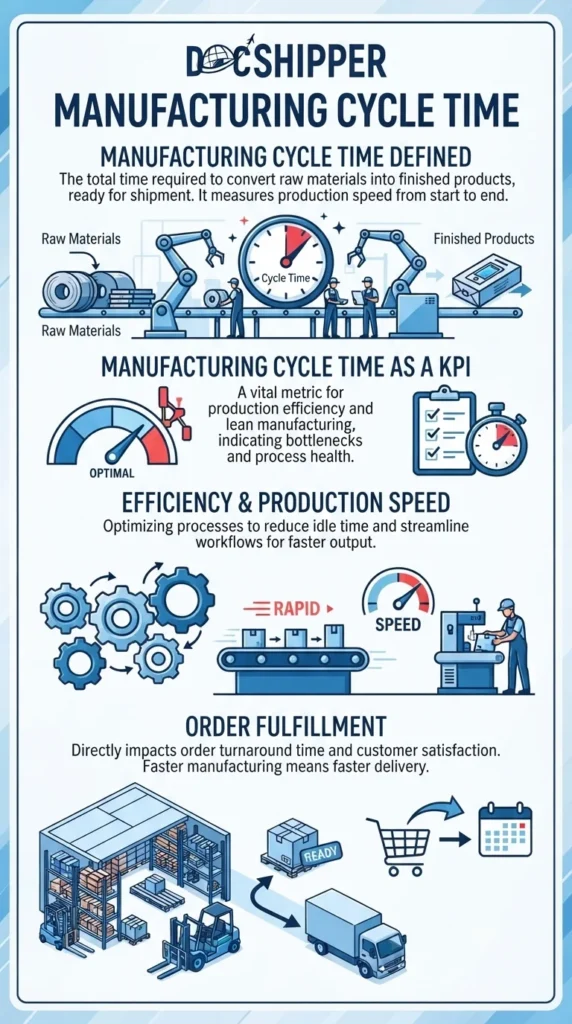
Manufacturing Cycle Time is the total duration required to transform raw materials into finished goods, from production initiation to completion. It encompasses processing time, inspection, material handling, and waiting periods. This metric directly impacts delivery schedules, inventory costs, and supply chain responsiveness in international trade operations.
Introduction
Many importers struggle with unexpected production delays that cascade into missed shipping windows, increased costs, and strained customer relationships. The root cause often lies in poorly understood or unmonitored manufacturing cycle time.
In global logistics, this metric determines whether your container departs on schedule or sits idle at port. For businesses managing international supply chains, understanding cycle time separates proactive planning from reactive crisis management.
Key characteristics of manufacturing cycle time include:
- Process Time: Actual production activities adding value to materials
- Inspection Time: Quality control checks and compliance verification
- Move Time: Material transfer between production stages
- Queue Time: Waiting periods before processing begins
- Storage Time: Inventory holding between operations or post-production
In-Depth Analysis & Expertise
Manufacturing cycle time comprises two distinct components: value-added time (activities directly transforming the product) and non-value-added time (necessary but non-transformative activities). Industry studies reveal that value-added time typically represents only 5-20% of total cycle time in traditional manufacturing environments.
The formula for calculating manufacturing cycle time follows this structure:
MCT = Process Time + Inspection Time + Move Time + Queue Time + Storage Time
From a logistics perspective, extended cycle times create three critical challenges. First, they reduce supply chain flexibility, making it difficult to respond to market fluctuations or order modifications. Second, longer cycles necessitate earlier order placement, increasing forecast uncertainty and potential obsolescence risk. Third, they inflate working capital requirements through higher inventory levels.
Regulatory considerations significantly impact cycle time in international trade. Products requiring certification (CE marking, FDA approval, country-specific compliance) add mandatory inspection and documentation periods. According to the World Trade Organization’s Technical Barriers to Trade Agreement, conformity assessment procedures must not create unnecessary obstacles, yet practical implementation adds 3-14 days to typical manufacturing cycles.
Lead time compression strategies focus on eliminating non-value-added time through lean manufacturing principles. Techniques include cellular manufacturing layouts, pull production systems, and batch size reduction. However, these require substantial process redesign and supplier coordination.
At DocShipper, we map manufacturing cycle times during supplier selection to identify potential bottlenecks before production begins. This proactive approach allows us to negotiate realistic delivery schedules and implement contingency plans for time-sensitive shipments.
The cycle time efficiency ratio (value-added time ÷ total cycle time × 100) serves as a benchmark for production optimization. World-class manufacturers achieve ratios above 25%, while average facilities operate between 5-10%. This disparity explains significant cost and responsiveness differences between suppliers quoting similar unit prices.
Concrete Examples & Data
Consider a European electronics importer sourcing USB cables from China. The manufacturing process breakdown reveals:
| Production Stage | Duration | Type |
|---|---|---|
| Cable extrusion & cutting | 18 hours | Value-added |
| Connector molding | 12 hours | Value-added |
| Assembly | 6 hours | Value-added |
| Electrical testing | 4 hours | Inspection |
| Queue between stages | 48 hours | Non-value-added |
| Packaging & labeling | 8 hours | Value-added |
| Final inspection | 6 hours | Inspection |
| Warehouse storage | 24 hours | Non-value-added |
| Total Cycle Time | 126 hours (5.25 days) | — |
In this scenario, only 38% of total cycle time represents actual production activities. The remaining 62% consists of waiting, moving, and storage—areas ripe for optimization.
Real-World Impact Scenario: A textile importer ordering 10,000 garments discovers their manufacturer’s cycle time is 21 days. With ocean freight requiring 28 days and customs clearance 3 days, the total lead time reaches 52 days. When a retail partner requests delivery in 45 days, the importer faces three options: air freight (adding $2,800), partial shipment via air (complexity), or declining the order (lost revenue).
Industry benchmarks vary significantly by sector:
- Electronics assembly: 3-7 days for standard components
- Textile manufacturing: 14-35 days depending on fabric sourcing
- Injection molding: 2-5 days for tooled products
- Metal fabrication: 7-21 days including finishing processes
- Custom machinery: 45-120 days with testing protocols
A furniture importer reduced manufacturing cycle time from 28 to 19 days by implementing three changes: negotiating dedicated production lines (eliminating 4 days of queue time), pre-positioning raw materials at the factory (saving 3 days), and conducting inspections during production rather than post-completion (saving 2 days). This 32% reduction enabled the company to switch from air to ocean freight on rush orders, saving $180,000 annually.
Conclusion
Manufacturing cycle time directly determines your competitive positioning in international trade. Shorter cycles enable responsive inventory strategies, reduce capital requirements, and create flexibility for customer demands. Understanding and actively managing this metric transforms supply chain performance from acceptable to exceptional.
Need assistance optimizing your manufacturing timeline or coordinating production schedules with shipping deadlines? Contact DocShipper for expert guidance on production monitoring and logistics integration.
📚 Quiz
Test Your Knowledge: Manufacturing Cycle Time
What does manufacturing cycle time measure in logistics operations?
According to the article, what percentage of total cycle time typically represents value-added activities in traditional manufacturing?
A textile importer discovers their manufacturer's cycle time is 21 days, ocean freight requires 28 days, and customs clearance takes 3 days. A retail partner requests delivery in 45 days. What is the correct assessment?
🎯 Your Results
📞 Free Quote in 24hFAQ | Manufacturing Cycle Time: Definition, Calculation & Concrete Examples
Manufacturing cycle time measures only the production phase from raw materials to finished goods. Lead time encompasses the entire process including order placement, material procurement, manufacturing cycle time, quality control, packaging, and delivery. Lead time = Procurement Time + Manufacturing Cycle Time + Delivery Time. For import operations, lead time typically exceeds cycle time by 15-40 days depending on sourcing complexity and transportation method.
Larger batch sizes increase total cycle time but reduce per-unit cycle time. A 10,000-unit batch might take 12 days (1.7 minutes per unit), while five 2,000-unit batches could take 18 days total (2.6 minutes per unit) due to repeated setup activities. However, smaller batches provide flexibility for modifications and reduce inventory holding periods. Optimal batch sizing balances setup efficiency against working capital requirements and delivery responsiveness.
Yes, cycle time fluctuates based on factory capacity utilization, material availability, workforce scheduling, and equipment maintenance cycles. The same product ordered in December (peak season) may take 40% longer than in March (low season). Experienced importers request cycle time commitments in writing and implement penalty clauses for delays exceeding agreed thresholds, typically allowing 10-15% variance for normal operational factors.
Cycle time itself doesn't directly impact HS code classification, but production methods documented during the manufacturing cycle affect country-of-origin determinations and preferential trade agreement eligibility. For example, Rules of Origin under FTAs often require substantial transformation, which must be evidenced through production records. Longer cycle times with multiple processing stages generally demonstrate greater value addition for origin qualification purposes.
Chinese New Year typically extends manufacturing cycle time by 20-35 days. Factories close 1-2 weeks before CNY for pre-holiday orders, shut down 7-15 days during the holiday, then require 10-15 days to reach full production capacity post-reopening due to workforce ramp-up. Orders placed 8 weeks before CNY should specify pre-holiday completion in contracts. Alternative strategies include shifting production to Southeast Asian suppliers or accepting extended timelines with appropriate inventory buffers.
Takt time represents the rate at which products must be completed to meet customer demand (available production time ÷ customer demand). Manufacturing cycle time measures how long one unit actually takes to produce. When cycle time exceeds takt time, production cannot meet demand without additional capacity. For example, if customer demand requires one unit every 45 minutes (takt time) but your cycle time is 60 minutes, you need multiple production lines or process improvements to satisfy demand.
Mid-production quality failures can extend cycle time by 30-200% depending on the rework or restart requirements. If defects appear during assembly, rework might add 2-3 days. If raw material quality issues surface after partial completion, restarting with new materials could triple the original cycle time. This risk underscores the importance of pre-production inspections and first-article approval processes that identify problems before full production begins.
Not necessarily. The shortest cycle time may indicate excess capacity (financial instability), rushed production (quality risks), or pre-made inventory (limited customization). Optimal supplier selection balances cycle time against quality consistency, pricing, communication responsiveness, and financial stability. A supplier offering 18-day cycle time with 99% quality rates often outperforms one promising 10 days but delivering 92% quality, considering rework costs and delays.
Cycle time uncertainty influences whether buyers should select EXW (assumes production monitoring responsibility) or DDP (shifts timeline management to supplier). With unpredictable cycle times, FOB or FCA terms provide visibility into when goods are ready for shipment without assuming responsibility for production delays. Buyers managing tight delivery schedules typically prefer FOB with third-party production monitoring to maintain control over the manufacturing-to-shipment handoff.
Modern supply chain visibility platforms integrate with factory ERP systems to provide real-time production status updates. Tools like factory webcams, digital inspection apps, and IoT sensors on production equipment transmit cycle time data automatically. However, implementation requires supplier cooperation and technical infrastructure. For suppliers without advanced systems, scheduled photo updates, daily production reports, and third-party inspection visits at key milestones provide adequate monitoring for most import operations.
Stricter environmental standards can extend cycle time by 15-30% through additional process steps like waste treatment, emission filtering, or chemical substitution requiring longer curing periods. China's environmental inspections periodically shut down non-compliant factories, adding unpredictable delays. Importers should verify suppliers maintain current environmental permits and implement contingency plans for potential regulatory-driven production stoppages, particularly in chemical, textile, and metal processing industries.
Yes, through process optimization rather than corner-cutting. Strategies include parallel processing (simultaneous rather than sequential operations), improved material flow layouts (reducing move time), automated inspection systems (faster than manual checks), and cellular manufacturing (dedicated workstations reducing queue time). These improvements require capital investment but sustainably reduce cycle time by 20-40% while maintaining or improving quality through reduced handling and streamlined workflows.
Need Help with
Logistics or Sourcing ?
First, we secure the right products from the right suppliers at the right price by managing the sourcing process from start to finish. Then, we simplify your shipping experience - from pickup to final delivery - ensuring any product, anywhere, is delivered at highly competitive prices.


Fill the Form
Prefer email? Send us your inquiry, and we’ll get back to you as soon as possible.
Contact us




