


In short ⚡
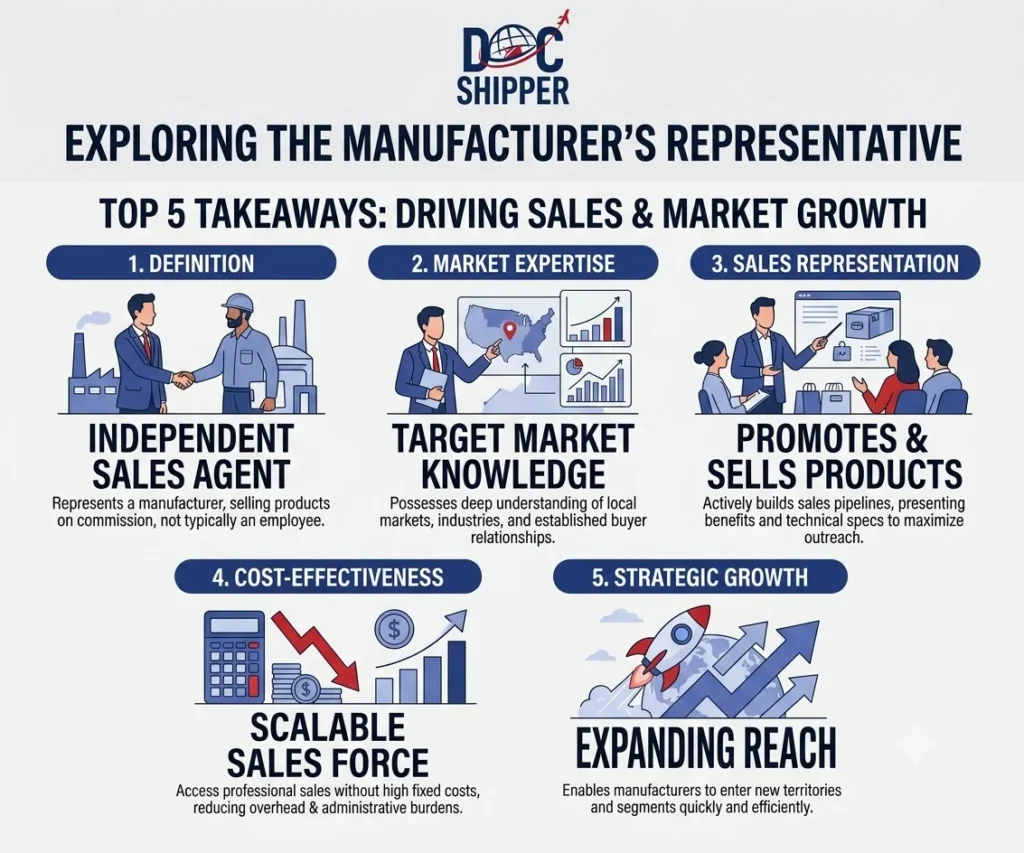
A Manufacturer's Representative is an independent sales agent who represents multiple manufacturers in a specific territory, acting as an intermediary between producers and buyers. Unlike direct employees, these professionals work on commission, promoting products to wholesalers, retailers, and distributors while providing local market expertise and customer relationship management.
Introduction
Many manufacturers struggle with a common dilemma: how to penetrate new markets without establishing expensive local sales offices. The confusion between direct sales forces, distributors, and manufacturer’s representatives often leads to inefficient market strategies and missed opportunities.
In international trade and logistics, manufacturer’s representatives play a critical role by bridging geographical and cultural gaps between producers and end markets. They provide manufacturers with immediate market access while maintaining flexibility and cost-effectiveness.
Key characteristics of manufacturer’s representatives include:
- Independent contractor status: Not employees, working on commission-based compensation
- Multi-line representation: Typically represent 5-15 non-competing manufacturers simultaneously
- Territory exclusivity: Granted specific geographical areas with exclusive selling rights
- Market intelligence: Provide real-time feedback on customer needs, competitive landscape, and pricing
- Customer relationship ownership: Build and maintain long-term relationships with buyers in their territory
Role & Expertise in Supply Chain
Manufacturer’s representatives operate under contractual agreements that define commission rates (typically 5-15% depending on industry), territory boundaries, product lines, and performance expectations. These agreements differ fundamentally from employment contracts, as representatives maintain independence while providing dedicated market coverage.
The legal framework governing these relationships varies by jurisdiction. In the United States, representatives are classified as independent contractors under IRS regulations, while the European Union’s Commercial Agents Directive provides specific protections including compensation upon contract termination. Understanding these distinctions is crucial for manufacturers entering international markets.
Representatives provide market penetration services that extend beyond simple order-taking. They conduct product demonstrations, provide technical support, manage customer inquiries, and often handle preliminary negotiations. This full-service approach enables manufacturers to maintain market presence without fixed overhead costs.
The commission structure creates natural alignment between manufacturer and representative interests. Unlike salaried employees, representatives earn only when sales occur, incentivizing aggressive market development. However, this also requires careful contract design to ensure long-term relationship stability and prevent conflicts over customer ownership.
In logistics operations, representatives coordinate with distribution networks to ensure product availability and timely delivery. According to U.S. Department of Commerce guidelines, successful international market entry through representatives requires clear communication channels between manufacturing facilities, logistics providers, and local market agents.
At DocShipper, we frequently coordinate with manufacturer’s representatives to ensure seamless customs clearance and delivery when our clients use these intermediaries for market access. Our experience shows that well-briefed representatives significantly reduce documentation errors and shipping delays.
Practical Examples & Industry Data
The effectiveness of manufacturer’s representatives varies significantly by industry and market conditions. Research indicates that 47% of manufacturers in industrial equipment sectors rely on independent representatives for at least a portion of their sales coverage, compared to only 12% in fast-moving consumer goods categories.
Industry Comparison Table
| Industry Sector | Typical Commission Rate | Average Lines Represented | Primary Advantage |
|---|---|---|---|
| Industrial Equipment | 8-12% | 6-10 manufacturers | Technical expertise & long sales cycles |
| Electronics Components | 5-8% | 10-15 manufacturers | Rapid market coverage & product diversity |
| Building Materials | 6-10% | 5-8 manufacturers | Established contractor relationships |
| Medical Devices | 10-15% | 3-6 manufacturers | Regulatory knowledge & compliance expertise |
Use Case: European Market Entry
A U.S.-based industrial pump manufacturer sought to enter the German market without establishing a local subsidiary. The company engaged a manufacturer’s representative with existing relationships among German engineering firms and water treatment facilities.
Key metrics from this implementation:
- Initial investment: $15,000 for product samples and training materials versus $250,000+ for a direct sales office
- Time to first sale: 90 days compared to estimated 6-9 months with direct approach
- Market coverage: Representative’s existing relationships provided immediate access to 40+ qualified prospects
- Commission structure: 10% on net sales with quarterly performance reviews
- Year-one results: €780,000 in sales with effective commission cost of €78,000 versus projected fixed costs of €350,000 for direct presence
This example demonstrates how manufacturer’s representatives provide cost-effective market entry with reduced financial risk, particularly valuable when testing new geographical markets or product categories.
Conclusion
Manufacturer’s representatives serve as a flexible, cost-effective market access solution that enables manufacturers to expand geographical reach while maintaining lean operational structures. Their commission-based model aligns interests while providing immediate market expertise and established customer relationships.
Need assistance coordinating international shipments with manufacturer’s representatives? Contact DocShipper for expert guidance on logistics coordination and documentation management.
📚 Quiz
Test Your Knowledge: Manufacturer's Representative
What is the primary employment status of a manufacturer's representative?
How does a manufacturer's representative differ from a distributor in terms of inventory management?
A U.S. electronics manufacturer wants immediate market access in Germany with minimal upfront investment. Which approach aligns best with manufacturer's representative advantages?
🎯 Your Result
📞 Free Quote in 24hFAQ | Manufacturer's Representative: Definition, Role & Practical Examples
A manufacturer's representative acts as a sales agent without taking ownership of inventory, earning commission on orders that ship directly from the manufacturer. Distributors purchase products outright, maintain inventory, and resell at markup. Representatives provide market coverage without inventory investment, while distributors assume financial risk and inventory management responsibilities. The choice depends on product characteristics, market conditions, and control preferences.
Representatives typically work on straight commission, ranging from 5-15% of net sales depending on industry, product complexity, and sales cycle length. Some arrangements include tiered structures rewarding higher volumes, or small monthly retainers against future commissions. Commission is usually paid after manufacturer receives payment from the customer, and contracts specify calculation methods, payment timing, and handling of returns or credits.
While representatives primarily focus on sales and customer relationships, many provide assistance with commercial documentation such as proforma invoices and sales contracts. However, customs documentation, shipping arrangements, and compliance requirements typically remain the manufacturer's or freight forwarder's responsibility. Clear contractual definition of documentation responsibilities prevents confusion and ensures regulatory compliance in international transactions.
Industrial equipment, electronics components, building materials, and specialty chemicals sectors extensively use representative networks. These industries benefit from the representative model due to technical complexity, long sales cycles, and relationship-driven purchasing patterns. Consumer packaged goods rarely use representatives due to distribution requirements and volume-driven economics. B2B markets with consultative selling processes gain maximum benefit from representative expertise and customer relationships.
Initial agreements usually span one to three years, with renewal options based on performance metrics such as sales volume, market penetration, and customer acquisition. Termination clauses specify notice periods (typically 30-90 days) and address commission payment on pending orders, customer transition procedures, and confidentiality obligations. European Union regulations mandate specific protections for commercial agents, including potential compensation upon termination.
Territory size varies dramatically based on customer density, product complexity, and market characteristics. Urban industrial regions might divide into city-sized territories, while rural areas may encompass multiple states or countries. Contracts specify boundaries using postal codes, state/provincial lines, or customer lists. Exclusive territory rights prevent manufacturer competition within defined areas, encouraging representatives to invest in market development and customer relationships.
Service responsibilities vary by agreement and industry. Some representatives offer installation support, basic troubleshooting, and customer training, particularly in technical product categories. However, warranty service and complex technical support typically remain manufacturer responsibilities. Contracts should clearly define service expectations, compensation for service activities, and coordination protocols between representatives, manufacturers, and customers to ensure seamless support.
Performance metrics typically include sales volume, new customer acquisition, market share growth, customer satisfaction scores, and competitive intelligence quality. Quarterly business reviews assess progress against targets, discuss market conditions, and adjust strategies. Effective manufacturers provide representatives with sales data, inventory availability, and lead time information, enabling accurate customer commitments and realistic expectation management.
Yes, manufacturers frequently engage multiple representatives covering different geographical territories or market segments within a single country. This approach maximizes market coverage while maintaining manageable territory sizes. However, clear boundary definition and conflict resolution procedures are essential. House account policies must address direct manufacturer sales to national accounts, preventing commission disputes and representative frustration.
Termination clauses address customer transition, typically requiring the departing representative to cooperate with customer handover to a replacement representative or direct manufacturer sales team. Commission agreements may include tail provisions, paying reduced commission rates on orders from existing customers for a specified period post-termination. European commercial agent regulations require compensation for customer relationships developed during the agency period.
Representatives typically receive published price lists and authorized discount ranges based on order size, customer type, or competitive situations. Some agreements allow representatives to negotiate within approved parameters, while others require manufacturer approval for any deviation from standard pricing. Clear pricing authority definitions prevent customer confusion, protect margins, and ensure consistent market positioning across territories.
Standard representative agreements establish that the manufacturer bears credit risk and collection responsibility. Representatives introduce customers and facilitate sales but don't guarantee payment. However, some contracts include provisions requiring representatives to provide customer creditworthiness information and notify manufacturers of concerning payment patterns. Del credere agreements, where representatives guarantee payment for additional commission, exist but are relatively uncommon in modern practice.
Need Help with
Logistics or Sourcing ?
First, we secure the right products from the right suppliers at the right price by managing the sourcing process from start to finish. Then, we simplify your shipping experience - from pickup to final delivery - ensuring any product, anywhere, is delivered at highly competitive prices.


Fill the Form
Prefer email? Send us your inquiry, and we’ll get back to you as soon as possible.
Contact us




