


In short ⚡
Distribution Planning is the strategic process of organizing and optimizing the movement of goods from production facilities to end customers. It encompasses inventory allocation, transportation scheduling, warehouse management, and delivery route optimization to ensure products reach their destination efficiently while minimizing costs and maximizing service levels.Introduction
Many businesses struggle with the critical question: how do we get products to customers on time without overspending on logistics? Poor distribution planning leads to stockouts, excessive inventory costs, and dissatisfied customers. In international trade, where margins are tight and supply chains complex, this challenge becomes even more pronounced.
Distribution planning serves as the backbone of supply chain efficiency. It bridges the gap between production and consumption, ensuring that the right products arrive at the right place, at the right time, in the right quantity. For importers and exporters, mastering this process means competitive advantage through reduced lead times and improved cash flow.
Key characteristics of effective distribution planning include:
- Demand forecasting accuracy to anticipate customer needs
- Network optimization across warehouses, distribution centers, and transportation modes
- Inventory balancing to prevent both stockouts and overstock situations
- Cost-service trade-off management aligning budget constraints with customer expectations
- Real-time visibility enabling proactive decision-making and issue resolution
Fundamentals & Strategic Expertise
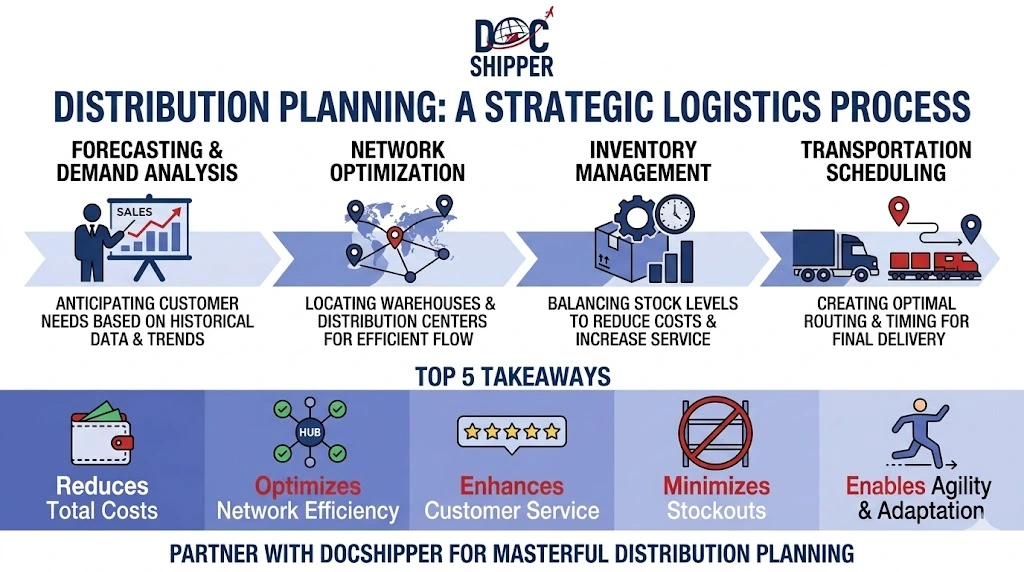
Distribution planning operates on multiple interconnected levels. At its core lies demand planning, which uses historical data, market trends, and seasonal patterns to predict future requirements. This forecast drives all subsequent decisions about inventory positioning and transportation capacity.
The second critical component is network design. Companies must determine the optimal number and location of distribution centers, considering factors like customer proximity, transportation costs, and labor availability. A well-designed network reduces transit times while maintaining cost efficiency. According to Eurostat, strategic warehouse placement can reduce distribution costs by 15-25% in European markets.
Inventory allocation represents the tactical execution of distribution planning. This involves deciding how much stock each location should hold based on local demand patterns, lead times from suppliers, and safety stock requirements. Advanced systems use algorithms to balance inventory across the network dynamically.
Transportation planning forms the fourth pillar. This includes mode selection (air, ocean, road, rail), carrier negotiation, and route optimization. International shipments add complexity through customs clearance, documentation requirements, and Incoterms considerations. At DocShipper, we integrate distribution planning with customs compliance to ensure seamless cross-border movements without unexpected delays.
Finally, performance measurement closes the loop. Key metrics include order fill rate, on-time delivery percentage, inventory turnover, and distribution cost as a percentage of sales. Continuous monitoring allows for rapid adjustments when market conditions change or disruptions occur.
Practical Examples & Data-Driven Insights
Consider a European electronics importer receiving components from Asia. Their distribution planning challenge involves balancing air freight speed against ocean freight economy while maintaining 98% product availability.
| Scenario | Transit Time | Cost per Unit | Inventory Days | Total Cost Index |
|---|---|---|---|---|
| 100% Air Freight | 5 days | $8.50 | 15 days | 142 |
| 100% Ocean Freight | 35 days | $1.20 | 45 days | 118 |
| Hybrid Model (70/30) | 12 days avg | $3.45 | 22 days | 100 |
The hybrid model demonstrates optimal distribution planning. By shipping 70% via ocean and 30% via air for fast-moving items, the company achieves the lowest total landed cost while maintaining service levels. This approach requires sophisticated demand forecasting to identify which products warrant premium transport.
Use Case: Seasonal Demand Planning
A fashion retailer importing from Bangladesh faces extreme seasonality. Their distribution planning incorporates:
- Pre-positioning inventory 8 weeks before peak season in regional hubs
- Dynamic allocation shifting stock between locations based on real-time sales data
- Expedited replenishment using air freight for bestsellers during peak periods
- Clearance distribution consolidating slow-movers in fewer locations post-season
- Reverse logistics planning for returns, integrated into the initial distribution strategy
This multi-layered approach reduced stockouts by 34% while cutting overall distribution costs by 18% compared to their previous reactive model. At DocShipper, we help clients implement similar data-driven distribution strategies, combining our logistics expertise with advanced planning tools to optimize every shipment.
Conclusion
Distribution planning transforms logistics from a cost center into a strategic competitive advantage. By integrating demand forecasting, network optimization, and transportation management, businesses achieve superior service levels while controlling expenses. The complexity of international trade demands expert guidance to navigate customs, documentation, and multi-modal transportation challenges.
Need assistance optimizing your distribution planning strategy? Contact DocShipper to discuss how we can streamline your global supply chain operations.
📚 Quizz
Test Your Knowledge: Distribution Planning
Q1 — What does Distribution Planning primarily focus on?
Q2 — A company ships 100% of its goods by air freight to reduce transit time. According to distribution planning best practices, is this the most cost-efficient strategy?
Q3 — A fashion retailer importing from Bangladesh wants to reduce stockouts during peak season. Which distribution planning action best addresses this challenge?
🎯 Your Result
📞 Free Quote in 24hFAQ | Distribution Planning: Definition, Process & Practical Examples
Distribution planning focuses specifically on moving finished goods from production to customers, while logistics planning encompasses the broader supply chain including raw material procurement, production scheduling, and reverse logistics. Distribution is a subset of overall logistics strategy.
Strategic distribution planning (network design, major capacity decisions) operates on 1-3 year horizons. Tactical planning (inventory positioning, transportation contracts) works 3-12 months ahead. Operational planning (daily routing, order fulfillment) happens in real-time to weekly cycles.
Enterprise Resource Planning (ERP) systems like SAP and Oracle provide foundational capabilities. Specialized tools include Manhattan Associates, Blue Yonder, and Kinaxis for advanced optimization. Transportation Management Systems (TMS) handle routing and carrier selection. Many companies use combinations tailored to their complexity.
Effective distribution planning directly drives on-time delivery rates, product availability, and order accuracy—the three primary drivers of customer satisfaction in B2B and B2C contexts. Poor planning leads to stockouts, delayed shipments, and increased costs that ultimately affect pricing competitiveness.
Demand forecasting is the foundation of distribution planning. Accurate forecasts determine inventory levels, warehouse capacity requirements, transportation needs, and staffing. Forecast errors cascade through the system, causing either excess inventory costs or lost sales from stockouts.
This balance requires defining service level agreements (SLAs) for different customer segments and product categories. Premium customers or high-margin products may justify expedited shipping, while standard items use economical modes. Advanced planning systems optimize this trade-off mathematically using cost-to-serve models.
International distribution adds complexity through customs clearance delays, documentation requirements, longer transit times, currency fluctuations, and regulatory compliance across jurisdictions. Incoterms selection, tariff classification, and origin verification become critical planning factors that domestic distribution doesn't face.
Strategic network designs review annually or when major market changes occur. Tactical inventory allocation and transportation plans update monthly or quarterly. Operational routing and scheduling happen daily or in real-time. Disruption events (strikes, weather, geopolitical issues) trigger immediate replanning.
Key performance indicators include perfect order rate (delivered complete, on-time, undamaged), inventory turnover ratio, distribution cost as percentage of sales, order cycle time, warehouse capacity utilization, and transportation cost per unit. Leading companies benchmark these metrics against industry standards.
E-commerce demands faster delivery, smaller order sizes, and direct-to-consumer capabilities. This shifts distribution from bulk shipments to regional distribution centers toward micro-fulfillment centers closer to urban populations. Returns management becomes integral to planning, not an afterthought.
Absolutely. Even basic distribution planning—forecasting demand, choosing optimal shipping methods, and maintaining appropriate inventory levels—improves cash flow and customer satisfaction. Scalable cloud-based tools now make sophisticated planning accessible to businesses of all sizes without major capital investment.
Modern distribution planning increasingly incorporates environmental objectives. Route optimization reduces fuel consumption and emissions. Network consolidation decreases total vehicle miles. Mode shifting from air to ocean or truck to rail lowers carbon footprint. Many companies now measure carbon cost alongside financial cost in planning decisions.
Need Help with
Logistics or Sourcing ?
First, we secure the right products from the right suppliers at the right price by managing the sourcing process from start to finish. Then, we simplify your shipping experience - from pickup to final delivery - ensuring any product, anywhere, is delivered at highly competitive prices.


Fill the Form
Prefer email? Send us your inquiry, and we’ll get back to you as soon as possible.
Contact us




