


In short ⚡
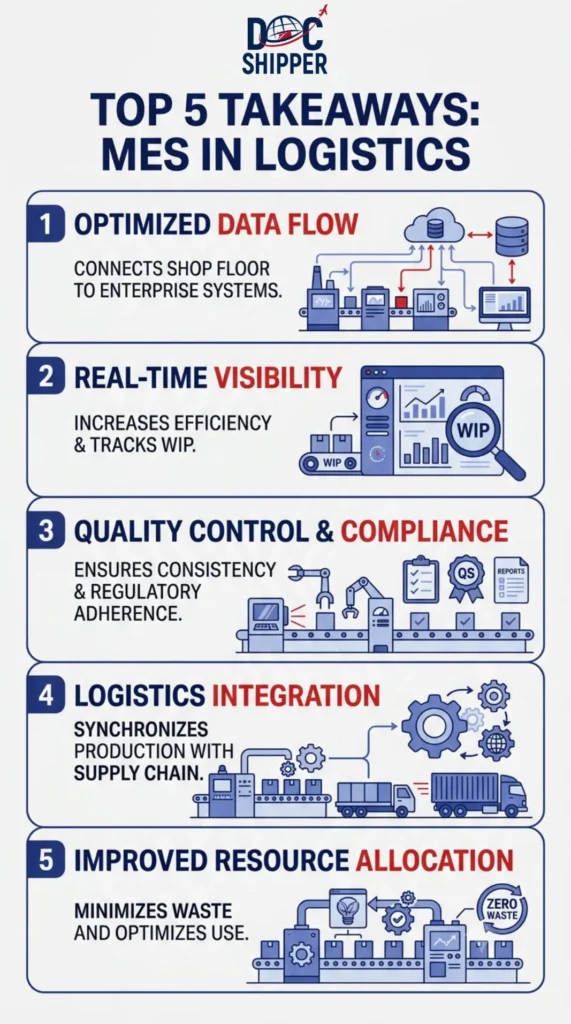
Manufacturing Execution Systems (MES) are specialized software platforms that monitor, track, and control manufacturing operations from raw material input to finished goods. They bridge the gap between enterprise resource planning (ERP) systems and shop floor equipment, providing real-time visibility into production processes, quality metrics, and operational efficiency across global supply chains.
Introduction
Global manufacturers face a persistent challenge: production data remains trapped in silos, disconnected from planning systems. This creates blind spots in quality control, inventory accuracy, and shipment readiness—critical issues for companies managing international logistics.
Manufacturing Execution Systems emerged as the operational backbone connecting strategic planning with execution reality. In import/export contexts, MES ensures product traceability, compliance documentation, and on-time delivery performance that customs authorities and freight forwarders require.
Key characteristics of modern MES platforms include:
- Real-time production tracking with batch/lot traceability for export documentation
- Quality management integration capturing inspection results and certificates of analysis
- Work order synchronization linking production schedules to shipping deadlines
- Equipment performance monitoring preventing delays that disrupt container booking
- Material genealogy supporting origin declarations and trade compliance requirements
MES Architecture & Strategic Implementation
Manufacturing Execution Systems operate in the Level 3 automation layer of the ISA-95 industrial hierarchy, positioned between supervisory control systems (Level 2) and enterprise business systems (Level 4). This architectural placement enables MES to aggregate machine-level data while feeding operational metrics to ERP platforms.
The functional scope encompasses eleven core activities defined by ISA-95 standards: resource allocation, dispatching production units, data collection/acquisition, quality management, process management, maintenance operations, performance analysis, operations scheduling, product tracking, document control, and labor management. For logistics operations, the product tracking and document control modules prove particularly critical.
Export-oriented manufacturers leverage MES to generate the commercial invoices, packing lists, and certificates of origin required for customs clearance. The system captures production lot numbers, processing dates, and quality test results that become legally binding export documentation. According to U.S. Customs and Border Protection, inaccurate product data accounts for 38% of shipment delays at entry points.
Implementation architecture typically follows three deployment models. On-premise installations suit manufacturers with stringent data sovereignty requirements or legacy equipment integration needs. Cloud-based MES platforms offer scalability for multi-site operations spanning different countries, with built-in compliance templates for various regulatory regimes. Hybrid configurations maintain sensitive production data locally while syncing logistics-relevant information to cloud modules accessible by freight forwarders and customs brokers.
At DocShipper, we coordinate with clients’ MES systems to extract electronic packing lists and batch certificates directly during shipment booking. This automated data exchange eliminates manual documentation errors that trigger customs holds, reducing clearance time by an average of 2.3 days on Asia-Europe routes.
Operational Benefits & Industry Data
Manufacturing sectors with complex logistics requirements demonstrate quantifiable improvements following MES implementation. Pharmaceutical manufacturers report 47% reduction in batch release cycles, directly accelerating time-sensitive cold chain exports where certificate of analysis delays cause product deterioration.
The automotive industry provides compelling evidence of MES impact on international operations. A 2023 study tracking 127 tier-1 suppliers across Germany, Mexico, and China found that integrated MES reduced export documentation preparation time by 61% compared to manual processes. These suppliers achieved same-day certificate issuance for 89% of shipments versus 34% baseline performance.
| Manufacturing Sector | Pre-MES Export Documentation Time | Post-MES Documentation Time | Compliance Error Reduction |
|---|---|---|---|
| Food & Beverage | 4.2 hours/shipment | 52 minutes/shipment | 79% |
| Electronics | 3.1 hours/shipment | 38 minutes/shipment | 83% |
| Pharmaceuticals | 6.7 hours/shipment | 1.4 hours/shipment | 91% |
| Aerospace Components | 8.3 hours/shipment | 2.1 hours/shipment | 87% |
Case Study: Electronics Manufacturer (Vietnam to EU)
A consumer electronics producer exporting 240 containers monthly to Rotterdam faced recurring delays due to discrepancies between production records and shipping documents. Their legacy ERP system lacked real-time production data, causing manual reconciliation that averaged 11 errors per 20-foot container.
Following cloud-based MES deployment integrated with their warehouse management system, the manufacturer achieved:
- Automated data synchronization eliminating 94% of documentation errors within six weeks
- Electronic product identification enabling customs pre-clearance in Rotterdam before vessel arrival
- Reduced dwell time from 4.8 days to 1.2 days at container terminals
- Lower demurrage costs saving $127,000 quarterly through faster container release
The system’s API connectivity with their freight forwarder’s platform transmitted verified packing lists and harmonized system codes directly to customs filing systems, creating an unbroken digital thread from factory floor to destination warehouse.
Conclusion
Manufacturing Execution Systems transform production data into actionable logistics intelligence, eliminating the documentation bottlenecks that plague international shipments. For manufacturers competing in time-sensitive global markets, MES integration represents essential infrastructure rather than optional technology.
Need expertise configuring MES-logistics workflows for your supply chain? Contact DocShipper to discuss integrated solutions that connect your production systems with freight execution.
📚 Quiz
Test Your Knowledge: Manufacturing Execution Systems
What is the primary function of Manufacturing Execution Systems in global supply chains?
According to the ISA-95 industrial hierarchy, where does MES operate?
A pharmaceutical exporter needs to accelerate batch release cycles for time-sensitive cold chain shipments. Based on industry data, what outcome can MES implementation deliver?
🎯 Your Result
📞 Free Quote in 24hFAQ | Manufacturing Execution Systems (MES): Definition, Implementation & Real-World Examples
ERP systems handle enterprise-level planning, financials, and order management, while MES focuses exclusively on shop floor execution and real-time production control. MES captures second-by-second machine data, quality measurements, and work-in-progress status that ERP platforms cannot process at the required speed. The two systems complement each other through bidirectional data exchange—ERP sends production orders downward, MES reports actual performance upward.
MES maintains complete production genealogy including raw material origins, processing parameters, and quality test results. This data automatically populates certificates of origin, phytosanitary documents, and safety data sheets required by importing countries. The system creates immutable audit trails proving product specifications match declared values on commercial invoices, reducing the risk of customs penalties for misdeclared goods.
Modern cloud-based MES platforms offer RESTful APIs that connect with transportation management systems used by freight forwarders. This integration enables automatic transmission of shipment-ready notifications, packing dimensions, hazardous material classifications, and product HS codes directly to booking platforms. Real-time production completion data allows forwarders to optimize container loading schedules and vessel space allocation.
Deployment duration varies by facility complexity and integration requirements. Single-site implementations with standard equipment typically complete in 4-6 months, including equipment connectivity, process mapping, and user training. Multi-site rollouts across different countries require 9-14 months due to localization needs, regulatory compliance variations, and standardization of production procedures. Cloud-based solutions reduce deployment time by approximately 35% compared to on-premise installations.
No. MES functions as a software layer collecting data from existing machinery through various connectivity methods. Modern MES platforms support OPC-UA industrial protocols, legacy serial connections, manual data entry terminals, and barcode scanning devices. Equipment without digital interfaces can connect through retrofit sensor kits or operator input stations. The system aggregates data regardless of equipment age or manufacturer.
MES creates bidirectional traceability linking finished goods to specific raw material batches and production runs. If a supplier issues a recall notice for defective components, the system instantly identifies all affected products, their current locations, and customers who received them. For exporters, this capability accelerates recall execution across multiple countries while generating the documentation customs authorities require to intercept shipments in transit.
Cloud-based MES creates potential exposure of proprietary production processes, formulations, and efficiency metrics. Mitigation strategies include data encryption at rest and in transit, role-based access controls limiting external visibility, and hybrid architectures keeping sensitive process parameters on-premises while sharing only logistics-relevant data externally. ISO 27001 certification and SOC 2 compliance audits provide third-party validation of security controls.
Modular cloud-based MES platforms now offer subscription pricing starting at $800-1,200 monthly for facilities with fewer than 50 employees. These entry-level systems focus on core functions like production tracking, quality management, and document generation that directly impact export operations. ROI typically manifests within 8-12 months through reduced documentation labor, fewer customs delays, and improved on-time delivery performance that protects customer relationships.
Enterprise MES platforms include localization frameworks supporting operator interfaces, reports, and system-generated documents in 40+ languages. User roles automatically display content in configured languages while maintaining a single underlying data model. For export documentation, the system generates certificates and packing lists in the destination country's official language while preserving English versions for customs brokers, ensuring compliance with both origin and destination regulatory requirements.
Cloud-based MES reduces maintenance burden significantly—vendors handle software updates, security patches, and infrastructure scaling automatically. Internal maintenance focuses on user permission management, production workflow adjustments, and integration maintenance with connected systems. Most manufacturers allocate 0.5-1.0 FTE for MES administration per production site. On-premise installations require additional IT resources for server maintenance, backup management, and disaster recovery testing.
MES captures energy consumption, water usage, and waste generation at the production order level, enabling product-specific carbon footprint calculations. European markets increasingly require environmental product declarations for imported goods—MES data feeds these calculations automatically. The system tracks renewable energy percentages, recycled material content, and emissions per unit, generating the sustainability certificates that retailers and regulators in environmentally conscious markets now demand.
Advanced MES platforms include finite capacity scheduling modules that consider shipping deadlines and container cubic constraints. The system sequences production orders to maximize container utilization, grouping products destined for the same port within compatible temperature zones. This optimization reduces partial container shipments, lowers per-unit freight costs, and improves working capital efficiency by aligning production completion with vessel departure schedules rather than arbitrary batch sizes.
Need Help with
Logistics or Sourcing ?
First, we secure the right products from the right suppliers at the right price by managing the sourcing process from start to finish. Then, we simplify your shipping experience - from pickup to final delivery - ensuring any product, anywhere, is delivered at highly competitive prices.


Fill the Form
Prefer email? Send us your inquiry, and we’ll get back to you as soon as possible.
Contact us




:%20Definition,%20Implementation%20&%20Real-World%20Examples)