


In short ⚡
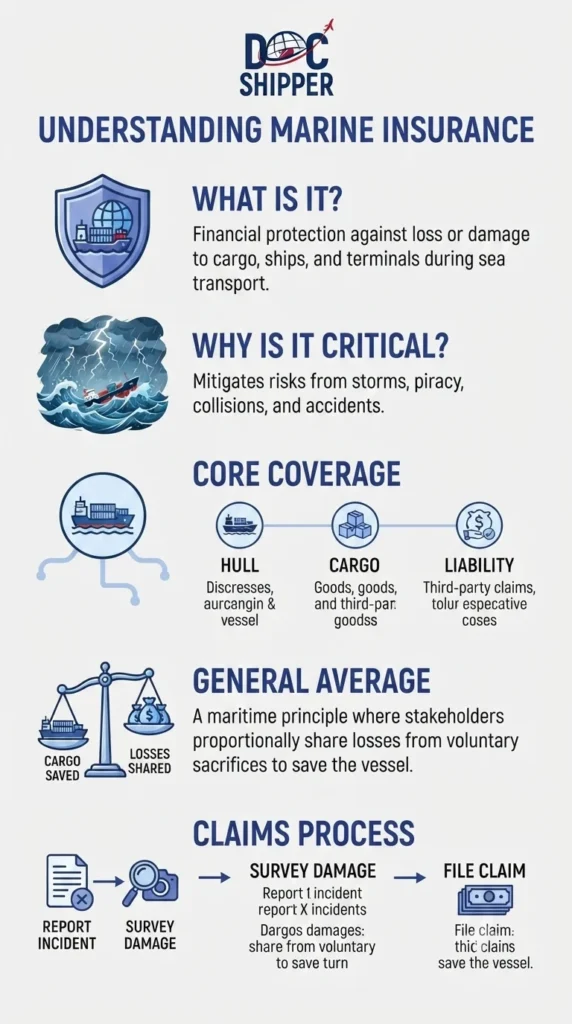
Marine insurance is a specialized contract covering loss or damage to ships, cargo, terminals, and any transport by which goods are transferred between origin and destination. This type of insurance protects international trade participants against physical loss or damage from external causes during shipment.
Introduction
Many importers and exporters underestimate the financial risk exposure during international transit. A single container lost at sea or damaged goods arriving at destination can lead to devastating financial losses. Marine insurance bridges this critical vulnerability in the global supply chain.
In the complex landscape of international trade, marine insurance serves as the safety net protecting goods valued at trillions of dollars annually. Whether shipping by sea, air, rail, or road, this coverage ensures business continuity when unforeseen events occur.
Key characteristics of marine insurance include:
- Cargo coverage – Protection for goods in transit against physical loss or damage
- Hull insurance – Coverage for vessels, including ships, boats, and other watercraft
- Freight insurance – Protection for transportation costs when cargo is lost or damaged
- Liability coverage – Protection against third-party claims arising from shipping operations
- Multi-modal protection – Coverage extending beyond maritime transport to include air and land segments
In-Depth Analysis & Expertise
Marine insurance operates under distinct coverage clauses established by the International Chamber of Commerce (ICC). The three primary levels—Institute Cargo Clauses (A), (B), and (C)—determine the scope of protection. Clause A provides all-risk coverage, while B and C offer progressively limited protection against named perils only.
The insurable interest principle forms the foundation of marine insurance contracts. This legal requirement stipulates that the policyholder must have a financial stake in the cargo’s safe arrival. Without insurable interest, the contract becomes void. This principle prevents speculation and ensures insurance serves its legitimate protective function.
Understanding Incoterms relationships is crucial when determining insurance obligations. Under CIF (Cost, Insurance, Freight) terms, the seller must arrange minimum coverage. However, under FOB (Free On Board), the buyer bears responsibility for insurance from the port of shipment. At DocShipper, we systematically verify insurance adequacy according to the agreed Incoterms to prevent coverage gaps.
The doctrine of utmost good faith (uberrima fides) imposes strict disclosure requirements on both insurers and insured parties. Material facts affecting risk assessment must be disclosed before contract formation. Failure to disclose can void the entire policy, leaving cargo unprotected. This includes information about cargo nature, packing methods, route hazards, and previous losses.
General average declarations represent a unique maritime principle where all parties in a sea venture proportionally share losses resulting from voluntary sacrifice of cargo to save the voyage. Marine insurance policies typically cover the insured’s contribution to general average, protecting against unexpected financial obligations. According to International Chamber of Shipping standards, these declarations follow the York-Antwerp Rules governing loss apportionment.
Practical Examples & Data
The global marine insurance market generates approximately $28.6 billion in annual premiums, reflecting the massive value of goods transported internationally. Understanding real-world applications helps businesses select appropriate coverage levels and manage risk effectively.
Comparative Coverage Analysis
| Coverage Type | Institute Clause | Protection Level | Premium Rate |
|---|---|---|---|
| All-Risk Coverage | Clause (A) | Comprehensive – covers all losses except exclusions | 0.3% – 0.6% of value |
| Named Perils (Extended) | Clause (B) | Fire, explosion, vessel collision, general average | 0.2% – 0.4% of value |
| Named Perils (Basic) | Clause (C) | Major casualties only (sinking, stranding, fire) | 0.1% – 0.25% of value |
Practical Case Study: Electronics Shipment
Consider an importer shipping $500,000 worth of consumer electronics from Shanghai to Rotterdam. The journey involves ocean freight, port handling, and inland transport to a warehouse in Germany.
Scenario parameters:
- Cargo value: $500,000 (invoice value + 10% for profit margin = $550,000 insured value)
- Route: Shanghai → Rotterdam → Hamburg (warehouse)
- Coverage selected: Institute Cargo Clause (A) – all-risk
- Premium rate: 0.4% of insured value
- Total premium cost: $2,200
During transit, severe weather causes container shift, damaging 30% of the cargo ($165,000). Under Clause (A) coverage, the insurer compensates the full amount after deducting the policy excess ($500). The importer recovers $164,500, avoiding catastrophic loss. This demonstrates how a $2,200 investment protects against $165,000 exposure.
Industry Statistics & Trends
According to the International Union of Marine Insurance, cargo claims represent 65% of marine insurance losses, with theft, damage, and non-delivery being primary causes. The average cargo claim settles at approximately $50,000, though high-value shipments can generate claims exceeding several million dollars.
Key risk factors affecting premiums include:
- Cargo nature: High-value electronics carry 2-3x higher rates than bulk commodities
- Route hazards: Piracy zones (Gulf of Aden) increase premiums by 0.1-0.3%
- Packaging quality: Inadequate packaging can void claims or increase rates by 20-40%
- Claims history: Clean records qualify for 10-15% premium discounts
- Seasonal factors: Hurricane season and monsoons can temporarily elevate rates
Conclusion
Marine insurance represents an essential risk management tool for international trade, protecting businesses against the inherent uncertainties of global transportation. Selecting appropriate coverage levels aligned with cargo value and route risks ensures business continuity when unforeseen events occur.
Need expert guidance on marine insurance requirements for your shipments? Contact DocShipper for comprehensive support in securing optimal cargo protection.
📚 Quiz
Test Your Knowledge: Marine Insurance
What is the primary scope of marine insurance coverage?
Which Institute Cargo Clause provides the most comprehensive protection?
A company ships $200,000 worth of electronics from Shanghai to Hamburg. Container damage during severe weather destroys 25% of cargo ($50,000). They have Clause (A) coverage with a $300 excess. How much will they recover?
🎯 Your Result
📞 Free Quote in 24hFAQ | Marine Insurance: Definition, Coverage & Practical Examples
Marine insurance is the broader category covering ships, cargo, terminals, and transport liability. Cargo insurance specifically protects goods in transit. Marine insurance includes hull insurance (vessel coverage), freight insurance, and liability coverage, whereas cargo insurance focuses exclusively on protecting merchandise from origin to destination. Most importers and exporters specifically need cargo insurance as a subset of marine insurance.
Marine insurance is not universally mandatory by law, but it becomes contractually required under certain Incoterms. Under CIF and CIP terms, the seller must provide minimum insurance coverage. Additionally, many banks require marine insurance as a condition for issuing letters of credit. Even when not legally required, insurance remains financially prudent given the high-value risks involved in international shipping.
Marine insurance premiums range from 0.1% to 0.6% of the insured cargo value, depending on coverage type, cargo nature, route, and claims history. All-risk coverage (Clause A) typically costs 0.3-0.6%, while basic named perils coverage (Clause C) costs 0.1-0.25%. High-risk routes, valuable cargo, or inadequate packaging increase premiums. For a $100,000 shipment, expect to pay between $100 and $600 for comprehensive coverage.
Institute Cargo Clause A provides all-risk coverage, protecting against all causes of loss or damage except specifically excluded perils. Exclusions include willful misconduct, ordinary leakage, inherent vice, delay, insolvency of carriers, and war (unless additional war risk coverage is purchased). This represents the most comprehensive cargo protection available, covering accidental damage, theft, water damage, contamination, and most physical losses during transit.
Yes, but strict notification requirements apply. Most marine insurance policies require immediate notification upon discovery of damage, typically within 3-7 days of delivery. Hidden damage discovered during unpacking must be reported immediately with supporting documentation. Delayed notification can jeopardize claims. You must preserve damaged goods for survey and provide evidence that damage occurred during the insured transit period, not after delivery.
Standard marine insurance policies specifically exclude coverage for delay, even if the delay causes financial loss. Insurance protects against physical loss or damage to cargo, not consequential losses from late arrival. However, if delay results in cargo deterioration (such as perishable goods spoiling), and the delay was caused by an insured peril (like ship collision), the resulting physical damage may be covered under the policy.
The insured value typically equals the invoice value plus 10% to cover freight, insurance costs, and expected profit margin. This formula (CIF value + 10%) ensures adequate compensation for total loss. Some policies allow insuring up to 110-120% of CIF value. Under-insurance leads to average clauses applying, where claims are proportionally reduced. Always disclose the accurate cargo value to avoid complications during claims settlement.
A marine insurance policy is the master contract between insurer and insured covering multiple shipments under agreed terms. An insurance certificate is a document evidencing that specific cargo is covered under a master policy. Certificates are commonly used in letters of credit and are transferable to buyers. They contain shipment details, coverage terms, and insured value. For single shipments, either a policy or certificate suffices.
Theft and piracy coverage depends on the clause selected. Institute Cargo Clause A covers theft of entire packages and piracy as all-risk coverage. Clauses B and C do not automatically cover theft or piracy unless specifically added by endorsement. Pilferage (partial theft from packages) requires specific coverage endorsement regardless of clause type. High-risk routes through piracy zones may require additional war and strikes coverage at extra premium.
Marine insurance must generally be arranged before the cargo commences its journey or at the moment of shipment. Retroactive coverage is rarely available and requires proof that no knowledge of loss existed at the time of insurance request. Most insurers refuse post-shipment applications to prevent adverse selection. Always arrange coverage before goods leave the warehouse or factory to ensure uninterrupted protection throughout the entire transit period.
Essential claim documents include the insurance policy or certificate, commercial invoice, packing list, bill of lading or airway bill, survey report documenting damage, photographs of damaged cargo, delivery receipt showing condition upon arrival, and correspondence with carriers. For total loss, provide proof of non-delivery. Submit claims promptly with complete documentation to avoid delays. Surveyors may inspect damaged goods before disposal, so preserve evidence until authorized to dispose.
Standard marine insurance excludes losses arising from insufficient or unsuitable packing. If cargo suffers damage because packaging failed to protect against ordinary transit hazards, insurers may deny the claim. However, if properly packed cargo sustains damage from an insured peril (collision, fire, vessel sinking), coverage applies. Insurers expect commercial-grade packaging appropriate for international shipping conditions. Always use proper export packaging to maintain coverage validity.
Need Help with
Logistics or Sourcing ?
First, we secure the right products from the right suppliers at the right price by managing the sourcing process from start to finish. Then, we simplify your shipping experience - from pickup to final delivery - ensuring any product, anywhere, is delivered at highly competitive prices.


Fill the Form
Prefer email? Send us your inquiry, and we’ll get back to you as soon as possible.
Contact us




