In short ⚡
How to Ship Lithium Batteries Internationally: Rules, Packaging, Labels starts with classifying the battery configuration, choosing the correct transport mode, preparing compliant packaging and marks, gathering required documents, and obtaining carrier approval. The exact requirements depend on the battery chemistry, UN number, state of charge, quantity, packaging and destination. The essential steps are:- Classify the shipment as lithium-ion or lithium-metal, then determine whether the batteries are shipped alone, packed with equipment or contained in equipment to assign the correct UN number.
- Choose air, sea, road or courier transport according to urgency, volume and carrier acceptance, following IATA DGR, the IMDG Code, ADR or the applicable courier policy.
- For qualifying air shipments, meet the 30% state-of-charge limit for UN3480 and UN3481 lithium-ion batteries under the 2026 IATA rule, and protect terminals against short circuits, movement and damage.
- Use the required packaging, lithium battery marks, Class 9 labels, UN numbers and other handling marks for the applicable packing instruction.
- Collect the UN38.3 test summary, SDS, battery specifications, state-of-charge confirmation, dangerous goods declaration when required, commercial invoice and packing list.
- Obtain written carrier or forwarder acceptance before dispatch, checking the exact configuration, route, quantity, packaging, documents and any restrictions on damaged or recalled batteries.
The guide covers battery classification, transport modes, state-of-charge rules, packaging and labels, required documents, carrier acceptance, common rejection causes, and additional EU market-access obligations.
We hope you’ll find this article genuinely useful, but remember, if you ever feel lost at any step, whether it’s finding a supplier, validating quality, managing international shipping or customs, DocShipper can handle it all for you!
To ship lithium batteries internationally, first identify the battery configuration and assign the correct UN number. That classification determines the applicable state-of-charge limit, packaging instruction, marks, labels, documents and carrier acceptance conditions.
The safest sequence is to classify the goods, select the transport mode, prepare the batteries and packaging, collect the manufacturer’s documents, then obtain carrier approval before handing over the shipment. A battery shipment can be technically compliant and still be refused if the airline, courier or forwarder does not accept that configuration.
DocShipper Info
Confirm the UN number before requesting freight rates.
Step 1: Classify your battery shipment
Lithium-ion batteries shipped alone are UN3480, while lithium-ion batteries packed with or contained in equipment are UN3481. Lithium-metal batteries use UN3090 when shipped alone and UN3091 when packed with or contained in equipment. The classification must be completed before you request a freight quotation.
Start by asking the manufacturer whether the battery is lithium-ion or lithium-metal. Lithium-ion batteries are rechargeable, whereas lithium-metal batteries generally use lithium in metallic form and are usually non-rechargeable. Do not rely only on the product name, model number or commercial invoice.
Next, identify how the battery is presented for transport. A spare battery placed in the same outer package as a power tool is generally “packed with equipment”; a battery already installed in the tool is “contained in equipment.” A carton containing only batteries is classified differently from a carton containing phones, laptops, e-bikes or other powered products.
Record the battery’s watt-hour rating, or Wh, for lithium-ion products and the lithium content for lithium-metal products. Watt-hours express the battery’s energy capacity and are calculated from voltage and ampere-hours, but the applicable thresholds, packing instructions and quantity limits must be checked in the current IATA Dangerous Goods Regulations, the IMDG Code or ADR rather than copied from an outdated template.
| Configuration | UN number | Key identification point |
| Lithium-ion cells or batteries shipped alone | UN3480 | Battery is not packed with or contained in equipment |
| Lithium-ion cells or batteries packed with or contained in equipment | UN3481 | Distinguish spare batteries from batteries installed in the equipment |
| Lithium-metal cells or batteries shipped alone | UN3090 | Battery is not packed with or contained in equipment |
| Lithium-metal cells or batteries packed with or contained in equipment | UN3091 | Equipment and battery travel in the same transport package |
Step 2: Choose the transport mode
Air transport follows the IATA DGR, sea transport follows the IMDG Code, road transport in applicable territories follows ADR, and couriers add their own acceptance policies. The best mode depends on the battery configuration, quantity, urgency, destination and whether the shipment is fully regulated dangerous goods.
Air freight is useful for urgent or high-value electronics, but it usually requires the strictest control of state of charge, packaging, documentation and airline approval. Since 1 January 2026, the 67th edition of the IATA DGR also applies a 30% maximum state of charge to qualifying UN3481 lithium-ion batteries shipped by air, not only to batteries shipped alone.
Sea freight is generally more suitable for larger battery volumes or less urgent cargo. The shipment must still comply with the IMDG Code, including the correct dangerous goods description, packaging, marks, labels, container information and documentation. “By sea” does not mean that testing or classification can be skipped.
Road transport may be used for inland legs before or after an ocean or air shipment. ADR requirements can apply to the vehicle, driver, packaging, documents and load, while a courier may impose stricter rules, route restrictions, account requirements or service exclusions. Ask for written acceptance before dispatching the goods.
| Mode | Main ruleset | Operational implication | Often suitable for |
| Air | IATA DGR | Strict state-of-charge, packaging, quantity and carrier controls | Urgent or high-value shipments |
| Sea | IMDG Code | Dangerous goods declaration, compliant packing and container documentation | Larger or less urgent volumes |
| Road | ADR where applicable | Road-specific requirements for transport, packaging and documentation | Domestic and pre-carriage legs |
| Courier | Applicable regulations plus courier policy | Acceptance, account and route restrictions may be stricter | Small shipments accepted under the courier’s service |
DocShipper Tips
Request written acceptance before dispatch.
Looking for a Reliable Shipping & Sourcing Partner?


Step 3: Prepare the goods: state of charge, packaging and marks
For air shipments, qualifying UN3480 and UN3481 lithium-ion batteries must be prepared at no more than 30% state of charge under the 2026 rule. The package must also use the correct packaging, marks and labels for the applicable packing instruction.
State of charge, or SoC, is the percentage of usable energy remaining in a battery. From 1 January 2026, the 30% limit applies to lithium-ion cells or batteries packed with equipment under UN3481 when they are above 2.7 Wh, subject to the applicable IATA provisions; the alternative indicated-capacity limit is no more than 25%. Confirm the exact requirement in the current IATA DGR before production packing.
Put the SoC requirement into the purchase order or packing instruction sent to the factory. The factory should set and record the charge before packing, because discovering at the airport that the batteries were shipped at the wrong level can lead to rework, delay or refusal.
Protect every cell and battery against short circuit, movement and physical damage. Use inner protection that prevents terminals from contacting conductive material, separate batteries where required, secure equipment against movement and select strong or UN-specification packaging when the applicable packing instruction requires it. Damaged, defective or recalled batteries require a separate assessment and should not be booked as ordinary battery cargo.
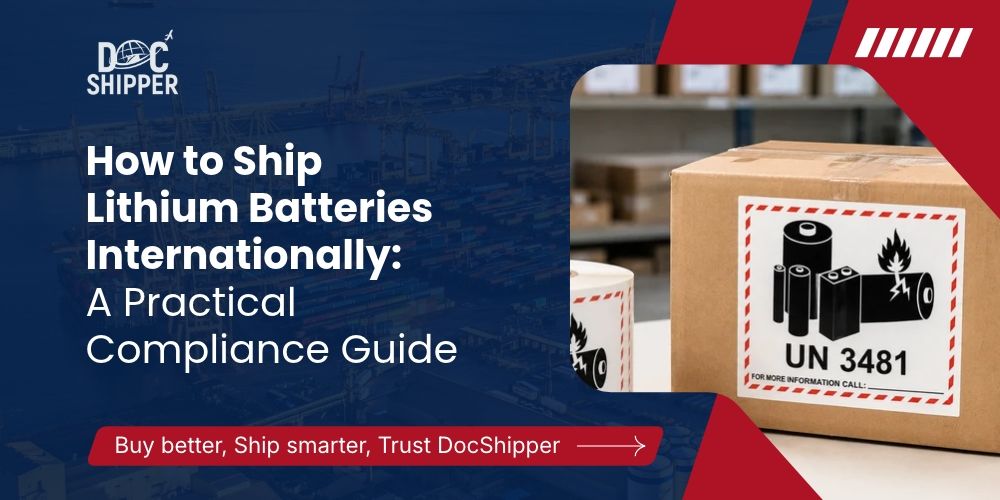
Marks and labels must match the classification and transport mode. Depending on the shipment, this can include the lithium battery mark, the Class 9 dangerous goods label, the proper UN number and additional handling or package marks. Never place a generic lithium battery sticker on a package without checking whether the mark, label, phone number, dimensions and documentation match the current rules.
A practical air preparation line should read: UN3481, lithium-ion batteries packed with equipment, above 2.7 Wh, SoC no more than 30%, IATA DGR 67th edition checked, packaging and marks confirmed. This is a compliance checkpoint, not a substitute for selecting the exact packing instruction.
DocShipper Alert
Verify the 2026 air requirements before factory packing.
Step 4: Prepare the documents
Request the UN38.3 test summary and the safety data sheet from the manufacturer before booking. If the shipment is fully regulated dangerous goods, a trained shipper must prepare and sign the dangerous goods declaration in the required format.
The UN38.3 test summary confirms that the battery type has undergone the applicable transport tests under the UN Manual of Tests and Criteria. It normally identifies the manufacturer, product or cell type and test information needed by the carrier or freight forwarder. A marketing brochure or a declaration that the product is “safe” is not an equivalent document.
The SDS, or safety data sheet, provides product and hazard information. It can help confirm the battery chemistry, emergency information and handling requirements, but an SDS does not replace the UN38.3 test summary or the dangerous goods declaration.
The DGD, or dangerous goods declaration, communicates the regulated shipment details to the transport operator. It must be completed by a person with the required dangerous goods training or under the applicable qualified process. The commercial invoice, packing list and export data must also describe the goods consistently with the dangerous goods paperwork.
- Manufacturer’s battery specification showing chemistry and model.
- Watt-hour rating for lithium-ion batteries or lithium content for lithium-metal batteries.
- UN38.3 test summary for the battery type.
- Current SDS where requested by the carrier, forwarder or destination process.
- Photographs or packing confirmation showing terminals, inner protection, outer packaging and marks.
- State-of-charge confirmation for air shipments where the rule applies.
- Dangerous goods declaration when required by the applicable mode and classification.
- Commercial invoice and packing list with matching descriptions, quantities and UN numbers.
Send these documents to the forwarder during quotation, not after the cargo reaches the warehouse. The document check should compare the battery model, UN number, quantity, packaging, SoC, marks and invoice description line by line.
Step 5: Book with a carrier that accepts batteries
Confirm carrier acceptance, routing and any dangerous goods conditions before the goods leave the factory. Airlines, couriers and shipping lines can apply restrictions that are stricter than the minimum regulatory requirements.
Give the carrier or forwarder the complete shipment profile: UN number, lithium-ion or lithium-metal chemistry, batteries alone or with equipment, Wh or lithium content, number of packages, net battery quantity, package dimensions, gross weight, origin, destination and selected mode. Include whether the batteries are new, used, damaged, defective or recalled.
For courier shipments, check whether the account is approved for lithium battery consignments and whether the service accepts the exact configuration. Some courier products accept only batteries contained in equipment, while others may reject standalone batteries, international routes or certain package sizes.
For air and sea freight, request confirmation that the booking will move under the declared dangerous goods conditions. Ask who will review the DGD, who will verify the packing instruction and whether the carrier needs photographs, a test summary, an SDS or a shipper’s approval before issuing the booking.
Allow time for document corrections and factory repacking. A carrier quotation is not necessarily proof of acceptance, so obtain a written confirmation tied to the exact UN number and shipment configuration.
DocShipper Tips
Share the full shipment profile before dispatch.
DocShipper Platform
One platform. Your entire supply chain
Sourcing, freight, customs & documents — all centralised, all visible, 24/7.

Common mistakes that get shipments rejected
The most common rejection causes are a missing UN38.3 test summary, an incorrect UN number, an unverified state of charge, damaged batteries and missing or incorrect labels. Most failures occur because the shipment data is incomplete before booking, not because lithium batteries are impossible to transport.
One frequent mistake is treating every product with a battery as UN3481. A spare battery beside a device, a battery installed inside a device and a carton containing only batteries can have different classifications and requirements. Ask the supplier for a packing breakdown rather than classifying the entire order from the product name.
Another mistake is applying the 30% air rule only to UN3480. From 1 January 2026, qualifying UN3481 lithium-ion batteries packed with equipment above 2.7 Wh are also within the new SoC requirement. Put the limit in the purchase order and request factory confirmation before loading.
Do not reuse an old label or declaration from a previous shipment. Check whether the battery model, UN number, quantity, SoC, package type and carrier route are identical. A label that was correct for one shipment may be incomplete or wrong for another.
- Classifying a spare battery as contained in equipment.
- Booking before receiving the UN38.3 test summary.
- Sending air cargo without confirming the 2026 SoC requirement.
- Using packaging that allows batteries to move or terminals to contact metal.
- Failing to disclose damaged, defective or recalled batteries.
- Using a courier without confirming its battery service and route acceptance.
- Creating inconsistent descriptions across the invoice, packing list and DGD.
- Assuming sea freight removes the need for IMDG compliance.
DocShipper Alert
Check every label and document against the actual shipment.
DocShipper Info
Review import, labelling and environmental obligations separately.
Regulations beyond transport
Transport compliance is only one part of the process. If batteries are placed on the EU market, Regulation (EU) 2023/1542 creates additional product, labelling, information and sustainability obligations.
The EU Battery Regulation has applied since 18 February 2024, but its requirements enter into force on different dates and can depend on the battery category. Transport documents therefore cannot be used as a complete market-access checklist.
According to CMS’s review of the EU Battery Regulation, harmonised labelling is scheduled from 18 August 2026. A QR code and battery passport are scheduled from 18 February 2027 for electric vehicle, light means of transport and rechargeable industrial batteries above 2 kWh, while the due-diligence obligation has been postponed to 18 August 2027.
Check the destination’s import, environmental, producer-responsibility and product-labelling rules separately from the transport regulations. Your customs clearance process should use the correct product description, tariff classification, origin information and supporting compliance records.
Conclusion
To ship lithium batteries internationally with fewer refusals, build the shipment around the battery configuration rather than around the product category.
- Classify first: the UN number drives the main transport requirements.
- Apply the air rule: qualifying UN3480 and UN3481 lithium-ion batteries must meet the 30% SoC limit under the 2026 IATA rule.
- Collect documents early: obtain the UN38.3 test summary and SDS before booking.
- Prepare the package correctly: protect terminals, prevent movement and use the required marks and labels.
- Confirm acceptance: check the exact configuration with the airline, shipping line, road carrier or courier.
- Choose sea for suitable larger volumes: it can be more practical for less urgent battery cargo, but IMDG compliance remains mandatory.
Shipping batteries or battery-powered products? We check the classification and documents, book with carriers that accept the goods and handle customs at destination.
FAQ | How to Ship Lithium Batteries Internationally: A Practical Compliance Guide
Do not include it in a standard battery shipment or present it to a courier as ordinary cargo. Isolate the battery, prevent short circuits and physical movement, and ask a qualified dangerous-goods specialist or carrier to assess it. Damaged, defective and recalled batteries may require special packaging, routing, approval or may be prohibited entirely, depending on the transport mode and the battery’s condition.
A used battery that is intact and still serviceable may be transportable, but it must be assessed according to its actual condition and intended use. Batteries collected for recycling, disposal or refurbishment can be subject to additional waste-transport, environmental and carrier requirements. Tell the forwarder that the battery is used and provide its condition, chemistry, capacity, test documents and intended destination before booking.
Do not classify the entire carton under a single assumption. Separate the contents by presentation: batteries installed in equipment, spare batteries packed with equipment and batteries shipped alone may have different classifications or packing instructions. Ask the supplier for a package-by-package breakdown and ensure the invoice, packing list, labels and dangerous goods declaration reflect each configuration accurately.
Ask the manufacturer for the document linked to the exact cell or battery model, including any applicable revision or model-family information. An SDS, product brochure or statement that the battery is safe does not replace the test summary. If the manufacturer cannot provide acceptable evidence, pause the shipment and ask the carrier or a dangerous-goods adviser whether an alternative verification process is available. Do not book the cargo based only on a commercial declaration.
No. Carrier acceptance confirms that the operator is willing to handle the shipment under the information provided; it does not replace correct classification, packaging or documentation. Before collection, compare the approved booking details with the physical cargo, including the battery model, UN number, quantity, package count, state of charge, marks and condition. Any change should be reported to the carrier before dispatch.
First determine whether the refusal concerns transport compliance, customs information, import restrictions or the carrier’s internal policy. Do not simply relabel and resend the package. Request the refusal reason in writing, verify the battery configuration and documents, and confirm whether the return movement has different requirements. A return may involve a new route, a different carrier, used or potentially damaged goods, and additional customs or waste-control obligations.
Need Help with
Logistics or Sourcing ?
First, we secure the right products from the right suppliers at the right price by managing the sourcing process from start to finish. Then, we simplify your shipping experience - from pickup to final delivery - ensuring any product, anywhere, is delivered at highly competitive prices.


Fill the Form
Prefer email? Send us your inquiry, and we’ll get back to you as soon as possible.
Contact us