


In short ⚡
The ABC System is an inventory management method that categorizes products into three classes—A, B, and C—based on their value and importance. Class A items represent high-value products requiring tight control, Class B covers moderate-value items, and Class C includes low-value, high-volume goods. This classification optimizes resource allocation and improves supply chain efficiency.
Introduction
Many businesses struggle with inventory management, treating all products equally despite vast differences in their contribution to revenue. This approach wastes resources and creates operational inefficiencies. The ABC System addresses this challenge by prioritizing inventory based on economic impact.
In international trade and logistics, where inventory costs directly affect profitability, implementing the ABC System becomes essential. It enables companies to focus efforts on high-impact items while streamlining management of less critical stock.
Key characteristics of the ABC System include:
- Value-based classification: Products ranked by annual consumption value (unit cost × annual volume)
- Pareto principle application: Typically 20% of items (Class A) generate 80% of value
- Differential management: Each class receives tailored monitoring and control procedures
- Resource optimization: Management effort proportional to item importance
- Dynamic adaptation: Regular reclassification as business conditions change
In-Depth Analysis & Expert Insights
The ABC System originated from the Pareto principle, which states that a small proportion of causes generates the majority of effects. Applied to inventory, this means a minority of SKUs typically accounts for most warehouse value.
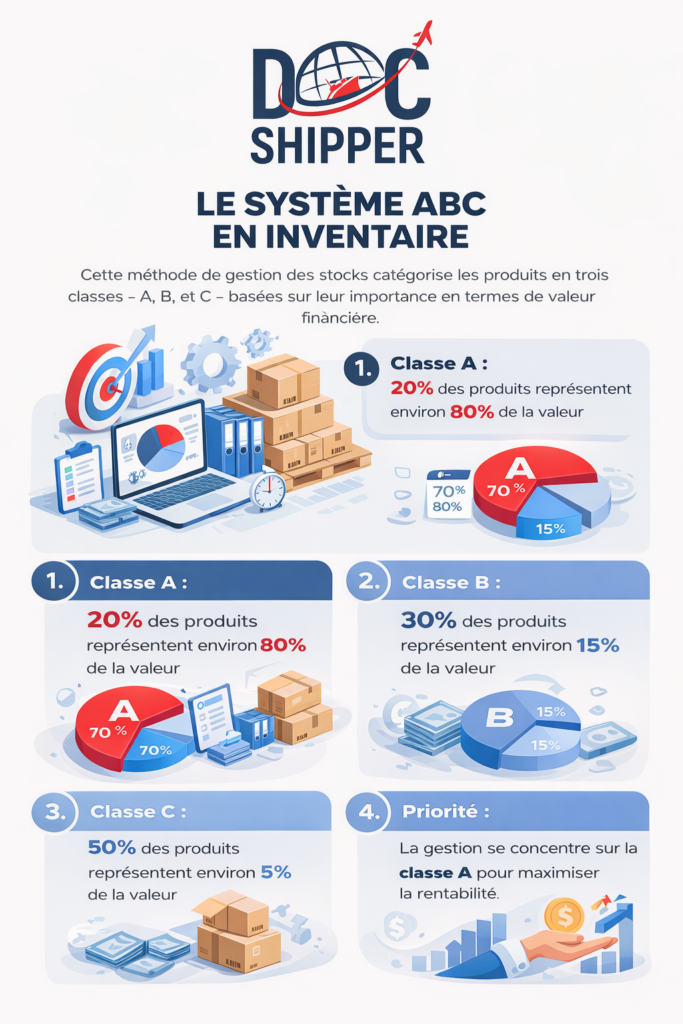
Class A items represent approximately 15-20% of total inventory but constitute 70-80% of total value. These products demand rigorous management: frequent cycle counts, tight safety stock levels, sophisticated forecasting models, and priority supplier relationships. Any stockout or excess directly impacts financial performance.
Class B items occupy the middle ground—roughly 30-35% of inventory representing 15-20% of value. They receive moderate attention with periodic reviews, standard reorder procedures, and balanced safety stock policies. These items bridge the gap between critical and routine inventory.
Class C items comprise 45-50% of inventory but only 5-10% of total value. Management focuses on simplicity: bulk ordering, minimal tracking, higher safety stocks to avoid frequent reordering costs. The goal is administrative efficiency rather than precision.
Implementation requires calculating the annual consumption value for each SKU (unit price × annual usage), ranking all items, then applying percentage thresholds. At DocShipper, we systematically apply ABC analysis when optimizing clients’ warehousing strategies, ensuring customs-cleared goods receive appropriate storage priority based on their commercial importance.
According to International Trade Administration guidelines, proper inventory classification significantly reduces carrying costs while improving service levels—a critical balance in cross-border logistics.
Practical Examples & Data
Consider an electronics importer managing 1,000 SKUs with €5 million annual inventory value. After ABC classification:
| Class | % of SKUs | % of Value | Number of Items | Total Value | Management Approach |
|---|---|---|---|---|---|
| A | 20% | 75% | 200 | €3,750,000 | Weekly reviews, precise forecasting, low safety stock |
| B | 30% | 20% | 300 | €1,000,000 | Monthly reviews, standard procedures, moderate safety stock |
| C | 50% | 5% | 500 | €250,000 | Quarterly reviews, bulk ordering, high safety stock |
Use Case: A textile importer reduced inventory holding costs by 32% after ABC implementation. Class A items (premium fabrics) received daily monitoring and just-in-time replenishment, reducing tied capital. Class C items (basic accessories) moved to quarterly bulk orders, cutting administrative time by 60%.
Key implementation metrics include:
- Inventory turnover improvement: Class A items typically achieve 8-12 turns annually versus 2-4 for Class C
- Stockout reduction: Focused attention on Class A reduces critical shortages by 40-60%
- Carrying cost savings: Overall inventory investment decreases 15-25% without service degradation
- Management efficiency: Staff time reallocated from low-value to high-impact activities
- Forecasting accuracy: Class A forecasting errors drop below 10% with dedicated analysis
At DocShipper, we integrate ABC classification into customs clearance planning, prioritizing expedited processing for Class A shipments while batching Class C items for cost-efficient clearance cycles.
DocShipper Platform
One platform. Your entire supply chain
Sourcing, freight, customs & documents — all centralised, all visible, 24/7.
Conclusion
The ABC System transforms inventory management from a uniform approach to a strategic, value-driven process. By aligning management intensity with economic impact, businesses optimize resources and improve supply chain performance.
Need expert guidance implementing ABC classification in your international logistics operations? Contact DocShipper for tailored supply chain optimization.
📚 Quiz
Test Your Knowledge: ABC System
Q1 — What is the primary criterion used to classify items in the ABC System?
Q2 — A common misconception about Class C items is that they should receive the tightest inventory controls because they represent the largest number of SKUs. Is this correct?
Q3 — An electronics importer has 1,000 SKUs worth €5M. After ABC classification, 200 items account for €3.75M of value. A new shipment of these high-value items arrives at customs. What is the most appropriate handling approach according to ABC logic?
🎯 Your Result
📞 Free Quote in 24hFAQ | ABC System: Definition, Calculation & Concrete Examples
Class A usually represents 15-20% of total SKUs but accounts for 70-80% of total inventory value, following the Pareto principle.
Most businesses review ABC classifications quarterly or semi-annually, though high-volatility industries may require monthly reassessment to reflect changing demand patterns.
ABC analysis applies to services by categorizing clients or service types based on revenue contribution, enabling prioritized resource allocation similar to inventory management.
ABC classifies by value importance, while XYZ analysis categorizes by demand variability—X items have stable demand, Y moderate fluctuation, Z high unpredictability. Combined, they create a comprehensive inventory strategy.
Yes, even businesses with 50-100 SKUs benefit from ABC classification by identifying which products deserve focused attention versus routine management, optimizing limited resources effectively.
While annual consumption value is primary, factors like lead time criticality, supplier reliability, product lifecycle stage, and strategic importance can influence classification decisions.
By applying tighter controls and lower safety stocks to high-value Class A items while accepting higher stocks of low-value Class C items, overall capital tied in inventory decreases without compromising service.
Absolutely—seasonal demand shifts, price changes, or product lifecycle transitions regularly cause reclassification. Dynamic updating ensures classification remains aligned with current business realities.
Most ERP systems (SAP, Oracle, Microsoft Dynamics) include ABC classification modules. Specialized WMS platforms and inventory optimization software also offer automated ABC analysis with customizable thresholds.
Class A items typically receive prime locations near shipping areas for quick access, reducing picking time. Class C items occupy less accessible zones since retrieval frequency is lower.
Common obstacles include resistance to differentiated treatment, data quality issues affecting accurate classification, and difficulty balancing value-based priorities with operational constraints like storage requirements.
Yes—ABC classification helps prioritize customs clearance, allocate airfreight versus ocean freight, and determine which products warrant expedited handling versus consolidated shipments, directly impacting international supply chain costs.
Need Help with
Logistics or Sourcing ?
First, we secure the right products from the right suppliers at the right price by managing the sourcing process from start to finish. Then, we simplify your shipping experience - from pickup to final delivery - ensuring any product, anywhere, is delivered at highly competitive prices.


Fill the Form
Prefer email? Send us your inquiry, and we’ll get back to you as soon as possible.
Contact us




