


In short ⚡
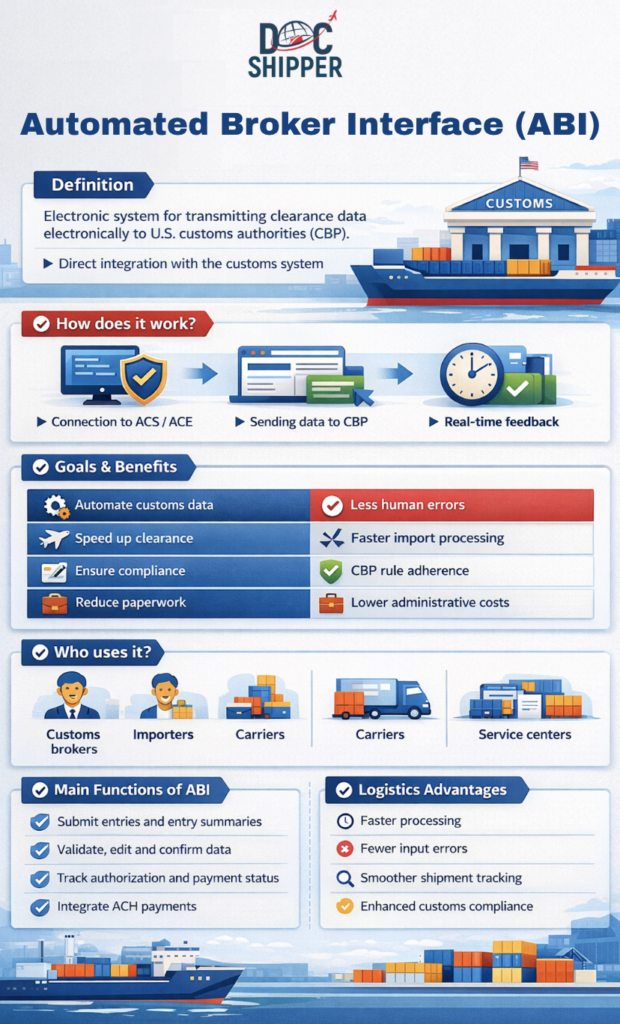
ABI (Automated Broker Interface) is an electronic system developed by U.S. Customs and Border Protection (CBP) that enables customs brokers, importers, and carriers to transmit shipment data electronically for customs clearance. This automated interface streamlines the declaration process, accelerates cargo release, and ensures regulatory compliance for goods entering the United States.
Introduction
Every business importing goods into the United States faces a critical challenge: how to navigate complex customs procedures efficiently while maintaining full compliance. Manual paper-based declarations create delays, errors, and unpredictable clearance times that disrupt supply chains.
The Automated Broker Interface (ABI) revolutionized U.S. customs operations by replacing manual processes with real-time electronic data transmission. Since its implementation, ABI has become the backbone of American import logistics, processing millions of entries annually.
Understanding ABI is essential for any company engaged in international trade with the United States:
- Mandatory compliance: CBP requires electronic filing for most commercial shipments
- Speed advantage: Electronic submissions receive priority processing over paper entries
- Cost efficiency: Reduces administrative overhead and storage costs for physical documentation
- Real-time tracking: Provides immediate status updates on clearance progress
- Error reduction: Automated validation catches discrepancies before submission
ABI System Mechanics & Regulatory Framework
The Automated Broker Interface operates as a secure electronic gateway between trade participants and U.S. Customs. Licensed customs brokers use specialized software to transmit entry data directly into CBP’s Automated Commercial Environment (ACE), the government’s primary system for trade processing.
To participate in ABI, brokers must obtain a filer code from CBP and maintain secure network connectivity. The system supports multiple transaction types including consumption entries, warehouse entries, and temporary importation bonds. Each transmission follows standardized formats defined in the CBP Automated Systems Catair documentation.
The clearance workflow involves five critical stages:
- Pre-arrival filing: Entry data submitted before cargo reaches U.S. ports
- Cargo release: CBP reviews documentation and authorizes physical release
- Entry summary: Final commercial invoice details transmitted within 10 days
- Duty payment: Electronic funds transfer through ACH Debit or daily statement
- Post-entry audit: CBP may conduct compliance reviews up to five years later
Regulatory authority for ABI stems from 19 CFR Part 143, which mandates electronic filing for most commercial imports. The Trade Facilitation and Trade Enforcement Act of 2015 further strengthened requirements, making participation effectively mandatory for regular importers.
At DocShipper, we maintain direct ABI connectivity through our licensed brokerage network, ensuring your shipments receive immediate processing without delays. Our systems integrate seamlessly with CBP protocols to guarantee compliance with all regulatory requirements.
Security protocols include two-factor authentication, encrypted data transmission, and audit trails for every transaction. CBP monitors all ABI activity for anomalies, and brokers face suspension for repeated errors or security violations. The system maintains comprehensive records that satisfy both customs requirements and internal corporate governance standards.
For authoritative information on ABI requirements, consult the official CBP Automated Systems documentation, which provides technical specifications and regulatory updates.
Practical Implementation & Data Requirements
Successful ABI implementation requires precise data management and coordination between multiple parties. Each entry must include mandatory data elements such as importer of record number, tariff classification (HTS code), country of origin, manufacturer identification, and declared value.
The following table compares traditional paper filing versus ABI electronic submission:
| Criteria | Paper Filing | ABI Electronic Filing |
|---|---|---|
| Processing Time | 2-5 business days | Minutes to hours |
| Error Rate | 8-12% (manual entry) | 1-2% (automated validation) |
| Cost per Entry | $150-$300 | $75-$150 |
| Document Storage | Physical archives required | Digital records in ACE |
| Real-time Status | Not available | Instant updates via ACE portal |
Use Case: Electronics Importer
A technology company imports 500 smartphones from China valued at $200,000. Using ABI, their customs broker transmits entry data 24 hours before arrival. CBP’s system validates the HTS code (8517.12.00), confirms anti-dumping duty rates, and releases the cargo within two hours of landing. Total clearance time: 2 hours versus 3-4 days with paper filing. Duty payment processes automatically via ACH, eliminating manual check processing.
Critical data elements for ABI transmission include:
- Entry type code: Identifies consumption, warehouse, or temporary import
- Surety code: Customs bond number ensuring duty payment
- Invoice details: Line-by-line description with unit values
- Manufacturer ID: MID number for each production facility
- Harmonized Tariff: 10-digit HTS classification for duty calculation
At DocShipper, our proprietary systems pre-validate all data elements before ABI submission, reducing rejection rates to below 0.5%. We maintain comprehensive databases of tariff classifications, duty rates, and regulatory requirements to ensure first-time acceptance.
Integration capabilities extend beyond basic filing. Modern ABI systems connect with enterprise resource planning (ERP) platforms, warehouse management systems, and transportation management software. This end-to-end visibility enables proactive exception management and supply chain optimization.
DocShipper Platform
Optimize Your Global Logistics with Cutting-Edge Solutions
Enhance efficiency, cut costs, and gain 24/7 visibility 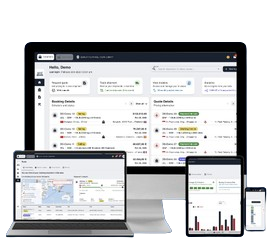 over your entire supply chain.
- Cut your shipping costs and maximize your margins
- Manage sourcing, freight, & customs on one platform
- Get real-time tracking and analytics
Conclusion
The Automated Broker Interface represents the standard for efficient U.S. customs clearance, combining speed, accuracy, and regulatory compliance. Mastering ABI processes delivers competitive advantages through faster cargo release and reduced operational costs.
Need expert guidance on ABI implementation or customs brokerage services? Contact DocShipper for comprehensive import solutions tailored to your business requirements.
📚 Quiz
Test Your Knowledge: ABI (Automated Broker Interface)
Q1. What is the primary purpose of the Automated Broker Interface (ABI)?
Q2. Which of the following statements about ABI and ACE is correct?
Q3. A technology company imports 500 smartphones from China. Their customs broker submits entry data via ABI 24 hours before the cargo arrives. What is the most likely outcome compared to paper filing?
🎯 Your Result
📞 Free Quote in 24hFAQ | ABI (Automated Broker Interface): Definition, Process & Practical Examples
Only licensed customs brokers with CBP-issued filer codes can submit ABI entries. Importers must designate a broker to act on their behalf for electronic filing purposes.
Yes, CBP requires electronic filing for virtually all commercial shipments. Limited exceptions exist for informal entries under $2,500 and specific government imports.
Most routine shipments receive release authorization within 1-4 hours of arrival. Complex entries requiring additional documentation may take 24-48 hours.
CBP's system automatically rejects transmissions with critical errors. Brokers receive immediate notification and must correct issues before resubmission, potentially delaying cargo release.
Importers can view entry status through the ACE Secure Data Portal using their assigned importer number. Full transaction details remain accessible to the designated customs broker.
ABI is the electronic interface for data transmission, while ACE (Automated Commercial Environment) is CBP's comprehensive trade processing system that receives and processes ABI submissions.
Customs brokers typically charge $75-$150 per entry for ABI processing, though fees vary based on shipment complexity and service level agreements.
ABI uses 256-bit encryption, secure VPN connections, and multi-factor authentication. All transactions create audit trails monitored by CBP security systems.
Yes, brokers can submit batch transmissions containing hundreds of entries. The system processes each independently and provides individual status updates.
CBP maintains electronic entry records for five years in ACE, satisfying legal recordkeeping requirements under 19 CFR Part 163.
Customs brokers must complete CBP-approved training on ACE functionality and ABI protocols. Ongoing education ensures compliance with system updates and regulatory changes.
ABI is specific to U.S. imports. However, similar electronic systems exist globally, and modern trade platforms can coordinate multi-country clearance processes through unified interfaces.
Need Help with
Logistics or Sourcing ?
First, we secure the right products from the right suppliers at the right price by managing the sourcing process from start to finish. Then, we simplify your shipping experience - from pickup to final delivery - ensuring any product, anywhere, is delivered at highly competitive prices.


Fill the Form
Prefer email? Send us your inquiry, and we’ll get back to you as soon as possible.
Contact us




