In short ⚡
Acceptable Quality Level (AQL) is a statistical quality control standard defining the maximum percentage of defective units acceptable in a production batch during inspection. It determines sampling plans and pass/fail criteria for international trade quality assurance.Introduction
Importers frequently face a critical dilemma: how many defects are acceptable before rejecting an entire shipment? Without clear quality benchmarks, businesses risk receiving substandard goods or unnecessarily rejecting acceptable batches.
The Acceptable Quality Level provides a standardized solution. It establishes objective criteria for quality inspection in manufacturing and international trade. This statistical method balances production realities with consumer expectations.
Key characteristics of AQL include:
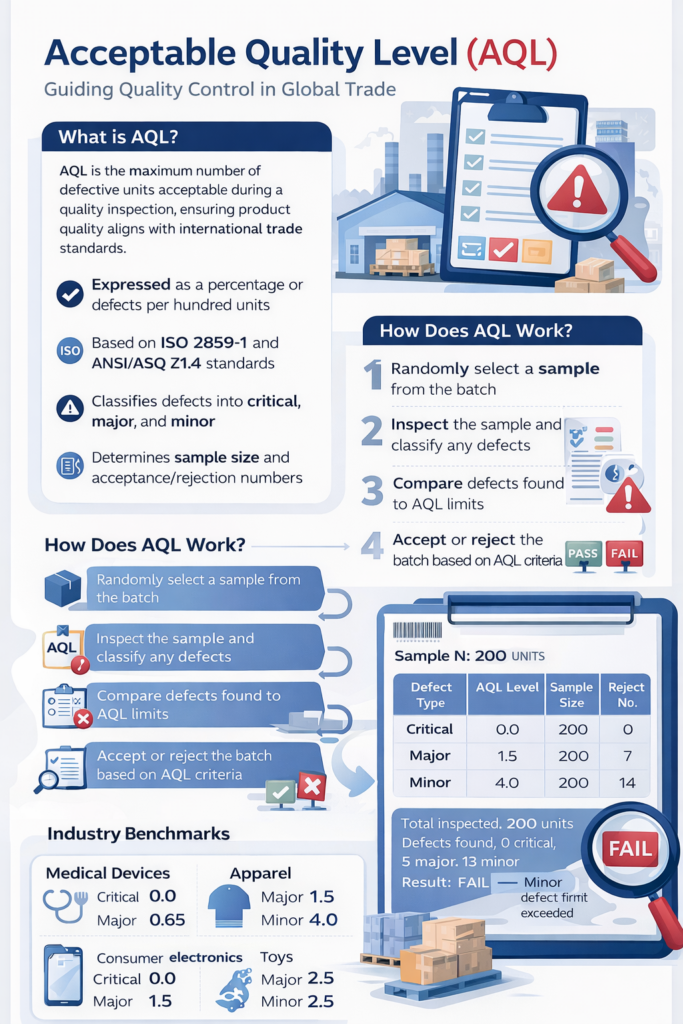
- Expressed as a percentage or defects per hundred units
- Based on ISO 2859-1 and ANSI/ASQ Z1.4 sampling standards
- Applies to random sample inspection, not 100% verification
- Classifies defects by severity: critical, major, minor
- Determines sample size and acceptance/rejection numbers
Understanding AQL is essential for purchase orders, supplier negotiations, and pre-shipment inspections. It protects buyers while maintaining realistic quality expectations.
Technical Framework & Quality Standards
The AQL system operates through statistically determined sampling plans. Rather than inspecting every unit, inspectors examine a calculated sample size. The number of defects found determines pass or fail status.
The most common AQL levels in international trade are 0.0, 1.0, 1.5, 2.5, and 4.0. Lower numbers indicate stricter quality requirements. AQL 0.0 means zero tolerance for critical defects. AQL 2.5 allows up to 2.5% defective units in the overall population.
Defect classification follows a three-tier system. Critical defects pose safety hazards or violate regulations—these typically require AQL 0.0. Major defects affect product functionality or usability, commonly set at AQL 1.5 or 2.5. Minor defects are cosmetic issues that don’t impair function, often allowed at AQL 4.0.
Sample size depends on lot size and inspection level. ISO 2859-1 provides tables correlating batch quantities with required samples. General Inspection Level II is standard for most products. Level I reduces inspection intensity; Level III increases scrutiny for high-risk items.
The acceptance number determines the threshold. If defects exceed this number, the batch fails. For example, with a sample of 200 units at AQL 2.5 for major defects, the acceptance number might be 10. Finding 11 or more major defects triggers rejection.
At DocShipper, we apply AQL standards during pre-shipment inspections to verify supplier compliance before goods leave the factory. This prevents costly returns and maintains your brand reputation.
Official reference: ISO 2859-1:1999 Sampling Procedures for Inspection by Attributes
Practical Application & Inspection Data
Understanding AQL theory matters less than applying it correctly. Real-world scenarios demonstrate how different AQL levels impact inspection outcomes and business decisions.
Case Study: Electronics Importer
A company orders 5,000 Bluetooth speakers from a Chinese manufacturer. They specify AQL 0.0 for critical defects (safety), AQL 1.5 for major defects (functionality), and AQL 4.0 for minor defects (cosmetic scratches).
Following ISO 2859-1 tables for General Inspection Level II with a lot size of 5,000 units, the required sample size is 200 units. The acceptance criteria become:
| Defect Type | AQL Level | Sample Size | Accept Number | Reject Number |
|---|---|---|---|---|
| Critical | 0.0 | 200 | 0 | 1 |
| Major | 1.5 | 200 | 7 | 8 |
| Minor | 4.0 | 200 | 14 | 15 |
Inspection results: 0 critical defects, 5 major defects, 18 minor defects. The batch passes for critical and major categories but fails on minor defects. The importer negotiates a discount or requests rework for cosmetic issues.
Industry-Specific AQL Benchmarks:
- Medical devices: AQL 0.0 (critical), 0.65 (major) — regulatory compliance demands
- Apparel: AQL 1.5 (major), 4.0 (minor) — industry standard for garments
- Consumer electronics: AQL 0.0 (critical), 1.5 (major), 2.5 (minor) — functionality focus
- Toys: AQL 0.0 (safety), 2.5 (major) — child safety regulations
- Promotional items: AQL 2.5 (major), 6.5 (minor) — cost-sensitive products
Statistical reality: AQL does not guarantee zero defects in the entire shipment. AQL 1.5 means statistically, 1.5% of the total lot may contain defects. The sampling method provides confidence levels, not absolute certainty.
At DocShipper, our quality control specialists conduct AQL-based inspections across Asia, Europe, and beyond. We document findings with photographic evidence and provide actionable reports for negotiation leverage.
Conclusion
Acceptable Quality Level transforms subjective quality judgments into objective, enforceable standards. It protects importers while maintaining realistic production expectations. Proper AQL application reduces disputes, minimizes returns, and strengthens supplier relationships.
Need expert quality control for your shipments? Contact DocShipper for professional AQL inspections and comprehensive supply chain management.
📚 Quiz
Test Your Knowledge: Acceptable Quality Level (AQL)
Q1. What does the Acceptable Quality Level (AQL) define in a production inspection?
Q2. A batch of 5,000 Bluetooth speakers is inspected at AQL 1.5 for major defects. The sample of 200 units reveals 8 major defects. What is the outcome?
Q3. You are sourcing children's toys and need to set AQL levels. Which approach correctly follows industry standards?
🎯 Your Result
📞 Free Quote in 24hFAQ | Acceptable Quality Level (AQL): Definition, Calculation & Practical Examples
AQL 2.5 allows a maximum of 2.5% defective units in the total lot. During sampling, if defects exceed the acceptance number for that AQL level, the entire batch fails inspection.
Yes, standard practice applies different AQL levels to defect categories. Typically AQL 0.0 for critical defects, 1.5 or 2.5 for major defects, and 4.0 for minor cosmetic issues.
Sample size depends on total lot quantity and inspection level. ISO 2859-1 tables provide exact sample sizes. General Inspection Level II is standard, requiring larger samples for bigger batches.
No, AQL is a statistical acceptance tool, not a guarantee. Even passed batches may contain defects within the acceptable percentage. It balances quality control with practical manufacturing realities.
Options include rejecting the shipment, negotiating price reduction, requesting rework or sorting by the supplier, or conducting 100% inspection. The decision depends on defect severity and business priorities.
Not necessarily. Overly strict AQL increases costs and may be unrealistic for certain products. Match AQL levels to product risk, industry standards, and customer expectations for optimal balance.
AQL accepts a defined defect percentage, while Six Sigma targets 3.4 defects per million opportunities. AQL is practical for sampling inspections; Six Sigma is a comprehensive quality management philosophy.
Unethical suppliers may pre-sort products or present cherry-picked samples. Independent third-party inspections with random sampling mitigate this risk. Always use surprise inspections when possible.
AQL 2.5 for major defects and AQL 4.0 for minor defects are industry standards for most consumer products. Critical safety defects typically require AQL 0.0 regardless of product type.
Absolutely. Clearly state AQL levels for each defect category in contracts. Without explicit AQL requirements, suppliers may apply their own standards, leading to quality disputes and rejected shipments.
Frequency depends on supplier reliability and product risk. New suppliers require every shipment inspection. Established partners with consistent quality may shift to random sampling or reduced inspection levels.
Acceptable Quality Level (AQL) is the maximum defect rate for batch acceptance. Rejectable Quality Level (RQL) or Limiting Quality (LQ) is the defect rate that should trigger rejection. RQL is typically higher than AQL in sampling plans.
Need Help with Logistics or Sourcing ?
First, we secure the right products from the right suppliers at the right price by managing the sourcing process from start to finish. Then, we simplify your shipping experience - from pickup to final delivery - ensuring any product, anywhere, is delivered at highly competitive prices.
Fill the Form
Prefer email? Send us your inquiry, and we’ll get back to you as soon as possible.
Contact us