



In short ⚡
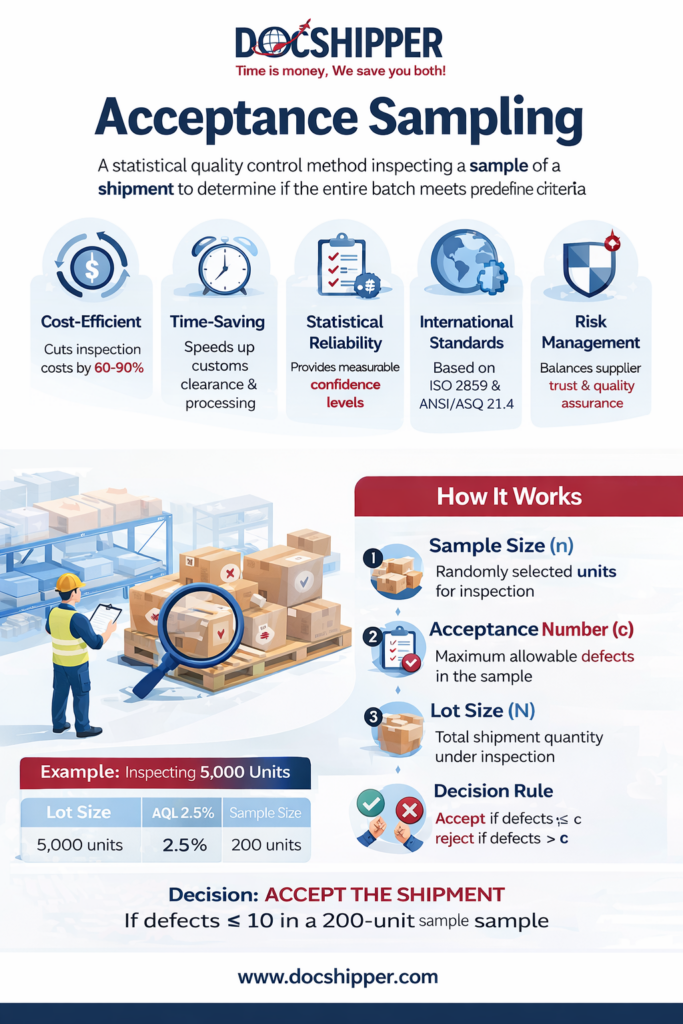
Acceptance sampling is a statistical quality control method used in international trade to inspect a representative portion of a shipment rather than examining every unit. This technique determines whether to accept or reject an entire batch based on predefined criteria, balancing inspection costs with quality assurance requirements in import/export operations.
Introduction
Importers face a critical dilemma: inspect every product and incur massive costs, or risk receiving defective goods that damage their reputation. This challenge intensifies when dealing with large-volume shipments from overseas suppliers.
Acceptance sampling provides the solution. This method enables businesses to make informed decisions about entire shipments by examining only a statistically significant sample. It’s particularly crucial in international logistics where time, distance, and costs make 100% inspection impractical.
- Cost efficiency: Reduces inspection expenses by 60-90% compared to full examination
- Time savings: Accelerates customs clearance and warehouse processing
- Statistical reliability: Provides measurable confidence levels for quality decisions
- Standardized protocols: Uses internationally recognized standards (ISO 2859, ANSI/ASQ Z1.4)
- Risk management: Balances supplier trust with quality assurance requirements
Technical Framework & Regulatory Context
Acceptance sampling operates on three fundamental parameters that determine inspection rigor. The sample size (n) represents the number of units randomly selected from the lot. The acceptance number (c) defines the maximum allowable defects before rejection. The lot size (N) establishes the total quantity under inspection.
Two primary sampling plans dominate international trade. Single sampling plans make accept/reject decisions based on one sample inspection. Double sampling plans allow a second sample if the first results are inconclusive, reducing inspection costs when quality is clearly acceptable or unacceptable.
The Operating Characteristic (OC) curve visualizes sampling plan performance. This graph plots the probability of acceptance against the actual defect rate, revealing the plan’s discriminatory power. A steep OC curve indicates strong differentiation between good and poor quality lots.
Regulatory frameworks mandate acceptance sampling in specific contexts. The ISO 2859 standard provides internationally recognized sampling procedures for inspection by attributes. Customs authorities in the EU, USA, and Asia reference these standards when conducting import verifications.
Producer’s risk (α) and consumer’s risk (β) quantify decision errors. Producer’s risk represents rejecting acceptable quality shipments (typically set at 5%). Consumer’s risk measures accepting poor quality lots (usually 10%). At DocShipper, we calibrate sampling plans to minimize both risks while maintaining inspection efficiency for our clients’ specific supply chains.
Practical Implementation & Data Analysis
Implementation begins with defining the Acceptable Quality Level (AQL)—the maximum defect percentage considered acceptable. Industry standards vary: electronics typically require 1.5% AQL, textiles accept 2.5-4.0% AQL, while industrial components demand 0.65% AQL or lower.
| Lot Size | AQL 1.5% | AQL 2.5% | Sample Size | Accept/Reject |
|---|---|---|---|---|
| 500-1,200 | Level II | Level II | 80 units | Ac:3 / Re:4 |
| 1,201-3,200 | Level II | Level II | 125 units | Ac:5 / Re:6 |
| 3,201-10,000 | Level II | Level II | 200 units | Ac:7 / Re:8 |
| 10,001-35,000 | Level II | Level II | 315 units | Ac:10 / Re:11 |
Use Case: A European importer receives 5,000 smartphone cases from a Chinese manufacturer. Using AQL 1.5% with General Inspection Level II, the sampling plan requires inspecting 200 units. If 7 or fewer defects are found, the shipment is accepted. Finding 8 or more triggers rejection.
The actual inspection discovered 6 defective units (broken clips, color mismatches). The shipment passed acceptance criteria. Statistical confidence: 95% probability that the true defect rate is below 2.8%—within acceptable parameters for this product category.
Cost comparison reveals significant savings. Full inspection of 5,000 units at $0.50 per unit costs $2,500. Acceptance sampling of 200 units costs $100—a 96% reduction. Time savings: 2 hours versus 3 days for complete examination.
Critical defects require special handling. These safety-related flaws (electrical hazards, structural failures) demand zero acceptance numbers. Many importers implement 100% inspection for critical characteristics while using sampling for minor defects.
DocShipper implements adaptive sampling strategies based on supplier history. New vendors receive tightened inspection (larger samples, stricter criteria). Proven suppliers with consistent quality earn reduced inspection levels, optimizing costs while maintaining quality assurance throughout our clients’ supply chains.
Conclusion
Acceptance sampling transforms quality control from a cost burden into a strategic advantage. This statistical approach delivers reliable quality assurance while dramatically reducing inspection time and expenses in international trade operations.
Need expert guidance implementing acceptance sampling protocols for your imports? Contact DocShipper for customized quality control solutions tailored to your supply chain requirements.
DocShipper Platform
Optimize Your Global Logistics with Cutting-Edge Solutions
Enhance efficiency, cut costs, and gain 24/7 visibility  over your entire supply chain.
- Cut your shipping costs and maximize your margins
- Manage sourcing, freight, & customs on one platform
- Get real-time tracking and analytics
📚 Quiz
Test Your Knowledge: Acceptance Sampling
Q1 — What is the core purpose of acceptance sampling in international trade?
Q2 — A common misconception about acceptance sampling is that it eliminates all defective products from reaching customers. Is this correct?
Q3 — A European importer receives 5,000 smartphone cases and applies AQL 1.5% at General Inspection Level II. The inspector finds 8 defective units out of 200 inspected. What is the correct outcome?
🎯 Your Result
📞 Free Quote in 24hFAQ | Acceptance Sampling: Definition, Calculation & Practical Examples
Acceptance sampling examines a statistical sample to make decisions about entire lots, while 100% inspection checks every unit. Sampling reduces costs by 60-90% and inspection time significantly, though it accepts a calculated risk of missing some defects.
AQL selection depends on product criticality, industry standards, and customer expectations. Critical safety items require 0.065-0.65% AQL, electronics typically use 1.5%, consumer goods accept 2.5-4.0%, and non-critical items may allow higher levels.
Acceptance sampling works best for homogeneous lots with randomly distributed defects. It's less suitable for products with systematic defects, highly variable quality, or when destructive testing is required. Custom solutions may be needed for specialized products.
Failed shipments trigger several options: complete rejection and return, 100% sorting to remove defects, rework by the supplier, price negotiation for reduced value, or tightened inspection of replacement shipments. The choice depends on contractual terms and business relationships.
Larger samples increase detection probability for defects but raise inspection costs. Statistical tables balance these factors—doubling sample size doesn't double accuracy. Professional sampling plans optimize the cost-confidence trade-off based on lot size and AQL requirements.
Yes, customs agencies worldwide accept ISO 2859 and ANSI/ASQ Z1.4 sampling procedures for import verification. Documentation showing compliance with these standards facilitates customs clearance and supports dispute resolution in international trade.
Single sampling makes accept/reject decisions from one sample. Double sampling takes a smaller initial sample; if results are borderline, a second sample determines the outcome. Double plans reduce average inspection when quality is clearly good or bad.
Review sampling plans quarterly or after significant changes: new suppliers, production process modifications, quality trend shifts, or customer complaint patterns. Tighten inspection after quality issues; reduce rigor for consistently reliable suppliers with documented performance history.
No sampling method guarantees zero defects—that's the consumer's risk inherent in statistical inspection. However, properly designed plans limit defective shipments to acceptable levels (typically 5-10% probability) while maintaining cost efficiency for large-volume operations.
Essential documents include: sampling plan specification (AQL, sample size, acceptance criteria), inspection reports with defect details, photographic evidence of findings, lot identification and traceability records, and inspector qualifications. This documentation supports quality claims and customs compliance.
Sampling parameters should be contractually defined: agreed AQL levels, inspection standards (ISO 2859), defect classification criteria, consequences of failed inspections, and dispute resolution procedures. Clear agreements prevent conflicts and establish shared quality expectations.
Key limitations include: inability to guarantee zero defects, potential for sampling errors with small lots, ineffectiveness against systematic quality problems, requirement for homogeneous product batches, and need for trained inspectors who understand statistical principles and proper random selection techniques.
Need Help with
Logistics or Sourcing ?
First, we secure the right products from the right suppliers at the right price by managing the sourcing process from start to finish. Then, we simplify your shipping experience - from pickup to final delivery - ensuring any product, anywhere, is delivered at highly competitive prices.


Fill the Form
Prefer email? Send us your inquiry, and we’ll get back to you as soon as possible.
Contact us




