


In short ⚡
ANSI (American National Standards Institute) is a private, non-profit organization that oversees the development of voluntary consensus standards for products, services, and systems in the United States. It facilitates standardization across industries, ensuring interoperability, safety, and quality in international trade and logistics operations.
Introduction
Confusion often arises when businesses encounter different measurement systems, labeling requirements, or technical specifications across global markets. Without unified standards, international shipments face delays, compliance issues, and increased costs.
ANSI plays a critical role in harmonizing technical standards that affect import/export operations, from packaging dimensions to electronic data interchange (EDI) protocols. For logistics professionals, understanding ANSI standards ensures seamless cross-border transactions and regulatory compliance.
- Voluntary consensus-based approach: Standards developed through industry collaboration rather than government mandate.
- International alignment: ANSI represents the U.S. in ISO (International Organization for Standardization) and IEC (International Electrotechnical Commission).
- Wide industry coverage: Over 9,500 American National Standards spanning manufacturing, logistics, technology, and safety.
- EDI standardization: ANSI X12 protocols govern electronic business documents used in supply chain management.
- Quality assurance: Standards ensure product safety, interoperability, and market access across borders.
ANSI’s Role & Standardization Framework
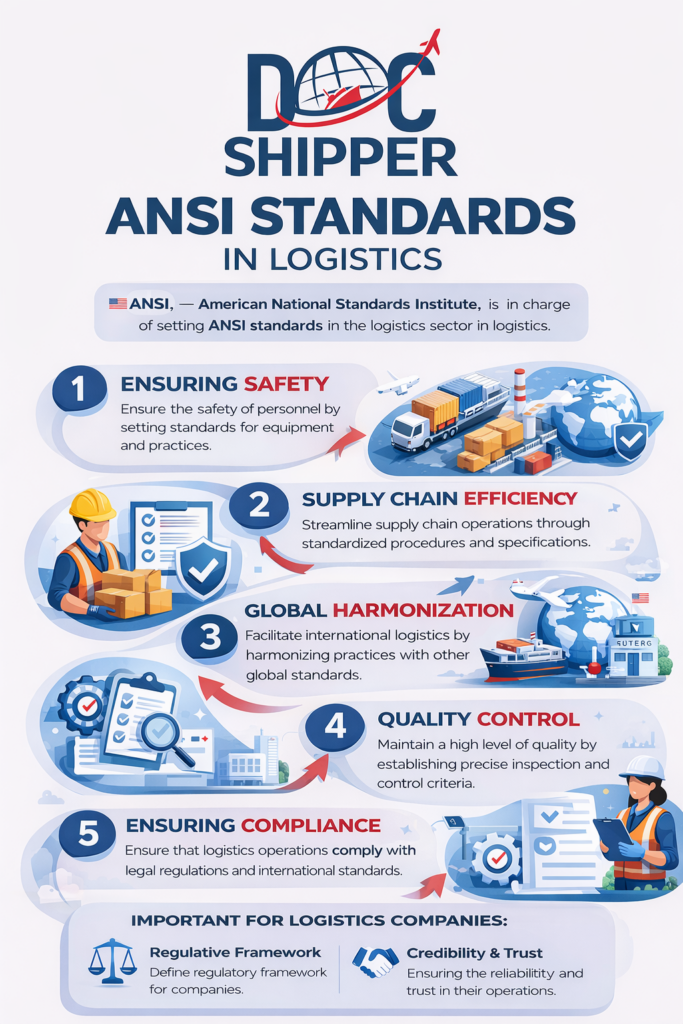
ANSI does not develop standards itself but accredits standards-developing organizations (SDOs) that follow rigorous consensus procedures. This decentralized model ensures industry expertise drives standardization while maintaining transparency and balance among stakeholders.
The organization coordinates over 270 accredited SDOs, including ASTM International, IEEE, and ASME. These bodies create technical specifications that become American National Standards (ANS) after ANSI approval. This process guarantees that standards reflect current industry practices and technological advancements.
In international logistics, ANSI X12 EDI standards are particularly crucial. These protocols define electronic message formats for purchase orders, shipping notices, invoices, and customs declarations. Without standardized EDI, supply chain partners would struggle to exchange data efficiently, leading to processing delays and errors.
ANSI also manages the U.S. National Committee (USNC) for ISO and IEC, ensuring American interests are represented in global standardization efforts. This alignment facilitates mutual recognition agreements that reduce duplicate testing and certification requirements for imported goods.
The accreditation framework requires SDOs to demonstrate openness, balance, due process, and consensus in standard development. This rigor ensures that ANSI-approved standards carry credibility with regulatory bodies, customs authorities, and trading partners worldwide. At DocShipper, we leverage these standardized protocols to streamline documentation processes and ensure compliance across multiple jurisdictions.
For businesses engaged in cross-border trade, ANSI standards provide a common technical language that reduces misunderstandings about product specifications, testing methods, and safety requirements. This harmonization is especially valuable when dealing with U.S. Customs and Border Protection (CBP), which often references ANSI standards in regulatory guidance. Learn more at ANSI’s official website.
Practical Applications & Industry Impact
Understanding how ANSI standards affect daily logistics operations helps businesses avoid costly compliance failures and operational inefficiencies. The following examples demonstrate their practical importance in international trade.
ANSI X12 EDI in Supply Chain Management
| Document Type | ANSI X12 Transaction Set | Logistics Function |
|---|---|---|
| Purchase Order | 850 | Initiates procurement process with standardized item codes |
| Advance Ship Notice | 856 | Notifies recipient of incoming shipment details |
| Invoice | 810 | Automates billing and payment reconciliation |
| Customs Declaration | 214/309 | Facilitates electronic customs clearance |
Companies using ANSI X12 EDI report 30-40% reduction in order processing time and fewer data entry errors. This efficiency directly impacts delivery speed and customer satisfaction in competitive markets.
Use Case: Electronics Importer Compliance
A U.S. electronics distributor importing consumer devices from Asia faced repeated customs delays due to inconsistent product labeling. By adopting ANSI C63 electromagnetic compatibility standards and ensuring suppliers provided ANSI-compliant test reports, the company achieved:
- 75% reduction in customs inspection rates
- Zero product recalls due to safety non-compliance over 18 months
- Faster market entry through pre-approved certification documentation
- Improved supplier relationships through clear technical specifications
This case illustrates how proactive ANSI standard adoption prevents supply chain disruptions and regulatory penalties. At DocShipper, we assist clients in identifying applicable standards and coordinating compliance documentation before shipment, minimizing clearance risks.
DocShipper Platform
One platform. Your entire supply chain
Sourcing, freight, customs & documents — all centralised, all visible, 24/7.

Key Industry Sectors Impacted
- Automotive: ANSI/SAE standards for vehicle components ensure global parts interoperability
- Textiles: ANSI/AATCC test methods verify fabric quality and safety for apparel imports
- Construction materials: ANSI A108 tile installation standards affect building product certification
- Food packaging: ANSI Z400 hazard communication standards govern labeling requirements
- Medical devices: ANSI/AAMI standards facilitate FDA approval and international market access
According to industry data, companies implementing ANSI-aligned quality management systems experience 22% fewer product defects and 18% lower warranty costs, demonstrating the financial benefits of standardization beyond regulatory compliance.
Conclusion
ANSI standards form the technical backbone of efficient international trade, providing common specifications that reduce friction in global supply chains. For importers and exporters, familiarity with relevant ANSI protocols ensures smoother customs clearance, fewer compliance issues, and stronger supplier partnerships.
Need guidance on ANSI compliance for your shipments? Contact DocShipper for expert assistance in navigating standardization requirements and optimizing your logistics operations.
📚 Quiz
Test Your Knowledge: ANSI
Q1 — What best describes ANSI's role in standardization?
Q2 — A company is told their product must comply with ANSI standards to enter the U.S. market. Is this accurate?
Q3 — A logistics manager wants to automate the exchange of purchase orders and shipping notices with overseas suppliers. Which ANSI standard should they implement?
🎯 Your Result
📞 Free Quote in 24hFAQ | ANSI (American National Standards Institute): Definition, Role & Practical Applications
ANSI develops U.S. national standards through accredited organizations, while ISO creates international standards. ANSI represents the U.S. in ISO, ensuring alignment between American and global standards for trade facilitation.
ANSI standards are voluntary unless referenced by federal regulations or state laws. However, many industries adopt them to demonstrate compliance with safety and quality requirements, reducing regulatory scrutiny.
ANSI X12 protocols standardize electronic business documents, enabling automated data exchange between trading partners. This reduces manual processing, minimizes errors, and accelerates order fulfillment cycles.
Yes, overseas suppliers often adopt ANSI standards to meet U.S. buyer specifications and regulatory expectations. Compliance facilitates customs clearance and demonstrates product quality to American customers.
The ANSI Standards Store (webstore.ansi.org) provides access to purchase standards. Many industry associations also offer guidance on sector-specific ANSI requirements relevant to international trade.
While not universally required, ANSI-compliant test reports and certifications can expedite customs clearance by demonstrating product conformity to recognized safety and quality benchmarks.
Standards undergo periodic review every 3-5 years to incorporate technological advances and industry feedback. Importers should verify they reference current versions to avoid compliance issues.
ANSI develops labeling standards for hazard communication, energy efficiency, and product identification. Compliance ensures labels meet U.S. regulatory expectations and consumer safety laws.
Products demonstrating ANSI compliance through proper documentation often face fewer physical inspections, as customs authorities recognize adherence to established quality and safety protocols.
ANSI accreditation ensures standards are developed through transparent, consensus-based processes. This credibility makes ANSI-approved standards more widely accepted by regulators, buyers, and international trade partners.
Yes, ANSI/MH standards govern material handling equipment, pallet dimensions, and warehouse safety. These specifications ensure compatibility across supply chain infrastructure and reduce operational risks.
DocShipper provides compliance consulting, documentation review, and supplier coordination to ensure your shipments meet applicable ANSI standards, minimizing customs delays and regulatory penalties.
Need Help with
Logistics or Sourcing ?
First, we secure the right products from the right suppliers at the right price by managing the sourcing process from start to finish. Then, we simplify your shipping experience - from pickup to final delivery - ensuring any product, anywhere, is delivered at highly competitive prices.


Fill the Form
Prefer email? Send us your inquiry, and we’ll get back to you as soon as possible.
Contact us




