


In short ⚡
An APU (Auxiliary Power Unit) is a self-contained device that provides electrical power, hydraulic pressure, and air conditioning to aircraft and certain ground vehicles when main engines are not operating. Essential for reducing fuel consumption and engine wear during ground operations.
Introduction
Many logistics professionals wonder why aircraft sit with engines off yet remain fully powered at gates. The answer lies in the APU, a critical component that transforms ground handling efficiency.
In international freight operations, understanding APU functionality directly impacts turnaround times, fuel economics, and cargo handling procedures. When main engines shut down, the APU ensures uninterrupted climate control for temperature-sensitive shipments.
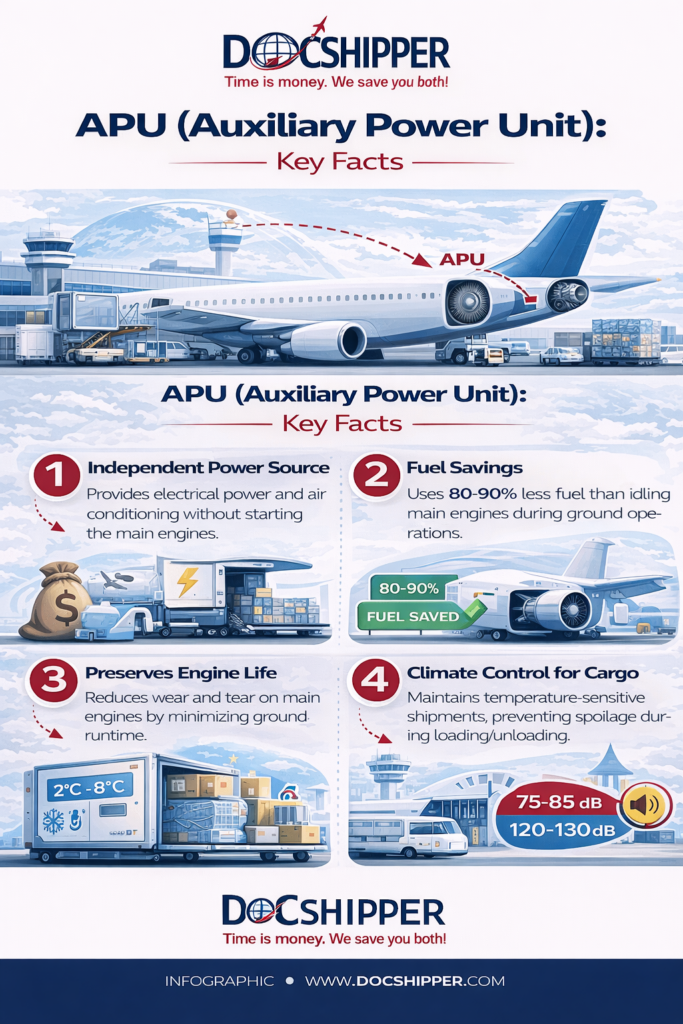
- Independent power generation without running main engines
- Fuel savings of 80-90% compared to main engine idle
- Climate control maintenance for perishable cargo during loading
- Reduced noise pollution at airport terminals and cargo facilities
- Extended engine lifespan by minimizing unnecessary operational hours
Technical Mechanisms & Operational Expertise
The APU functions as a miniature gas turbine engine, typically mounted in the aircraft’s tail cone. It burns jet fuel to drive a generator producing electrical power and compressed air for pneumatic systems.
Modern APUs deliver 90-120 kVA of electrical power, sufficient to operate all aircraft systems including avionics, lighting, and cargo bay climate control. The compressed air output enables air conditioning and engine starting without ground support equipment.
Regulatory frameworks govern APU usage. According to EASA regulations, APU operation must comply with noise abatement procedures at European airports, particularly during nighttime operations affecting cargo flights.
The bleed air system represents the APU’s pneumatic function, supplying pressurized air at 200-250°C. This air powers the air conditioning packs and provides engine starting capability without external ground power units.
At DocShipper, we coordinate with airlines to ensure APU availability during critical cargo operations, particularly for pharmaceutical shipments requiring uninterrupted cold chain management during aircraft ground time.
Maintenance intervals typically occur every 5,000-7,000 operating hours. Airlines must balance APU usage against maintenance costs, as overuse accelerates component wear while underuse leads to system degradation.
The fuel consumption rate averages 100-200 kg per hour, significantly lower than main engine idle consumption of 800-1,200 kg per hour for wide-body aircraft. This efficiency drives operational cost reductions in cargo handling.
Practical Examples & Industry Data
Understanding APU economics requires examining real-world operational scenarios that logistics providers encounter daily.
Cost Comparison: APU vs. Main Engine Ground Operation
| Power Source | Fuel Consumption (kg/hr) | Cost per Hour ($) | Noise Level (dB) |
|---|---|---|---|
| APU Operation | 150 | 120 | 75-85 |
| Main Engine Idle | 1,000 | 800 | 120-130 |
| Ground Power Unit | 40 | 50 | 65-75 |
Use Case: Pharmaceutical Shipment Temperature Control
A cargo flight transporting temperature-sensitive vaccines arrives at Frankfurt Airport. Ground handling requires 90 minutes for unloading 12 tons of pharmaceutical cargo.
- Scenario A (APU): APU maintains cargo bay at 2-8°C. Fuel cost: $180. Temperature compliance: 100%.
- Scenario B (No APU): Cargo bay temperature rises to 15°C within 45 minutes. Shipment rejected. Loss: $450,000.
- Scenario C (Ground Power): External GPU provides power. Connection delay: 15 minutes. Temperature spike: 12°C. Partial compliance issues.
Industry data from IATA shows that APU-equipped cargo operations reduce temperature excursion incidents by 78% compared to ground power dependency.
Annual operational savings for a typical cargo airline operating 15 wide-body aircraft: $2.4 million through APU optimization versus main engine ground running.
At DocShipper, we verify APU functionality before confirming cargo bookings for climate-sensitive shipments, ensuring uninterrupted cold chain integrity throughout the logistics process.
DocShipper Platform
One platform. Your entire supply chain
Sourcing, freight, customs & documents — all centralised, all visible, 24/7.

Conclusion
The APU represents critical infrastructure in modern air cargo operations, delivering fuel efficiency, operational flexibility, and cargo protection during ground handling. Understanding its function enables better logistics planning and risk mitigation.
Need expert guidance on temperature-controlled air freight or cargo handling requirements? Contact DocShipper for comprehensive logistics solutions tailored to your shipping needs.
📚 Quiz
Test Your Knowledge: APU (Auxiliary Power Unit)
Q1 — What is the primary function of an APU (Auxiliary Power Unit) on a cargo aircraft?
Q2 — Compared to running main engines at idle, how much more fuel-efficient is an APU during ground operations?
Q3 — A cargo flight carrying temperature-sensitive vaccines lands and the APU fails. No ground power unit is immediately available. What is the most likely outcome for the shipment?
🎯 Your Result
📞 Free Quote in 24hFAQ | APU (Auxiliary Power Unit): Definition, Function & Practical Examples
The APU provides electrical power and climate control for cargo bays when main engines are off, ensuring temperature-sensitive shipments remain within required ranges during ground operations and loading procedures.
An APU consumes approximately 100-200 kg of fuel per hour, while main engines at idle burn 800-1,200 kg per hour, making the APU 80-90% more fuel-efficient for ground operations.
Yes, but they require external ground power units (GPU) and air conditioning carts, which increase turnaround time by 15-25 minutes and create dependency on airport ground support infrastructure availability.
APU-powered climate control systems maintain cargo bay temperatures from -20°C to +30°C, meeting pharmaceutical, perishable goods, and electronics shipping requirements during ground handling operations.
Modern APUs can operate continuously for 8-12 hours, sufficient for extended ground delays, cargo loading operations, and maintenance activities without requiring main engine operation or external power sources.
Yes, many airports enforce noise abatement procedures limiting APU operation during nighttime hours (typically 23:00-06:00), requiring airlines to use ground power units or manage cargo operations within restricted timeframes.
APUs undergo scheduled maintenance every 5,000-7,000 operating hours, including inspection of the turbine, generator, and bleed air systems, with major overhauls required at 15,000-20,000 hours depending on manufacturer specifications.
APU failure can delay flights by 2-4 hours if ground power units are unavailable or insufficient, particularly affecting temperature-controlled cargo requiring continuous climate management during loading and pre-flight preparations.
APU operation reduces handling costs by $600-800 per flight compared to main engine ground running, while eliminating dependency on ground power unit rental fees averaging $150-200 per aircraft turnaround.
Most modern wide-body cargo aircraft include APUs as standard equipment, while smaller freighters may rely on ground power units, creating operational limitations at airports with inadequate ground support infrastructure.
Cargo requiring climate control must be immediately transferred to temperature-controlled facilities or alternative aircraft, potentially causing shipment delays of 6-24 hours and requiring documentation of temperature excursion events for regulatory compliance.
Professional freight forwarders like DocShipper coordinate with airlines to confirm APU operational status before booking temperature-sensitive cargo, ensuring backup ground power availability and contingency plans for climate-controlled shipments.
Need Help with
Logistics or Sourcing ?
First, we secure the right products from the right suppliers at the right price by managing the sourcing process from start to finish. Then, we simplify your shipping experience - from pickup to final delivery - ensuring any product, anywhere, is delivered at highly competitive prices.


Fill the Form
Prefer email? Send us your inquiry, and we’ll get back to you as soon as possible.
Contact us




:%20Definition%20&%20Guide%20for%202026)