



In short ⚡
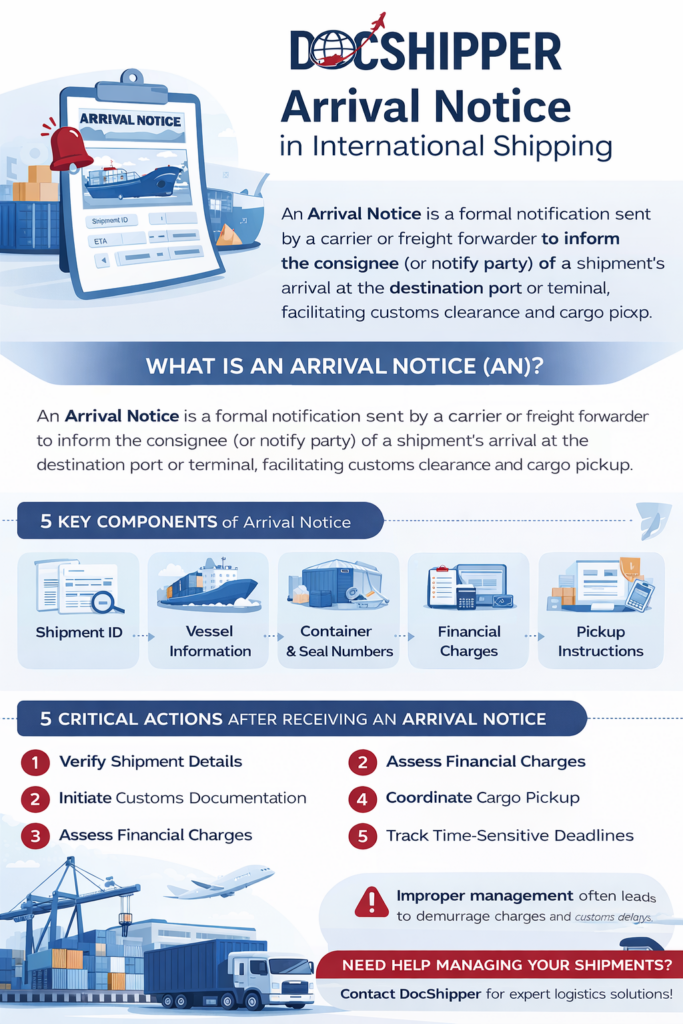
An Arrival Notice is a formal notification sent by a carrier or freight forwarder to the consignee (or notify party) informing them that their cargo has arrived at the destination port or terminal. This document triggers the customs clearance process and contains essential details including shipment reference numbers, vessel information, container numbers, estimated availability date, and outstanding charges. It serves as the official alert to initiate cargo pickup procedures.
Introduction
One of the most common frustrations in international trade is discovering your shipment has arrived—but you weren’t notified in time. This delay can trigger demurrage charges, storage fees, and customs penalties.
The Arrival Notice exists precisely to prevent this scenario. It’s the critical communication bridge between cargo arrival and actual delivery, ensuring all parties can coordinate customs clearance, payment settlement, and logistics planning.
Key characteristics of an Arrival Notice include:
- Timing: Typically issued 24-72 hours before or immediately after vessel arrival
- Recipient: Sent to the consignee and notify party listed on the Bill of Lading
- Financial information: Details all outstanding freight charges, terminal handling fees, and documentation costs
- Release conditions: Specifies requirements for cargo pickup (original B/L, telex release, payment proof)
- Time sensitivity: Includes free time periods and demurrage/detention calculation start dates
Understanding this document is essential for maintaining supply chain efficiency and controlling logistics costs.
Understanding the Arrival Notice: Components & Legal Implications
The Arrival Notice functions as both an informational document and a financial statement. Its legal standing varies by jurisdiction, but it consistently serves as proof of cargo availability.
The document typically contains several critical elements. The shipment identification section includes the Bill of Lading number, booking reference, container numbers, and seal numbers. This information must match customs declarations exactly to avoid clearance delays.
The vessel and voyage details specify the carrying vessel name, voyage number, actual arrival date, and the terminal or Container Freight Station (CFS) location. This information determines jurisdiction for customs procedures and applicable terminal tariffs.
Financial transparency is provided through the charges breakdown, which itemizes ocean freight (if collect), destination terminal handling charges (THC), documentation fees, Bill of Lading fees, and any applicable surcharges. According to international shipping conventions, these charges must be paid or secured before cargo release.
The free time allocation is perhaps the most commercially significant element. It specifies the number of days allowed for cargo pickup before demurrage (for containers at terminal) or detention (for containers removed from terminal) charges begin accruing. Standard free time ranges from 3-7 days but varies by carrier, trade lane, and contract terms.
Finally, the release instructions detail the documentary requirements for cargo pickup. This may include surrender of original Bills of Lading, telex release authorization, proof of payment, customs clearance documentation, or delivery order issuance.
At DocShipper, we monitor Arrival Notices for all client shipments and immediately initiate customs clearance procedures to maximize free time utilization and prevent unnecessary storage charges.
Legal considerations include the carrier’s liability limitations once notice is properly served. Most jurisdictions consider the carrier’s custody responsibility fulfilled upon proper notification, shifting risk to the consignee. The Federal Maritime Commission has increased scrutiny on demurrage practices, emphasizing the importance of timely and clear Arrival Notices.
Practical Examples & Processing Timelines
Understanding theoretical concepts is valuable, but practical application reveals the true impact of Arrival Notice management on business operations.
Comparative Scenario: FCL vs LCL Shipments
| Aspect | FCL (Full Container Load) | LCL (Less than Container Load) |
|---|---|---|
| Notice Timing | 48 hours before vessel arrival | After deconsolidation (2-5 days post-arrival) |
| Free Time | 5-7 days typically | 3-5 days after CFS availability |
| Demurrage Risk | High ($75-150/day per container) | Lower (storage per CBM/day) |
| Release Complexity | Direct from terminal with Equipment Interchange Receipt | Requires CFS appointment and cargo segregation |
| Documentation | Original B/L or telex release | House B/L + master B/L reference |
Real-World Case Study: Electronics Import to Rotterdam
A European electronics distributor received an Arrival Notice for a 40′ HC container from Shenzhen. The notice arrived 3 days before vessel berthing, showing:
- Ocean freight: Prepaid (FOB terms)
- Destination charges: €385 (THC + documentation)
- Free time: 6 days from vessel discharge
- Estimated discharge: Monday, 08:00
The importer immediately initiated customs clearance, submitted the Entry Summary Declaration (ENS), and arranged payment of destination charges. By Thursday, customs released the cargo, and the container was picked up on Friday—within the free time window, avoiding €95/day demurrage charges.
Had the importer delayed action by just 3 days, the additional cost would have been €285, plus potential supply chain disruption to their retail customers.
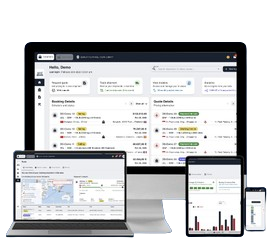
DocShipper Platform
One platform. Your entire supply chain
Sourcing, freight, customs & documents — all centralised, all visible, 24/7.
Critical Timeline Benchmarks
Industry data reveals optimal response patterns:
- Within 24 hours of notice: Verify cargo details and initiate customs documentation preparation
- 48-72 hours before availability: Complete customs declaration submission and arrange payment of charges
- Day of availability: Confirm customs clearance status and schedule pickup/delivery
- Within free time: Execute physical cargo removal to avoid demurrage
- Post-pickup: Return empty containers within detention-free period (typically 5-7 days)
At DocShipper, our automated tracking system alerts clients the moment an Arrival Notice is issued, and our customs team begins clearance procedures immediately to ensure optimal free time utilization across all shipments.
Conclusion
The Arrival Notice is far more than a simple notification—it’s a time-sensitive financial and operational trigger that directly impacts logistics costs and supply chain efficiency. Proper management of this document prevents demurrage charges, ensures customs compliance, and maintains delivery schedules.
Need expert handling of your international shipments and customs clearance? Contact DocShipper for comprehensive freight forwarding and logistics support.
📚 Quiz
Test Your Knowledge: Arrival Notice
Q1 — What is the primary purpose of an Arrival Notice in international shipping?
Q2 — If you do not receive an Arrival Notice, are you still liable for demurrage charges once the free time expires?
Q3 — A European importer receives an Arrival Notice for an FCL shipment showing 6 days of free time starting Monday. Customs clearance is completed by Thursday. What is the correct course of action to avoid demurrage?
🎯 Your Result
📞 Free Quote in 24hFAQ | Arrival Notice: Definition, Purpose & Practical Examples in International Shipping
Lack of notice doesn't eliminate your responsibility for demurrage charges. Contact your carrier or freight forwarder immediately. Most shipping lines provide online tracking where you can verify vessel arrival and cargo availability status independently.
No. Carriers exercise a legal lien on cargo until all freight charges and destination fees are settled. Payment or acceptable credit arrangements must be completed before a delivery order or cargo release is issued.
The Bill of Lading is the contract of carriage and title document issued at origin. The Arrival Notice is an informational and billing document issued at destination. You need both—the B/L to claim cargo ownership, and the Arrival Notice to know when and how to collect it.
Free time is the period allowed for cargo pickup without incurring storage or demurrage charges. It typically starts from the cargo availability date (not vessel arrival date) and ranges from 3-7 days depending on carrier policy and contract terms.
The Arrival Notice is sent to the consignee (receiver) and the notify party listed on the Bill of Lading. The shipper typically doesn't receive it unless they're also listed as the notify party, which is common in FOB shipments where the seller maintains involvement.
Legally, carriers must provide reasonable notice. However, "reasonable" varies by jurisdiction. Most carriers issue notices 24-72 hours before cargo availability. If notice is delayed due to incorrect contact information on the B/L, you may still be liable for charges from the official availability date.
A Telex Release (or Express Release) is an electronic authorization from the carrier confirming cargo can be released without surrendering original Bills of Lading. This expedites the release process, particularly useful when original documents are delayed or when speed is critical.
Contact your carrier or freight forwarder immediately with documentation supporting your dispute (freight agreement, booking confirmation, etc.). However, most carriers require payment or a letter of guarantee before releasing cargo, with disputes resolved afterward through their claims process.
Demurrage applies when containers remain at the terminal beyond free time. Detention applies when you've picked up the container but haven't returned it empty within the allowed period. Both incur daily charges, but detention rates are often higher as the carrier loses container utilization.
Yes, but you'll need to provide a Letter of Authorization (LOA) along with the required release documents. The authorized party must present this LOA, valid identification, and comply with all release requirements specified in the Arrival Notice.
Immediately contact your supplier and freight forwarder. Discrepancies may indicate documentation errors or, in rare cases, cargo mix-ups. Don't proceed with customs clearance until discrepancies are resolved, as incorrect declarations can trigger customs penalties and cargo holds.
Individual shipment charges are generally non-negotiable as they're based on published tariffs. However, high-volume shippers can negotiate better rates in their service contracts with carriers. Freight forwarders like DocShipper often secure preferential rates through volume commitments, passing savings to clients.
Need Help with
Logistics or Sourcing ?
First, we secure the right products from the right suppliers at the right price by managing the sourcing process from start to finish. Then, we simplify your shipping experience - from pickup to final delivery - ensuring any product, anywhere, is delivered at highly competitive prices.


Fill the Form
Prefer email? Send us your inquiry, and we’ll get back to you as soon as possible.
Contact us




