In short ⚡
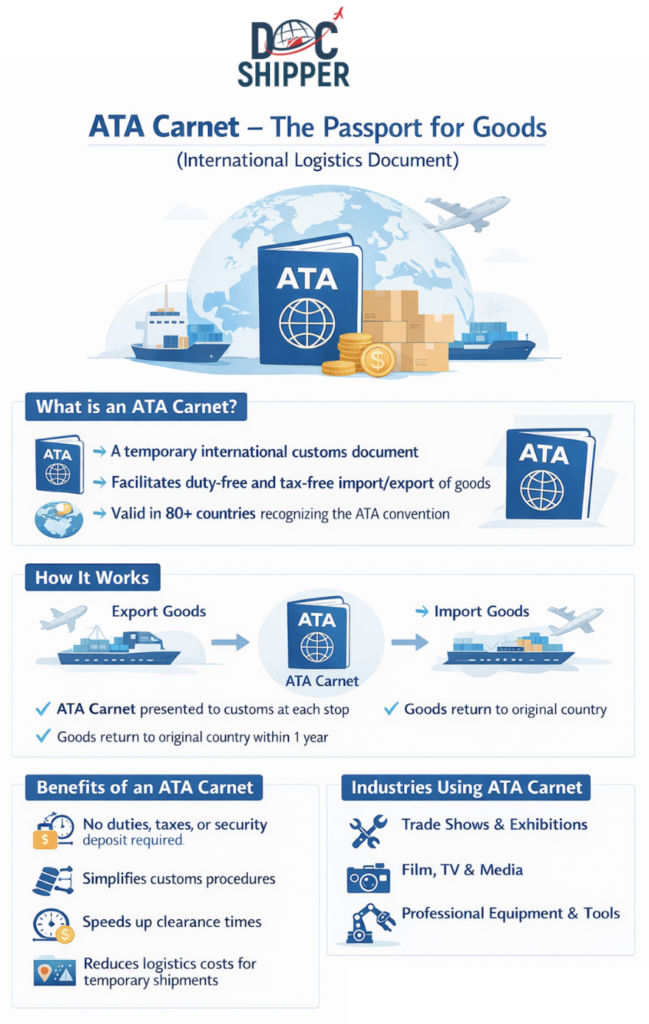
The ATA Carnet is an international customs document that allows temporary duty-free importation of goods across borders for up to one year. Acting as a "passport for goods," it eliminates the need for payment of customs duties and VAT in 78 countries, provided items are re-exported within the authorized period.
Introduction
Many businesses face significant financial burdens when temporarily moving equipment, samples, or exhibition materials across borders. Without proper documentation, companies may pay full customs duties and VAT—even for goods returning home within days.
The ATA Carnet solves this problem by providing a standardized, internationally recognized temporary admission document. It’s essential for trade shows, professional equipment, commercial samples, and cultural exhibitions.
- Global acceptance: Valid in 78 countries under the Istanbul Convention
- Financial guarantee: Covers potential duties up to 40% of goods value
- Multiple entries: Allows repeated border crossings within validity period
- Simplified procedures: Single document replaces multiple national forms
- Time-limited: Standard validity of 12 months from issue date
In-Depth Understanding & Legal Framework
The ATA system operates under the Istanbul Convention, which merged three previous customs conventions in 1990. This treaty standardizes temporary admission procedures worldwide, eliminating bureaucratic complexity for international business operations.
The carnet functions through a chain of guarantee. National issuing associations (like chambers of commerce) guarantee payment of duties if goods aren’t re-exported. This security mechanism protects customs authorities while enabling duty-free movement.
Three main categories qualify for ATA coverage: professional equipment (cameras, medical devices, tools), commercial samples (product demonstrations, prototypes), and goods for exhibitions or fairs. Personal effects and consumable goods are explicitly excluded.
The voucher system within the carnet tracks each border crossing. Customs officials detach and stamp specific vouchers—yellow for exportation, white for importation, green for re-exportation. This creates an auditable trail proving temporary admission compliance.
At DocShipper, we systematically verify carnet validity dates and voucher completeness before shipments depart. This prevents costly delays when customs discover documentation errors at borders.
According to the World Customs Organization, proper ATA usage reduces clearance times by 60% compared to standard temporary importation procedures.
Concrete Examples & Cost Analysis
Understanding the financial impact of ATA Carnets requires comparing costs against traditional customs procedures. The calculation involves issuance fees, insurance premiums, and potential duty savings.
| Scenario | Goods Value | ATA Cost | Without ATA | Savings |
|---|---|---|---|---|
| Trade show equipment (US to Germany) | $50,000 | $450 | $12,500 (duties + VAT) | $12,050 |
| Film production gear (UK to UAE) | $150,000 | $1,200 | $22,500 (15% duty) | $21,300 |
| Medical samples (France to Japan) | $25,000 | $320 | $3,750 (duties) | $3,430 |
Use Case: A German automotive supplier exhibits prototypes at three Asian trade shows over six months. Goods value: €200,000. ATA Carnet cost: €850. Without the carnet, each country would require temporary import bonds totaling €60,000 in deposits, plus administrative fees of €2,400. The carnet eliminates these costs entirely.
Processing time comparison: Standard temporary admission requires 3-7 days per country for bond arrangements. ATA Carnets enable same-day customs clearance at 89% of participating borders, according to ICC World Chambers Federation data.
Key cost factors:
- Issuance fee: 0.5-2% of goods value (varies by country)
- Insurance premium: Typically $250-$500 for standard coverage
- Replacement cost: $150-$300 if lost or damaged
- Extension fee: $100-$200 for validity period extensions
- Penalty for non-discharge: Full duties plus 10-20% administrative fees
DocShipper assists clients in calculating exact ATA costs versus traditional methods, ensuring the most cost-effective approach for each shipment scenario.
Conclusion
The ATA Carnet remains the gold standard for temporary international goods movement, offering unmatched financial savings and procedural simplicity. Proper understanding of its mechanisms and cost structures enables businesses to optimize cross-border operations significantly.
Need expert guidance on ATA Carnet procedures for your next international shipment? Contact DocShipper for personalized logistics support.
📚 Quiz
Test Your Knowledge: ATA Carnet
Q1 — What is the primary purpose of an ATA Carnet?
Q2 — Which of the following goods is explicitly EXCLUDED from ATA Carnet coverage?
Q3 — A company plans to exhibit prototypes at three trade shows in different countries over eight months. Which statement best describes correct ATA Carnet usage in this scenario?
🎯 Your Result
📞 Free Quote in 24hFAQ | ATA Carnet: Definition, Calculation & Concrete Examples
Standard processing takes 5-10 business days. Expedited services can reduce this to 24-48 hours for an additional fee, depending on the issuing chamber of commerce.
Yes, a single carnet covers all 78 member countries. You can visit multiple destinations during the validity period without obtaining separate documents for each country.
You must apply for an extension before expiration or re-export the goods. Failure to comply results in full duty assessment plus penalties, typically 10-20% of the goods' value.
Yes. Consumables, postal items, goods for processing or repair, and items intended for sale are excluded. The carnet only covers temporary admission scenarios.
Costs include a base fee ($150-$300), insurance premium (0.5-2% of goods value), and sometimes membership fees for chambers of commerce. Total costs typically range from $400-$1,500.
In member countries, yes. However, training levels vary. Some borders may require additional explanation, particularly in less-trafficked entry points. Carrying supporting documentation helps.
No. All goods must be listed before issuance. If you need to add items, you must obtain a new carnet. Amendments to existing carnets are not permitted under convention rules.
Customs officials stamp the green re-exportation voucher. This stamped voucher, returned to the issuing association, proves compliance. Without it, you remain liable for duties.
Yes, the carnet is transport-mode agnostic. It works for all entry methods—air cargo, ocean freight, road transport, and even hand-carried items through passenger terminals.
Request a replacement immediately from the issuing chamber. Damaged carnets may not be accepted at subsequent borders. Replacement fees typically range from $150-$300.
No. Carnets are non-transferable and issued to specific holders. The company or individual named on the carnet must be the importer/exporter at all border crossings.
No. One carnet covers multiple events within the same country during the validity period. Simply present the same document at each customs clearance point.
Need Help with Logistics or Sourcing ?
First, we secure the right products from the right suppliers at the right price by managing the sourcing process from start to finish. Then, we simplify your shipping experience - from pickup to final delivery - ensuring any product, anywhere, is delivered at highly competitive prices.
Fill the Form
Prefer email? Send us your inquiry, and we’ll get back to you as soon as possible.
Contact us