


In short ⚡
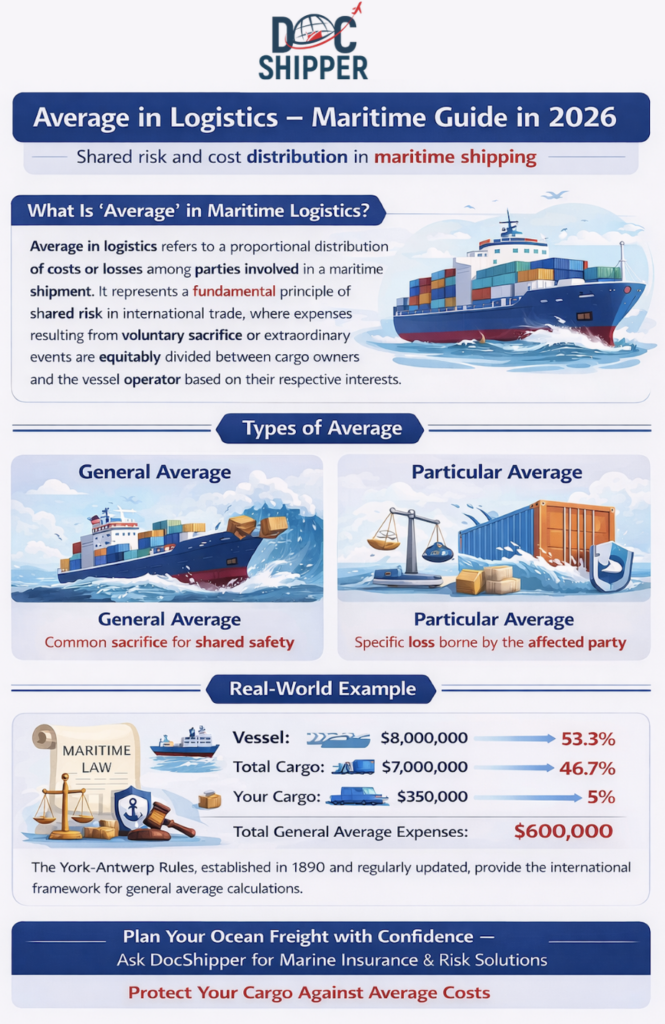
Average in logistics refers to a proportional distribution of costs or losses among parties involved in a maritime shipment. It represents a fundamental principle of shared risk in international trade, where expenses resulting from voluntary sacrifice or extraordinary events are equitably divided between cargo owners and the vessel operator based on their respective interests.
Introduction
Many importers discover the concept of “average” only when facing unexpected charges after a maritime incident. This centuries-old maritime principle can significantly impact your shipping costs and requires proper insurance coverage.
In international freight, average determines how extraordinary expenses or losses are shared between stakeholders. Understanding this mechanism is essential for proper risk management and cost forecasting in ocean freight operations.
- General Average: Voluntary sacrifice for common safety (jettison, fire extinguishing)
- Particular Average: Accidental damage to specific cargo or vessel
- Legal Framework: Governed by York-Antwerp Rules and maritime law
- Financial Impact: Can represent 10-30% of cargo value in major incidents
- Insurance Coverage: Requires specific marine cargo insurance clauses
Types of Average & Legal Mechanisms
General Average occurs when the master of a vessel makes a voluntary sacrifice or incurs extraordinary expenses to preserve the ship and cargo from common peril. Classic examples include jettisoning containers during a storm or flooding compartments to extinguish fire.
The York-Antwerp Rules, established in 1890 and regularly updated, provide the international framework for general average calculations. These rules define which expenses qualify and how contributions are calculated. The most recent version (2016) addresses modern challenges like container loss and environmental costs.
Particular Average represents partial loss or damage affecting only specific cargo or the vessel itself, without involving voluntary sacrifice. This includes water damage from leaks, contamination, or partial theft. Unlike general average, these losses are borne solely by the affected party or their insurer.
The adjustment process requires appointing an average adjuster—a specialized professional who investigates the incident, verifies claims, and calculates each party’s contribution. This process can take 12-36 months, during which cargo may be held as security. At DocShipper, we guide clients through general average procedures and coordinate with adjusters to expedite cargo release.
Security requirements are critical: before releasing cargo involved in general average, carriers demand either cash deposits (typically 10-40% of cargo value), bank guarantees, or proof of adequate insurance coverage. According to International Maritime Organization guidelines, these securities protect the common interest until final settlement.
Calculation Methods & Real-World Examples
General average contributions are calculated based on the contributory value of each party’s interest. The formula distributes the total allowable expenses proportionally among cargo owners and the shipowner according to the saved value of their property.
| Component | Value (USD) | Contribution Rate | Amount Due |
|---|---|---|---|
| Vessel | $8,000,000 | 53.3% | $319,800 |
| Total Cargo | $7,000,000 | 46.7% | $280,200 |
| Your Cargo | $350,000 | 5% | $14,000 |
| Total General Average Expenses: | $600,000 |
Real Case Study: In 2021, the containership Ever Given blocked the Suez Canal for six days. The general average declaration involved approximately $600 million in total costs, including salvage operations, canal authority claims, and delays. Cargo owners with $1 million in goods faced initial security demands of $150,000-$300,000 before cargo release.
Particular average calculation is simpler but equally important. If your container suffers water damage worth $20,000 and your policy has a $5,000 deductible, you receive $15,000. The calculation depends on your insurance terms—whether “Free of Particular Average” (FPA), “With Average” (WA), or “All Risks” coverage.
Key cost factors influencing average contributions include: salvage fees (typically 15-25% of saved property value), port of refuge expenses, temporary repairs, cargo handling and storage, survey fees, and the average adjuster’s commission (usually 2-4% of total expenses).
Time impact: General average cases average 18-24 months for settlement. During this period, your working capital is tied up in security deposits. At DocShipper, we help clients secure appropriate marine insurance before shipment to avoid cash flow disruptions and facilitate immediate cargo release through proper documentation.
Prevention strategies: While you cannot prevent maritime incidents, proper insurance coverage (Institute Cargo Clauses A recommended), accurate cargo declarations, proper packaging, and carrier selection based on safety records significantly reduce financial exposure to average claims.
DocShipper Platform
One platform. Your entire supply chain
Sourcing, freight, customs & documents — all centralised, all visible, 24/7.

Conclusion
Understanding average in logistics is essential for managing financial risks in international shipping. Whether facing general or particular average situations, proper insurance coverage and expert guidance protect your business from unexpected costs and cargo delays.
Need assistance with marine insurance or average claim management? Contact DocShipper for expert guidance on protecting your international shipments.
📚 Quiz
Test Your Knowledge: Average in Logistics
Q1 — What does "Average" mean in the context of maritime logistics?
Q2 — A cargo owner's container is damaged by a water leak during transit, with no voluntary sacrifice made to save the ship. Which type of average applies, and who bears the loss?
Q3 — Your cargo (valued at $350,000) is aboard a vessel that declares General Average after a storm. Total GA expenses are $600,000 and your cargo represents 5% of total contributory value. What is your contribution, and can you refuse to pay?
🎯 Your Result
📞 Free Quote in 24hFAQ | Average in Logistics: Definition, Calculation & Practical Examples
General average is declared when the ship's master makes a voluntary sacrifice or incurs extraordinary expenses to save the vessel, cargo, and crew from imminent peril. Common triggers include jettisoning cargo, intentional grounding, fire suppression, or seeking refuge in an emergency port.
The average adjustment process typically takes 18-36 months, depending on case complexity, number of cargo interests involved, and dispute resolution. Simple cases may settle in 12 months, while major incidents can exceed three years.
No. General average is a legal principle under maritime law. Refusing to provide security or pay your assessed contribution results in cargo detention by the carrier until obligations are met. Your only recourse is disputing the calculation through legal channels.
It depends on your policy terms. Institute Cargo Clauses A (All Risks) covers both general and particular average. Clauses B and C have limitations. FPA (Free of Particular Average) policies only cover general average and total losses, excluding partial damage.
An average bond is a legal document signed by the cargo owner and their insurer guaranteeing payment of the assessed general average contribution. It allows cargo release without cash deposit, substituting the insurer's guarantee for immediate payment.
The shipowner or carrier typically appoints the average adjuster, usually based in the vessel's flag state or the incident location. While cargo interests don't choose the adjuster, they can engage their own surveyor to protect their interests during the adjustment process.
Yes. Salvage expenses incurred to preserve the common adventure from peril are allowable general average charges. However, salvage awards for saving the vessel alone may not be fully recoverable if they don't benefit the cargo interests.
If your cargo is totally lost during the general average event, you still owe a contribution based on your cargo's pre-incident value. This contribution is typically paid by your cargo insurer if you have appropriate coverage, otherwise you remain personally liable.
Contributory value represents the commercial value of saved property at the destination port, plus freight charges. For cargo, it's typically the CIF invoice value plus 10%. For the vessel, it's the sound market value after deducting non-allowable damage.
No. General average is exclusively a maritime law principle. Air cargo and land transport operate under different legal frameworks. Similar cost-sharing mechanisms don't exist for aviation or trucking incidents—losses are handled through standard liability and insurance provisions.
Essential documents include: original bill of lading, commercial invoice, packing list, marine insurance policy or certificate, cargo survey report (if damaged), and correspondence with the average adjuster. Your insurer will also require a completed average bond form.
Particular average involves accidental partial loss or damage affecting only specific cargo or the vessel, with no voluntary sacrifice for common safety. The affected party alone bears the loss. General average requires all parties to contribute proportionally to expenses benefiting the common adventure.
Need Help with
Logistics or Sourcing ?
First, we secure the right products from the right suppliers at the right price by managing the sourcing process from start to finish. Then, we simplify your shipping experience - from pickup to final delivery - ensuring any product, anywhere, is delivered at highly competitive prices.


Fill the Form
Prefer email? Send us your inquiry, and we’ll get back to you as soon as possible.
Contact us




