


In short ⚡
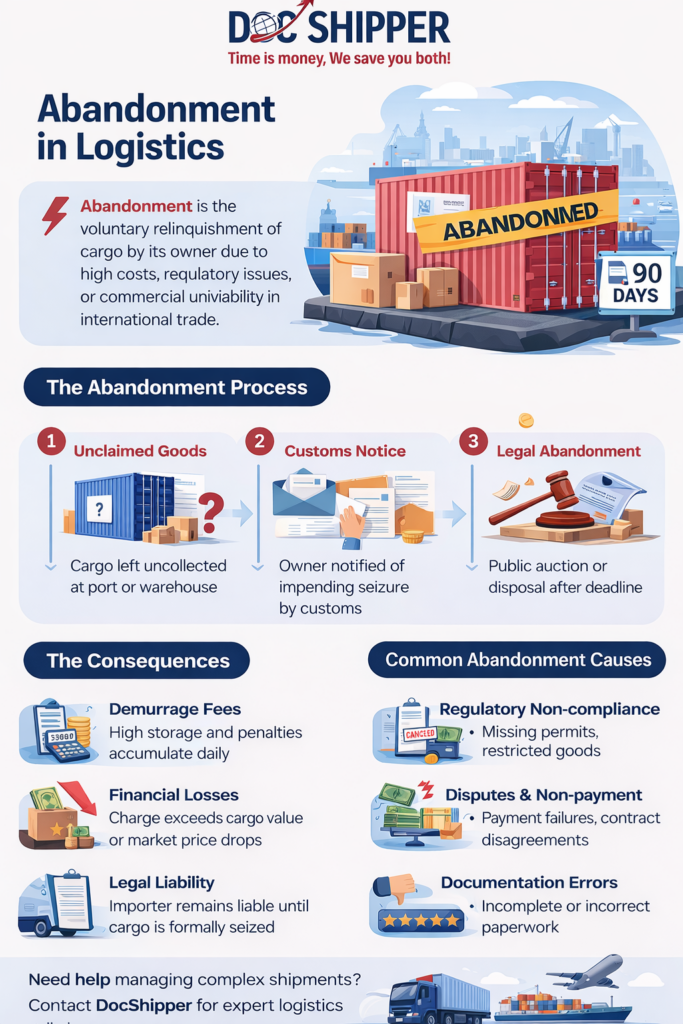
Abandonment refers to the voluntary relinquishment of cargo or goods by the owner, typically due to high costs, regulatory non-compliance, or commercial unviability. In international trade, it triggers specific customs procedures and financial consequences for all parties involved in the supply chain.Introduction
A common misconception in international logistics is that shipments can simply be “left behind” without consequences. In reality, cargo abandonment creates a complex cascade of legal, financial, and operational challenges that affect importers, freight forwarders, carriers, and customs authorities alike.
Understanding abandonment is critical because it represents one of the most costly risks in cross-border trade. When goods are abandoned at ports, warehouses, or customs facilities, they accumulate demurrage fees, storage costs, and potential legal liabilities that can exceed the original shipment value.
Key characteristics of cargo abandonment include:
- Voluntary relinquishment by the consignee or owner
- Regulatory triggers when goods remain unclaimed beyond statutory periods
- Financial consequences including storage fees, penalties, and disposal costs
- Legal procedures governed by customs regulations and commercial law
- Chain reaction effects impacting carriers, forwarders, and terminal operators
Mechanisms & Legal Implications
Abandonment occurs through two primary pathways: explicit abandonment, where the owner formally declares their intention to relinquish the cargo, and implicit abandonment, where goods remain unclaimed beyond the legal free time period. Most jurisdictions define abandonment after 30 to 90 days of non-clearance, though this varies significantly by country and cargo type.
The customs treatment of abandoned goods follows strict protocols. Authorities typically issue formal notices to the importer of record, allowing a grace period for clearance or re-export. If no action is taken, customs may seize the goods for public auction, destruction, or donation depending on the nature of the cargo. According to EU customs regulations, abandoned goods become property of the state after exhausting all notification procedures.
Financial liability chains create the most complex aspect of abandonment. The carrier holds a lien on the cargo for unpaid freight charges. The terminal operator accumulates storage and demurrage fees. The freight forwarder may face claims from both parties. The importer remains legally responsible even after abandonment until customs formally releases them from obligation.
Common causes triggering abandonment include regulatory non-compliance (missing permits, prohibited goods), commercial disputes (payment failures, quality issues), cost escalation (where fees exceed cargo value), market changes (rendering goods unsaleable), and documentation errors (preventing legal clearance).
At DocShipper, we implement preventive monitoring systems that flag shipments at risk of abandonment, allowing intervention before costs become prohibitive. Our compliance verification ensures all documentation is correct before departure, significantly reducing abandonment risk.
Concrete Examples & Data
Industry data reveals the scale of the abandonment challenge. According to port authority statistics, approximately 2-4% of containerized cargo experiences some form of abandonment or extended detention annually. The average cost of abandoned cargo ranges from $5,000 to $50,000 per container, depending on duration and cargo type.
| Scenario | Initial Value | Duration | Accumulated Costs | Outcome |
|---|---|---|---|---|
| Electronics shipment (China-EU) | $30,000 | 45 days | $8,200 | Abandoned – auctioned |
| Textile goods (India-USA) | $15,000 | 60 days | $12,500 | Abandoned – destroyed |
| Machinery parts (Germany-Brazil) | $75,000 | 30 days | $18,000 | Resolved – re-exported |
| Perishable goods (Vietnam-Japan) | $22,000 | 15 days | $25,000 | Total loss |
Use Case: Electronics Importer Crisis
A European electronics retailer ordered $120,000 worth of consumer devices from China. Upon arrival at Rotterdam, customs identified missing CE certification documentation. The importer attempted to obtain retroactive certification but faced a 60-day process. Meanwhile, daily storage fees of $180 accumulated alongside demurrage charges of $150 per day.
By day 45, total costs reached $14,850 while market prices for the devices dropped 30% due to newer model releases. The importer calculated that clearing the shipment would result in a net loss of $50,000+. They formally abandoned the cargo, triggering customs seizure and eventual auction where goods sold for $35,000, covering only partial terminal fees.
Critical factors in abandonment decisions include:
- Cost threshold – when accumulated fees exceed 40-50% of cargo value
- Time sensitivity – perishable or time-dependent goods face higher abandonment rates
- Regulatory complexity – shipments requiring multiple permits show 3x higher abandonment risk
- Market volatility – commodities with rapid price fluctuations experience more abandonments
- Documentation quality – incomplete paperwork accounts for 60% of abandonment cases
Conclusion
Cargo abandonment represents a preventable yet costly risk in international logistics, requiring proactive documentation management and regulatory compliance. Understanding the legal mechanisms and financial implications enables importers to implement effective risk mitigation strategies.
Need expert guidance on managing complex shipments and avoiding abandonment scenarios? Contact DocShipper for comprehensive logistics support tailored to your supply chain needs.
DocShipper Platform
One platform. Your entire supply chain
Sourcing, freight, customs & documents — all centralised, all visible, 24/7.
📚 Quiz
Test Your Knowledge: Abandonment in Logistics
Q1 — What does "cargo abandonment" mean in international logistics?
Q2 — A common misconception about cargo abandonment is that the importer is released from all financial liability the moment they formally abandon the goods. Is this correct?
Q3 — A European importer's shipment of electronics is held at port for 45 days due to missing CE certification. Daily storage and demurrage fees total $330/day. At what point does abandonment typically become the rational economic decision?
🎯 Your Result
📞 Free Quote in 24hFAQ | Abandonment in Logistics: Definition, Calculation & Concrete Examples
Cargo is legally abandoned when the consignee fails to claim or clear goods within the statutory period (typically 30-90 days) or formally notifies authorities of relinquishment. Customs regulations define specific procedures and timelines that vary by jurisdiction.
The importer of record remains primarily liable for all fees until customs formally seizes the cargo. However, carriers and freight forwarders may pursue claims against the shipper or consignee depending on contractual terms and applicable law.
Recovery depends on the abandonment stage. Before customs seizure, goods can typically be reclaimed by paying all accumulated fees. After seizure but before auction, recovery may be possible through formal petition. Post-auction recovery is generally impossible.
Demurrage (port storage fees) and detention (container holding fees) are primary cost drivers leading to abandonment. When these daily charges accumulate beyond cargo value, economic abandonment becomes rational despite legal obligations remaining.
Perishable cargo receives expedited treatment. Customs authorities typically dispose of or donate such goods quickly to prevent health hazards, often within 7-15 days rather than standard abandonment periods. Liability for fees remains with the importer.
Yes. Repeated abandonments create negative customs records that may trigger increased scrutiny, mandatory bonds, or import privilege suspension. Most countries maintain databases tracking importer compliance history including abandonment incidents.
Forwarders can include abandonment clauses in contracts requiring advance deposits or guarantees for high-risk shipments. Once cargo is in transit, refusal becomes complex and depends on contractual terms and applicable transportation law.
Standard cargo insurance typically excludes abandonment-related losses unless specifically endorsed. Marine cargo policies may cover abandonment only when resulting from insured perils (damage, seizure) rather than commercial decisions or regulatory non-compliance.
Critical documents include commercial invoices, packing lists, certificates of origin, import licenses, phytosanitary certificates (for organic goods), and product certifications. Complete, accurate documentation submitted before shipment reduces abandonment risk by 80%.
Alternatives include partial abandonment (releasing some items), re-export to origin or third countries, donation to charitable organizations (with customs approval), or sale-in-bond to recover partial value. Each option requires specific customs procedures and approvals.
Goods in free trade zones or bonded warehouses face different abandonment timelines, often extended to 12-24 months. However, storage costs continue accumulating, and zone operators maintain similar lien rights as traditional terminals.
Professional customs brokers conduct pre-clearance documentation reviews, identify regulatory issues before cargo arrival, expedite clearance processes, and maintain communication with all parties. Their involvement reduces abandonment risk by addressing compliance issues proactively.
Need Help with
Logistics or Sourcing ?
First, we secure the right products from the right suppliers at the right price by managing the sourcing process from start to finish. Then, we simplify your shipping experience - from pickup to final delivery - ensuring any product, anywhere, is delivered at highly competitive prices.


Fill the Form
Prefer email? Send us your inquiry, and we’ll get back to you as soon as possible.
Contact us




