In short ⚡
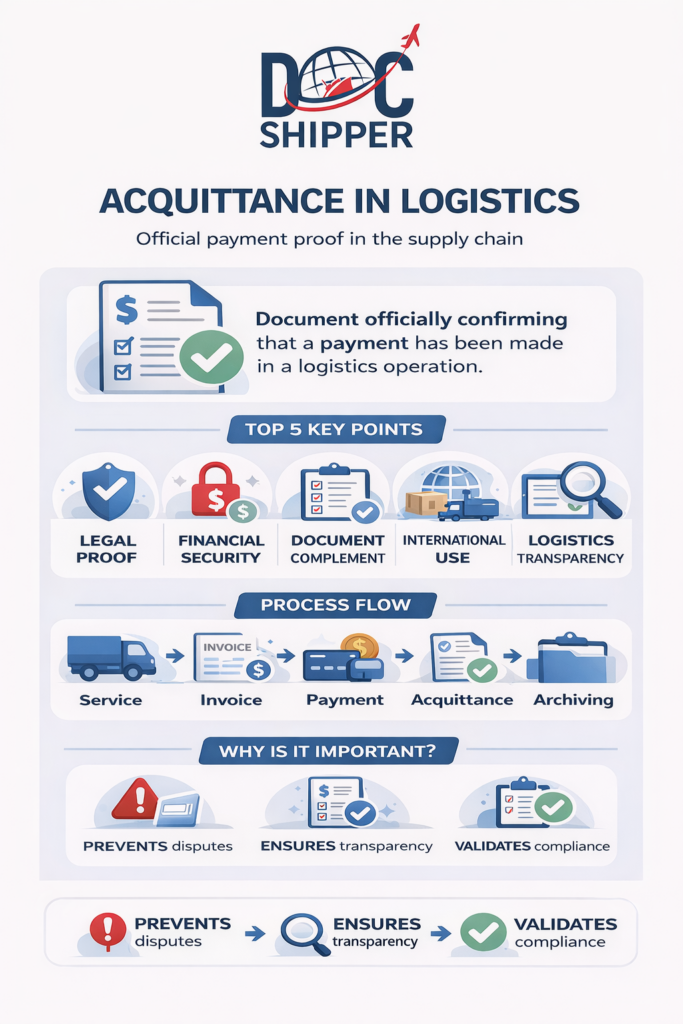
Acquittance is a formal written acknowledgment confirming that a debt, payment obligation, or contractual duty has been fully discharged. In international logistics, this document serves as legal proof that freight charges, customs duties, or other financial obligations have been settled, protecting both parties from future disputes.
Introduction
In international trade, payment disputes represent one of the most common sources of conflict between shippers, freight forwarders, and customs authorities. A missing or improperly executed acquittance can delay cargo release, trigger audits, or expose businesses to legal liability.
This document plays a critical role throughout the supply chain—from port terminal payments to final customs clearance. Understanding its legal weight and proper execution prevents costly delays and compliance issues.
- Legal protection: Serves as irrefutable evidence of payment completion
- Customs compliance: Required for duty discharge verification
- Audit trail: Essential documentation for financial and tax audits
- Dispute resolution: Prevents double-billing and fraudulent claims
- Contractual closure: Formally terminates payment obligations between parties
Legal Framework & Expertise
The acquittance derives its legal authority from commercial law principles governing discharge of obligations. Under international conventions like the UNIDROIT Principles and INCOTERMS® 2020, written proof of payment is mandatory for high-value transactions exceeding specific thresholds.
In customs operations, the acquittance functions as a quittance fiscale—a receipt proving that import duties, VAT, and excise taxes have been paid. Without this document, customs authorities may refuse cargo release or impose detention charges. The European Union Customs Code explicitly requires proof of financial settlement before goods can enter free circulation.
The document must contain five essential elements to be legally valid: the creditor’s identification, debtor’s details, exact amount paid, date of settlement, and an authorized signature. Missing any component can invalidate the acquittance in legal proceedings.
For freight forwarders, the acquittance serves as discharge from liability. Once issued, the carrier or logistics provider is released from responsibility for the specific charges covered. This is particularly important in multimodal transport where multiple parties handle sequential payment obligations.
At DocShipper, we systematically verify acquittance documentation during customs clearance to prevent shipment delays. Our compliance team ensures all payment receipts meet local regulatory standards before submitting clearance requests, eliminating the risk of administrative rejections.
The statute of limitations for contesting an acquittance varies by jurisdiction—typically ranging from 3 to 10 years. Businesses must retain these documents for the full statutory period to defend against late claims or tax audits.
Practical Examples & Data
Understanding acquittance through real-world scenarios clarifies its operational importance across different logistics contexts.
Use Case: Container Demurrage Payment
A German importer receives a 40-foot container at Hamburg Port but exceeds the 7-day free time. The terminal operator issues a demurrage invoice of €840. Upon payment, the terminal provides an acquittance stamped with their official seal. Without this document, the shipping line refuses to release the empty container for return, triggering additional per diem charges of €120 daily. The acquittance immediately resolves the dispute and prevents €3,600 in potential weekly charges.
Comparative Analysis: Document Requirements by Region
| Region | Mandatory for Customs | Digital Acceptance | Retention Period |
|---|---|---|---|
| European Union | Yes (above €1,000) | Yes (e-signature valid) | 10 years |
| United States | Recommended | Yes (CBP accepts) | 5 years |
| China | Yes (all amounts) | Limited (fapiao system) | 5 years |
| United Arab Emirates | Yes (VAT compliance) | Yes (full digital) | 5 years |
Key Operational Data Points
- Processing time: Digital acquittances reduce clearance delays by 67% compared to paper documents
- Dispute rate: Properly executed acquittances reduce payment disputes by 89% in freight forwarding
- Audit compliance: 94% of customs audits request acquittance verification for duty payments
- Cost impact: Missing acquittances cause an average delay of 4.2 days, costing €180-€350 in storage fees per container
- Digital adoption: 73% of European logistics providers now accept e-acquittances with qualified electronic signatures
Conclusion
The acquittance remains an indispensable instrument in international logistics, providing legal certainty and operational efficiency. Its proper execution prevents disputes, accelerates customs clearance, and ensures compliance with financial regulations across jurisdictions.
Need assistance managing payment documentation for your international shipments? Contact DocShipper for expert guidance on customs compliance and logistics documentation.
📚 Quiz
Test Your Knowledge: Acquittance
Q1 — What does an acquittance formally confirm?
Q2 — A colleague tells you that a bank transfer confirmation is equivalent to an acquittance. Are they correct?
Q3 — A German importer pays €840 in demurrage fees at Hamburg Port but does not obtain an acquittance. What is the most likely consequence?
🎯 Your Result
📞 Free Quote in 24hFAQ | Acquittance: Definition, Legal Implications & Practical Examples
An acquittance is a formal legal document confirming full discharge of an obligation, while a receipt simply acknowledges payment received. The acquittance carries stronger legal weight in dispute resolution and explicitly releases the debtor from further claims.
Yes, in most jurisdictions. Under eIDAS regulation in the EU and ESIGN Act in the US, electronic acquittances with qualified digital signatures hold the same legal status as paper documents. However, China's fapiao system has specific requirements for tax-related acquittances.
The creditor (party receiving payment) issues the acquittance. In logistics, this could be the shipping line, freight forwarder, customs broker, or terminal operator—depending on which service was provided and paid for.
Generally no. Once issued, an acquittance creates a legal presumption of payment. Revocation requires proving fraud, mistake, or non-payment through formal legal proceedings. This is why verification before issuance is critical.
Request a certified copy from the issuing party immediately. Most logistics providers maintain digital archives. For customs purposes, you may need a sworn statement and the original payment proof (bank transfer confirmation) as temporary evidence.
Legal requirements vary. EU customs mandate acquittances for duties above €1,000, but best practice recommends obtaining them for all payments exceeding €150 to maintain clear audit trails and prevent disputes.
Retention periods depend on jurisdiction: 10 years in the EU for customs-related documents, 5 years in the US for CBP compliance, and 5-7 years in most Asian countries. Always follow the longest applicable period.
Yes, but it must explicitly state "partial acquittance" and specify the remaining balance. The document should reference the original invoice and clearly indicate what portion has been settled to avoid confusion.
Verify it contains all mandatory elements: issuer identification, payer details, exact amount, date, and authorized signature. If complete, request written explanation for rejection. Common issues include signature authority problems or missing tax identification numbers.
No. A bank statement proves money was sent, but an acquittance confirms the creditor acknowledges receipt and considers the obligation discharged. Both documents serve different legal purposes and should be retained separately.
Not always. While professional forwarders issue them for significant charges, you may need to request acquittances explicitly for smaller fees. At DocShipper, we provide comprehensive payment documentation for all transactions as standard practice.
Yes, acquittances serve as valid supporting documents for business expense deductions in most tax jurisdictions. They provide stronger evidence than simple receipts because they formally confirm the transaction's completion and legal discharge.
Need Help with Logistics or Sourcing ?
First, we secure the right products from the right suppliers at the right price by managing the sourcing process from start to finish. Then, we simplify your shipping experience - from pickup to final delivery - ensuring any product, anywhere, is delivered at highly competitive prices.
Fill the Form
Prefer email? Send us your inquiry, and we’ll get back to you as soon as possible.
Contact us