


In short ⚡
ACS (Approved Customs Status), also known as ACE in some jurisdictions, is a customs authorization granted to businesses demonstrating reliable compliance with customs regulations. This status enables expedited customs clearance, reduced inspections, and streamlined import/export procedures, significantly reducing delays and operational costs for international trade operations.Introduction
Many importers struggle with unpredictable customs delays that disrupt supply chains and inflate costs. Without proper authorization, every shipment faces potential inspections, documentation reviews, and processing bottlenecks. The Approved Customs Status addresses this challenge by offering pre-approved businesses privileged treatment at borders.
In global logistics, ACS represents a critical competitive advantage. Companies holding this certification benefit from faster border crossings, reduced physical inspections, and enhanced predictability in their international operations. This status is particularly valuable for businesses with high-volume, time-sensitive shipments.
Key characteristics of ACS include:
- Pre-authorization: Customs authorities validate the company’s compliance systems before granting status
- Expedited processing: Shipments receive priority clearance with minimal documentation delays
- Reduced inspections: Physical examinations decrease significantly compared to standard procedures
- Supply chain security: Enhanced security protocols that satisfy international trade requirements
- Mutual recognition: Many countries honor ACS equivalents through bilateral agreements
ACS Mechanisms & Regulatory Framework
The Approved Customs Status operates through a rigorous vetting process administered by national customs authorities. In the United States, the program is known as C-TPAT (Customs-Trade Partnership Against Terrorism), while the European Union implements AEO (Authorized Economic Operator) status. Despite different names, these programs share common principles and often maintain mutual recognition agreements.
To qualify for ACS, businesses must demonstrate five core competencies. First, compliance history requires at least three years of customs operations with no significant violations. Second, financial solvency ensures the company can meet its obligations and won’t pose financial risks. Third, record-keeping systems must enable complete traceability of all transactions and movements.
Fourth, security standards encompass physical premises, personnel vetting, cargo security, and business partner screening. According to the European Commission’s AEO guidelines, applicants must implement comprehensive security measures covering the entire supply chain. Fifth, internal control procedures require documented processes for managing customs-related activities.
The application process typically spans six to twelve months. Customs authorities conduct on-site audits examining documentation systems, security infrastructure, and operational procedures. Once granted, ACS status remains valid indefinitely but requires ongoing compliance monitoring and periodic revalidation.
At DocShipper, we assist clients throughout the entire ACS application process, from initial compliance assessment to documentation preparation and audit support, ensuring your business meets all requirements for expedited customs treatment.
Practical Examples & Data Analysis
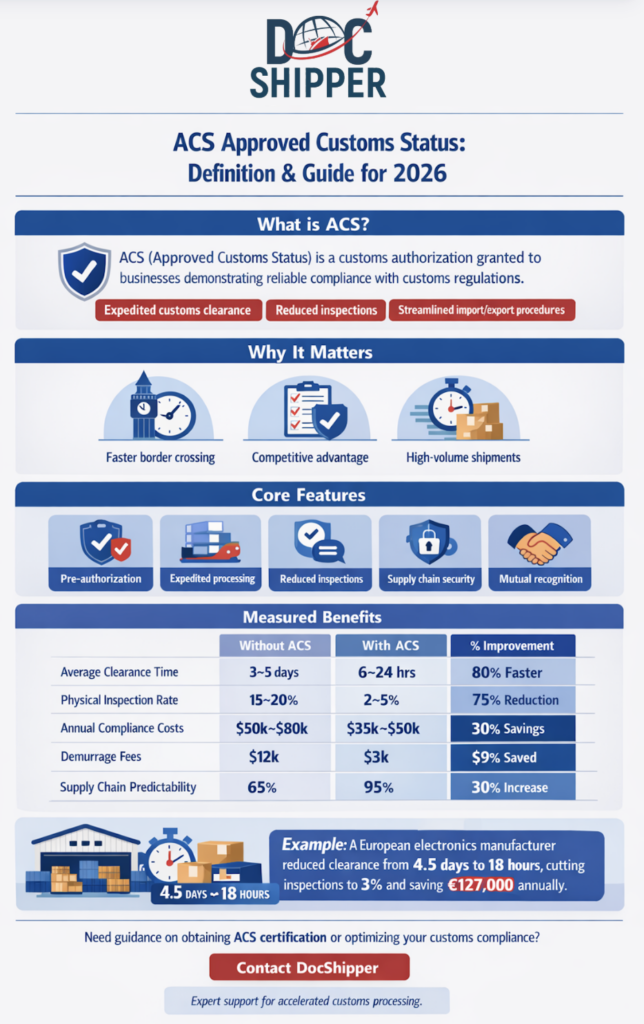
The tangible benefits of ACS become evident when comparing processing times and costs. Research indicates that ACS-certified companies experience 40-60% faster customs clearance compared to non-certified businesses. This translates directly to reduced inventory holding costs and improved supply chain reliability.
| Metric | Without ACS | With ACS | Improvement |
|---|---|---|---|
| Average Clearance Time | 3-5 days | 6-24 hours | 80% faster |
| Physical Inspection Rate | 15-20% | 2-5% | 75% reduction |
| Annual Compliance Costs | $50,000-$80,000 | $35,000-$50,000 | 30% savings |
| Demurrage/Detention Fees | $12,000/year | $3,000/year | $9,000 saved |
| Supply Chain Predictability | 65% on-time | 95% on-time | 30% increase |
Case Study: A European electronics manufacturer importing components from Asia processed 240 containers annually. Before obtaining AEO status, average customs clearance took 4.5 days, with 18% of shipments requiring physical inspection. After certification, clearance time dropped to 18 hours, with only 3% inspection rate. This resulted in annual savings of €127,000 in storage fees and eliminated production delays caused by unpredictable component arrivals.
Key operational advantages include:
- Priority processing: Designated fast-track lanes at major ports and border crossings
- Simplified documentation: Reduced paperwork requirements for routine shipments
- Deferred duty payments: Extended payment terms for customs duties in some jurisdictions
- Self-assessment options: Authority to declare goods without prior customs verification
- Enhanced business reputation: ACS status signals reliability to partners and customers
DocShipper Platform
Optimize Your Global Logistics with Cutting-Edge Solutions
Enhance efficiency, cut costs, and gain 24/7 visibility  over your entire supply chain.
- Cut your shipping costs and maximize your margins
- Manage sourcing, freight, & customs on one platform
- Get real-time tracking and analytics
Conclusion
The Approved Customs Status represents a strategic investment for businesses engaged in regular international trade. Beyond immediate cost savings and faster clearance, ACS provides competitive advantages through enhanced supply chain predictability and reduced operational risk. For companies processing high volumes or time-sensitive goods, this certification often becomes essential for maintaining market competitiveness.
Need guidance on obtaining ACS certification or optimizing your customs compliance? Contact DocShipper for expert assistance tailored to your international logistics needs.
📚 Quiz
Test Your Knowledge: Approved Customs Status (ACS)
Q1 — What does Approved Customs Status (ACS) primarily grant to certified businesses?
Q2 — A company holds ACS certification. Does this guarantee that none of its shipments will ever be physically inspected by customs authorities?
Q3 — A European electronics manufacturer obtains AEO status (the EU equivalent of ACS). Which outcome best reflects what they can realistically expect?
🎯 Your Result
📞 Free Quote in 24hFAQ | ACS (Approved Customs Status): Definition, Benefits & Practical Examples
These are regional names for similar customs trusted trader programs. AEO operates in the EU, C-TPAT in the US, and ACS is a generic term. All provide expedited customs clearance for certified businesses meeting security and compliance standards.
The application and approval process typically requires 6-12 months, including documentation preparation, on-site audits, and customs authority review. Complex supply chains may require additional time for comprehensive security assessments.
Primary costs include internal compliance system upgrades ($15,000-$40,000), security infrastructure improvements ($10,000-$50,000), and consulting fees if using external experts ($5,000-$20,000). No application fees exist in most jurisdictions.
Yes, though requirements remain identical regardless of company size. Small businesses with consistent import/export activity, clean compliance records, and adequate security measures can successfully obtain ACS certification.
No. ACS significantly reduces inspection frequency but doesn't eliminate it entirely. Customs authorities retain the right to inspect any shipment based on risk assessment, random selection, or specific intelligence concerns.
Many countries have mutual recognition agreements honoring equivalent certifications. For example, EU AEO holders receive benefits when importing to countries with recognition agreements, including the US, Japan, China, and Switzerland.
Revocation occurs due to serious compliance violations or security breaches. Companies immediately lose expedited processing privileges and return to standard customs procedures. Reapplication typically requires demonstrating corrective measures and waiting periods.
Most programs grant indefinite status subject to ongoing compliance. However, authorities conduct periodic reviews (typically every 3-5 years) and continuous monitoring. Companies must immediately report significant operational changes affecting security or compliance.
Required documents include three years of customs declarations, financial statements, organizational charts, security procedures, premises layouts, IT system descriptions, business partner lists, and internal control documentation demonstrating comprehensive compliance management.
Yes, logistics service providers including freight forwarders, customs brokers, and warehouse operators can obtain ACS certification. This allows them to offer enhanced services to clients requiring expedited customs processing.
Requirements include physical access controls, personnel background checks, cargo security procedures, business partner screening, information technology security, crisis management protocols, and documented security training programs for all relevant staff.
No, ACS doesn't reduce the amount of duties or taxes owed. It provides procedural advantages like faster processing and deferred payment options, but all applicable duties, taxes, and fees remain payable according to standard tariff classifications.
Need Help with
Logistics or Sourcing ?
First, we secure the right products from the right suppliers at the right price by managing the sourcing process from start to finish. Then, we simplify your shipping experience - from pickup to final delivery - ensuring any product, anywhere, is delivered at highly competitive prices.


Fill the Form
Prefer email? Send us your inquiry, and we’ll get back to you as soon as possible.
Contact us




