


In short ⚡
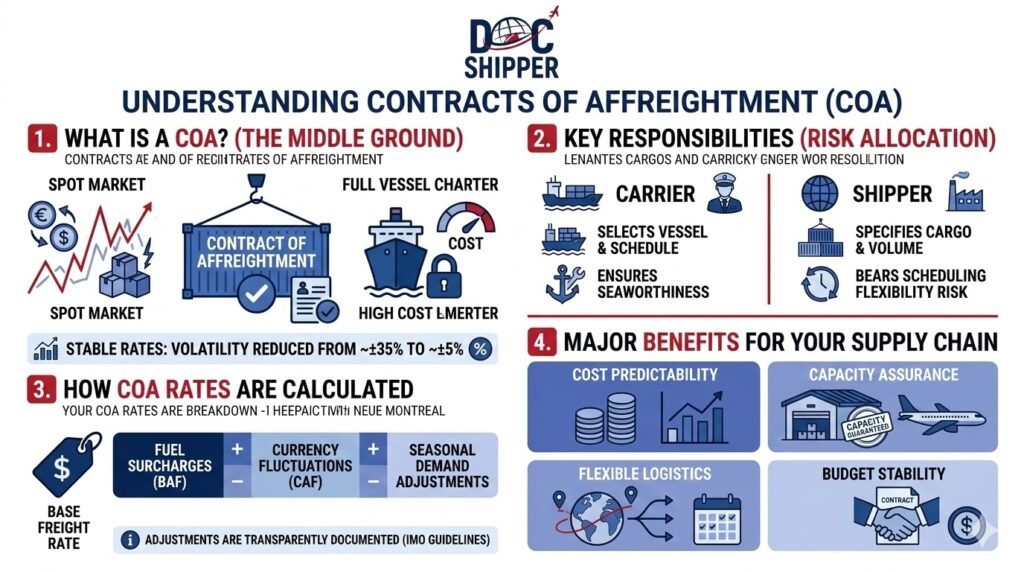
A Contract of Affreightment (COA) is a maritime agreement between a shipper and a carrier for transporting multiple cargo shipments over a specified period, without committing to specific vessels. Unlike voyage charters, COAs provide flexible scheduling while guaranteeing cargo space and freight rates, making them essential for high-volume international trade operations.
Introduction
Many importers struggle to balance shipping flexibility with cost predictability. Spot market volatility can devastate budgets, while long-term vessel charters lock companies into rigid commitments they may not need.
The Contract of Affreightment solves this dilemma by creating a middle ground in maritime logistics. It guarantees cargo capacity and stable rates without requiring shippers to charter entire vessels or commit to fixed sailing schedules.
Understanding COAs is crucial for businesses managing regular international shipments. Key characteristics include:
- Volume commitment: Shippers agree to transport a specified quantity of cargo over the contract period
- Carrier flexibility: The carrier selects vessels and schedules to fulfill obligations
- Rate stability: Freight costs remain predictable despite market fluctuations
- Duration specificity: Contracts typically span 6 months to several years
- Cargo type designation: Agreements specify commodity types, packaging requirements, and loading/discharge ports
In-Depth Analysis & Expert Insights
Contracts of Affreightment operate under distinct legal frameworks compared to other shipping arrangements. The contractual obligation centers on cargo quantity rather than vessel provision, fundamentally differentiating COAs from time or voyage charters.
Under international maritime law, particularly the Hague-Visby Rules and national shipping codes, the carrier maintains responsibility for seaworthiness and proper cargo handling. However, the shipper bears greater scheduling flexibility risks since the carrier controls vessel selection and timing within agreed parameters.
The calculation methodology for COA rates typically involves base freight rates per ton or cubic meter, adjusted for fuel surcharges (BAF – Bunker Adjustment Factor), currency fluctuations (CAF – Currency Adjustment Factor), and seasonal demand variations. According to International Maritime Organization guidelines, these adjustments must be transparently documented.
Performance guarantees form the contract’s backbone. Shippers commit to minimum cargo volumes, often with “take-or-pay” clauses requiring payment even if cargo isn’t shipped. Carriers guarantee capacity availability, facing penalties for failing to provide transportation when requested within contract terms.
The risk allocation differs significantly from spot bookings. While shippers gain rate protection, they sacrifice immediate market opportunities if spot rates drop below contracted levels. Carriers secure volume certainty but must absorb operational costs if market rates rise substantially.
At DocShipper, we systematically review COA terms to ensure our clients understand volume commitments, laycan windows, and demurrage provisions before signing, preventing costly disputes during contract execution.
Practical Applications & Industry Data
ABS currently classifies approximately 12,500 vessels totaling over 250 million gross tons—representing roughly 11% of the global commercial fleet. This extensive portfolio demonstrates the organization’s market influence and technical credibility.
The financial implications of ABS certification are substantial:
| Certification Status | Insurance Premium Impact | Port Access | Average Delay Risk |
|---|---|---|---|
| ABS Certified | Standard rates | Unrestricted | 2-5% |
| Non-Certified | +40-80% surcharge | Limited/Denied | 35-60% |
| Expired Certification | Coverage void | Detention likely | 70-90% |
Use Case: Container Ship Certification
A 8,000 TEU container vessel operating Asia-Europe routes requires comprehensive ABS certification. The process includes:
- Initial classification cost: $180,000-$250,000
- Annual survey expenses: $35,000-$50,000
- Special periodic survey (5-year): $120,000-$180,000
- Emergency inspection response: 24-48 hours in major ports
- Insurance premium reduction: 15-25% compared to non-IACS vessels
For LNG carriers, ABS provides specialized gas carrier certification under IGC Code requirements. These vessels represent the highest classification complexity, with certification costs reaching $500,000+ for newbuilds.
Recent industry data shows that Port State Control detention rates for ABS-classed vessels remain consistently below 2%, compared to the global average of 5.6%. This performance metric directly translates to reduced operational disruptions and cargo delivery reliability.
DocShipper maintains partnerships with ABS-certified carriers across our service network, ensuring clients benefit from reduced insurance costs and minimized customs clearance complications related to vessel documentation.
Practical Examples & Data-Driven Scenarios
Understanding COA mechanics requires examining real-world applications. Consider a European furniture manufacturer importing 50,000 tons of timber annually from Southeast Asia.
| Shipping Method | Annual Cost (USD) | Rate Volatility | Scheduling Control | Volume Flexibility |
|---|---|---|---|---|
| Spot Market | $2,750,000 | ±35% | High | Maximum |
| Contract of Affreightment | $2,400,000 | ±5% | Medium | Moderate |
| Time Charter | $3,200,000 | 0% | Maximum | Minimum |
This comparison demonstrates how COAs provide cost optimization with acceptable flexibility trade-offs. The manufacturer saves $350,000 annually versus spot market average while avoiding the $800,000 premium of dedicated vessel charter.
Case Study: A Brazilian mining company established a 3-year COA for 1.2 million tons of iron ore exports to China. Contract terms specified:
- Base rate: $18.50 per ton (2022 market average: $22.30)
- Quarterly shipments: 100,000 tons minimum
- Loading ports: Tubarão and Ponta da Madeira
- Discharge ports: Qingdao, Ningbo, Shanghai
- Laycan flexibility: 14-day windows per shipment
When 2023 spot rates surged to $28 per ton due to supply chain disruptions, the company realized $11.4 million in savings through rate protection. However, during Q4 2023 when rates dropped to $16 per ton, they paid $250,000 above market—a net benefit of $11.15 million over 18 months.
Key performance metrics for successful COAs include:
- Utilization rate: Percentage of contracted volume actually shipped (target: >92%)
- Schedule adherence: Carrier’s on-time performance within laycan windows (target: >85%)
- Cost variance: Actual costs versus budgeted amounts (target: ±3%)
- Claim frequency: Cargo damage or loss incidents per 1,000 tons (target: <0.5)
- Demurrage exposure: Additional costs from loading/discharge delays (target: <1% of freight value)
Conclusion
Contracts of Affreightment represent strategic tools for managing maritime logistics costs and risks. They deliver predictable freight expenses while maintaining operational flexibility that spot markets cannot guarantee and charters cannot provide.
Need expert guidance on structuring a Contract of Affreightment for your shipping needs? Contact DocShipper for customized logistics solutions.
DocShipper Platform
Cut logistics costs. Not corners.
See exactly where your logistics costs are bleeding — and how to fix it. Book your expert demo.
📚 Quiz
Test Your Knowledge: Contract of Affreightment
Q1 — What is the core obligation defined by a Contract of Affreightment (COA)?
Q2 — Under a COA, what happens if spot market freight rates drop below the contracted rate during the agreement period?
Q3 — A Brazilian mining company ships 1.2 million tons of iron ore to China over 3 years under a COA. When spot rates surge to $28/ton while their contracted rate is $18.50/ton, what is the correct interpretation?
🎯 Your Result
📞 Free Quote in 24hFAQ | Contract of Affreightment: Definition, Calculation & Practical Examples
Most COAs span 6 to 36 months, though some extend to 5 years for stable, high-volume trades. Shorter durations limit rate advantages while longer terms increase commitment risks.
Voyage charters book specific vessels for single trips at market rates. COAs commit to transporting total cargo volumes over time using any suitable vessels the carrier selects, providing rate stability.
Cancellation terms vary by contract. Most COAs include minimum volume commitments with penalties for underutilization, though some allow limited flexibility with advance notice and potential fees.
Carriers breaching capacity commitments typically face contractual penalties, must arrange alternative transportation at their expense, or compensate shippers for market rate differences and consequential damages.
Base rates are typically fixed, but most COAs include adjustment clauses for fuel costs (BAF), currency fluctuations (CAF), and sometimes market-linked escalators tied to published freight indices.
Carriers remain liable for cargo damage during transit under standard maritime law, similar to other shipping contracts. Insurance requirements and liability limits should be explicitly defined in COA terms.
Renegotiation requires mutual agreement. Some contracts include review clauses triggered by extraordinary market conditions, but unilateral changes are generally not permitted without penalty provisions.
COAs work best for bulk commodities, raw materials, and manufactured goods with predictable shipping patterns. Examples include grains, minerals, timber, steel, and containerized consumer products.
Standard laytime provisions apply. Shippers pay demurrage for loading/discharge delays beyond agreed free time. Specific rates and calculation methods should be clearly stipulated in contract terms.
Yes. While carriers have liability for cargo damage, shippers should maintain comprehensive marine cargo insurance. COAs typically specify minimum insurance requirements and certificate presentation obligations.
Some carriers offer consortium COAs where multiple shippers collectively meet volume commitments. This approach provides COA benefits to smaller exporters unable to fulfill individual minimum quantities.
Each shipment requires standard shipping documents: bills of lading, commercial invoices, packing lists, certificates of origin, and any commodity-specific certificates. The COA itself governs overall contractual obligations.
Need Help with
Logistics or Sourcing ?
First, we secure the right products from the right suppliers at the right price by managing the sourcing process from start to finish. Then, we simplify your shipping experience - from pickup to final delivery - ensuring any product, anywhere, is delivered at highly competitive prices.


Fill the Form
Prefer email? Send us your inquiry, and we’ll get back to you as soon as possible.
Contact us




