


In short ⚡
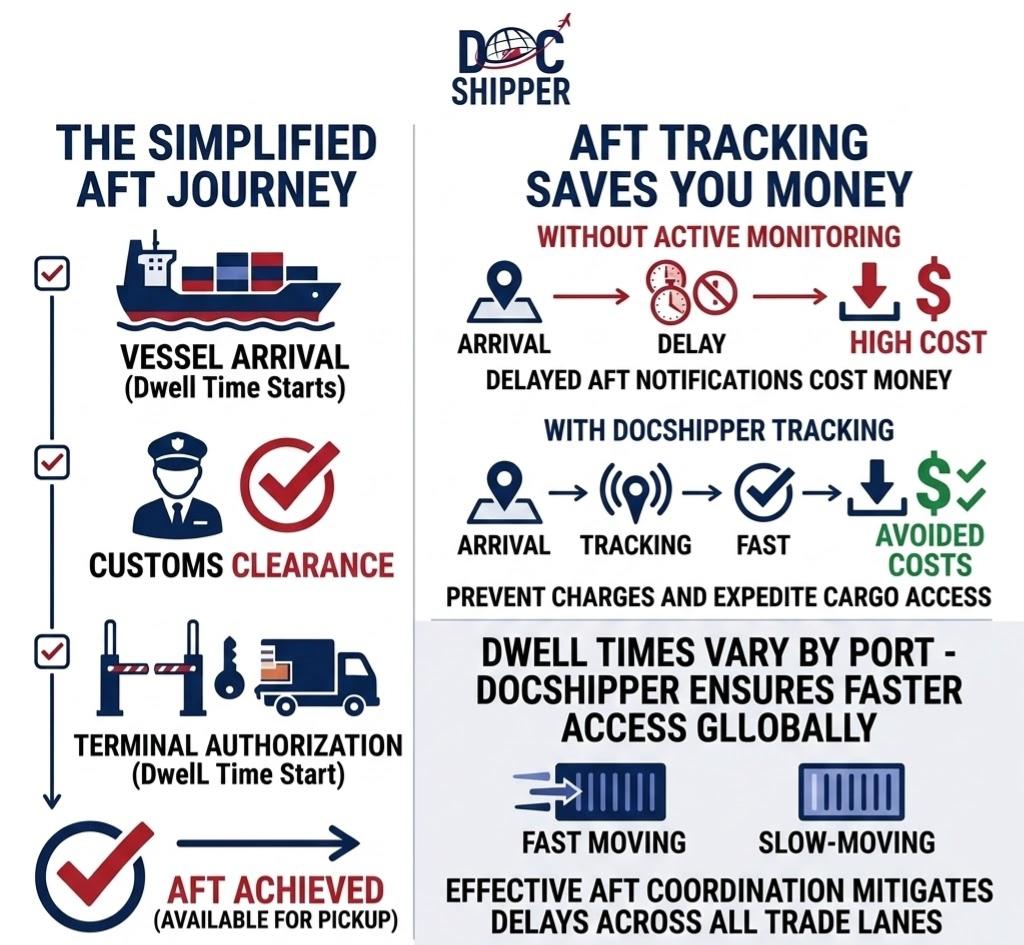
AFT (Available For Transfer) is a shipping status indicating that a container has been unloaded from the vessel and is ready for physical transfer to the consignee or their representative at the port terminal. This status confirms customs clearance completion and terminal release authorization, marking the final stage before cargo collection.
Introduction
One of the most common frustrations in international logistics is container delays at port terminals. Importers often face confusion about when their cargo is actually ready for pickup. The AFT status eliminates this ambiguity by providing a clear signal that all administrative and operational barriers have been cleared.
In the import/export supply chain, AFT represents a critical milestone. It confirms that the shipping line, customs authorities, and terminal operators have all completed their respective processes. Without this status, attempting cargo collection results in rejection and additional demurrage charges.
- Customs clearance confirmation: All duties and taxes paid, documentation approved
- Terminal release authorization: Shipping line has issued delivery order
- Physical availability: Container located and accessible in terminal yard
- Demurrage trigger point: Free time countdown typically begins at AFT notification
- Pickup eligibility: Trucking company can legally collect the container
AFT Mechanisms & Operational Implications
The AFT status is generated through an integrated terminal operating system (TOS) that synchronizes data between multiple stakeholders. Understanding this process is essential for logistics coordinators managing tight delivery schedules.
Vessel discharge completion is the first prerequisite. Once the container is physically unloaded and positioned in the terminal yard, the system registers its location. However, physical presence alone does not trigger AFT status—administrative clearances must follow.
Customs release constitutes the second critical gate. Customs authorities must transmit electronic clearance to the terminal system. In the European Union, this occurs through the Import Control System (ICS2), while the United States uses the Automated Commercial Environment (ACE). At DocShipper, we monitor these systems in real-time to anticipate AFT notifications and coordinate immediate pickup.
Freight payment verification ensures all shipping line charges are settled. Unpaid ocean freight, terminal handling charges (THC), or documentation fees will block AFT status regardless of customs clearance. This is where many importers encounter unexpected delays.
Delivery order issuance by the carrier or their agent authorizes the terminal to release the container. This document, increasingly digital via platforms like INTTRA or CargoSmart, must reference the exact container number and bill of lading.
Demurrage and detention implications make AFT timing financially critical. Most carriers begin free time calculations from the AFT timestamp, not vessel arrival. A container marked AFT on Monday but collected on Friday may already incur three days of demurrage charges at $75-150 per day per container.
According to the World Shipping Council, average dwell times between AFT status and actual pickup range from 2.8 days in efficient ports like Rotterdam to 7.4 days in congested facilities. These delays directly impact inventory costs and supply chain reliability.
Practical Examples & Terminal Data
Real-world scenarios demonstrate how AFT status impacts logistics operations and cost structures. The following examples illustrate typical situations importers face across different trade lanes.
Use Case 1: Electronics Import – Los Angeles Port
A consumer electronics importer receives a 40-foot high-cube container from Shenzhen. The vessel arrives on March 1st at 06:00. Customs pre-clearance was filed via ISF (Importer Security Filing), but physical inspection is randomly selected.
| Date/Time | Event | Status |
|---|---|---|
| March 1, 06:00 | Vessel berthing completed | Discharged |
| March 1, 14:30 | Container unloaded to yard | Available in terminal |
| March 2, 09:15 | Customs examination hold | Hold – Customs |
| March 3, 16:45 | Inspection completed, released | Customs cleared |
| March 4, 08:00 | Freight paid, DO received | AFT |
Financial impact: Free time = 5 days from AFT. If pickup occurs on March 9th (day 6), demurrage charge = $125/day × 1 day = $125. The 3-day gap between vessel arrival and AFT demonstrates why tracking discharge dates alone is insufficient.
Use Case 2: Automotive Parts – Hamburg Terminal
An automotive manufacturer imports precision components from Japan. The shipment requires EUR.1 certificate verification for preferential tariff treatment under the EU-Japan Economic Partnership Agreement.
- Vessel arrival: February 10, 04:30
- Container discharge: February 10, 11:20
- Customs document query: February 11 (EUR.1 discrepancy detected)
- Corrected documentation submitted: February 12
- AFT status achieved: February 13, 14:00
- Actual pickup: February 13, 16:30
Cost avoidance: By resolving the documentation issue within 48 hours and coordinating immediate pickup after AFT notification, the importer avoided 3 days of demurrage ($95/day × 3 = $285) and maintained just-in-time production schedules.
DocShipper Platform
Optimize Your Global Logistics with Cutting-Edge Solutions
Enhance efficiency, cut costs, and gain 24/7 visibility  over your entire supply chain.
- Cut your shipping costs and maximize your margins
- Manage sourcing, freight, & customs on one platform
- Get real-time tracking and analytics
Comparative Terminal Performance Data
| Port | Avg. Discharge to AFT | Free Time (Days) | Demurrage Rate |
|---|---|---|---|
| Rotterdam | 1.2 days | 7 | €85/day |
| Los Angeles | 2.8 days | 5 | $125/day |
| Singapore | 0.9 days | 6 | $95/day |
| Felixstowe | 3.4 days | 5 | £110/day |
| Shanghai | 1.6 days | 7 | ¥650/day |
These metrics highlight significant variability in terminal efficiency. Importers working with DocShipper benefit from our port-specific expertise, allowing us to anticipate AFT timing and position trucking resources accordingly.
Conclusion
AFT status represents the definitive authorization for cargo collection, marking the convergence of customs clearance, freight payment, and terminal operations. Effective AFT monitoring directly reduces demurrage costs and supply chain delays.
Need expert assistance managing AFT notifications and terminal coordination? Contact DocShipper for comprehensive import/export support.
📚 Quiz
Test Your Knowledge: AFT (Available For Transfer)
Q1 — What does AFT (Available For Transfer) status confirm?
Q2 — A container has passed customs inspection and received customs clearance. Is it automatically granted AFT status?
Q3 — A container arrives in Los Angeles on March 1st and achieves AFT status on March 4th. The carrier offers 5 free days from AFT. The importer collects the container on March 10th. How many days of demurrage are owed?
🎯 Your Result
📞 Free Quote in 24hFAQ | AFT (Available For Transfer): Definition, Calculation & Concrete Examples
Customs clearance is one component of AFT status. A container can be customs-cleared but still not AFT if freight remains unpaid or the delivery order hasn't been issued. AFT confirms all prerequisites are complete.
AFT confirms administrative readiness, but physical access depends on terminal operations. During peak periods, container retrieval may require appointment scheduling even after AFT notification. Verify terminal gate hours and slot availability.
Most shipping lines calculate demurrage from AFT timestamp, not vessel arrival. Free time begins when the container becomes legally and operationally available for pickup. Always verify specific carrier terms in your service contract.
Yes, if delays resulted from carrier operational failures (equipment shortages, system errors), you can file a demurrage dispute. Document the AFT timeline and correspondence. Success rates vary by carrier and jurisdiction.
AFT alerts are typically sent via email or accessible through carrier/terminal web portals. Freight forwarders like DocShipper integrate these systems to provide consolidated tracking and proactive notifications across multiple carriers.
You need: delivery order (original or electronic), customs release documentation, valid identification, and equipment interchange receipt (EIR). Some terminals require advance gate appointments and proof of insurance.
Yes, in rare cases. Post-clearance audits, payment disputes, or security concerns can trigger AFT revocation. The container returns to "hold" status until issues are resolved. This emphasizes the importance of accurate documentation.
LCL (Less than Container Load) cargo requires additional deconsolidation time at the CFS (Container Freight Station). AFT for LCL typically occurs 24-48 hours after the master container's AFT, once cargo is separated and available for individual pickup.
During peak congestion (e.g., post-pandemic 2021-2022), AFT delays averaged 5-9 days beyond vessel arrival in major US ports. Current averages range from 2-4 days depending on terminal efficiency and customs processing capacity.
The term "AFT" is primarily maritime-specific. Air freight uses equivalent statuses like "Customs Released" or "Ready for Pickup" (RFP). The concept is identical: confirmation that cargo is administratively and physically available for collection.
Pre-clear customs via advance filing systems (ISF, ENS), ensure freight is prepaid, and coordinate with your freight forwarder to submit delivery order requests immediately upon vessel arrival. DocShipper's express clearance services can reduce AFT timing by 40-60%.
Yes, demurrage charges accrue daily after free time expires. Extended delays (typically 14-21 days) may result in container transfer to long-term storage with additional per diem fees ranging from $25-75/day, plus potential auction of cargo for unpaid charges.
Need Help with
Logistics or Sourcing ?
First, we secure the right products from the right suppliers at the right price by managing the sourcing process from start to finish. Then, we simplify your shipping experience - from pickup to final delivery - ensuring any product, anywhere, is delivered at highly competitive prices.


Fill the Form
Prefer email? Send us your inquiry, and we’ll get back to you as soon as possible.
Contact us




%20:%20Definition%20&%20Guide%20in%202026)