In short ⚡
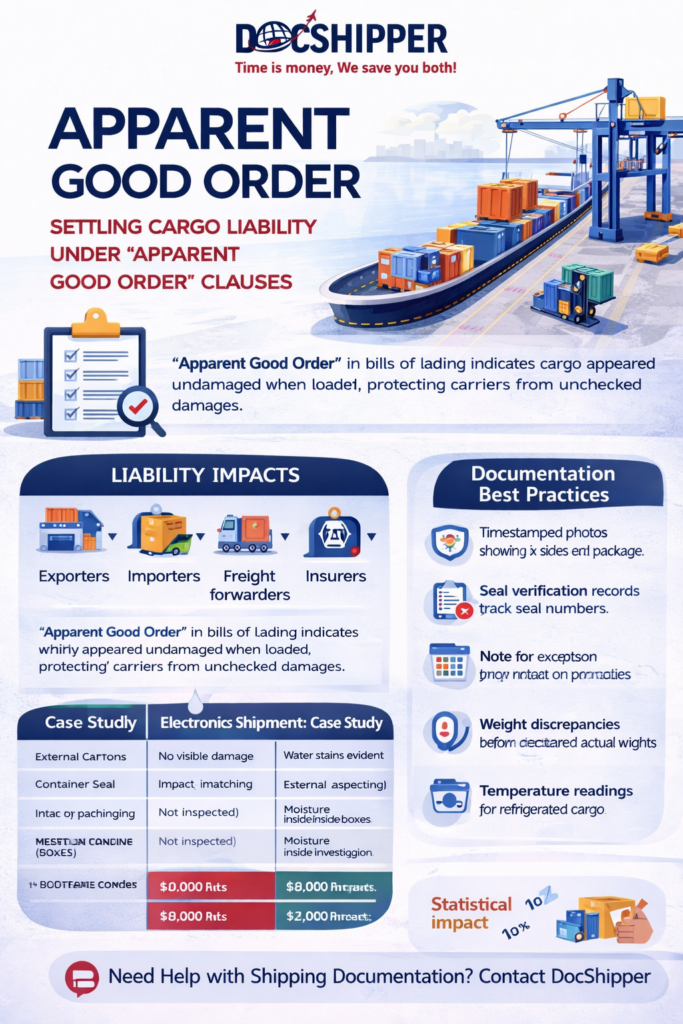
Apparent Good Order is a clause used in bills of lading indicating that cargo appeared externally undamaged when loaded. This notation protects carriers from liability for concealed damages not visible during inspection, establishing the condition baseline for shipment responsibility disputes.
Introduction
Every year, thousands of cargo disputes arise from misunderstandings about damage responsibility. The phrase “apparent good order” on shipping documents often becomes the focal point of these conflicts.
This clause represents a critical checkpoint in international logistics. It defines the carrier’s liability boundaries and establishes the cargo condition baseline at loading time.
Understanding this concept is essential for:
- Exporters protecting their interests during cargo handover
- Importers evaluating claims potential upon delivery
- Freight forwarders managing liability documentation
- Insurance companies determining coverage applicability
- Customs authorities verifying shipment integrity
The term directly impacts cargo insurance claims, payment disputes, and legal proceedings across maritime and air freight operations.
Legal Framework & Carrier Responsibilities
The apparent good order clause originates from international maritime conventions, particularly the Hague-Visby Rules. These regulations standardize carrier obligations worldwide.
When a carrier issues a clean bill of lading with this notation, they acknowledge only the external condition of packages. Internal damages, concealed defects, or content discrepancies fall outside this verification scope.
This creates a fundamental legal distinction. The carrier confirms three elements:
- Package integrity: No visible tears, dents, or structural damage
- Seal condition: Container seals intact and matching documentation
- Quantity verification: Number of packages matches the shipping order
However, carriers cannot verify internal cargo condition without opening sealed containers. This limitation protects them from liability for pre-existing damages.
The burden of proof shifts significantly. If damage appears upon delivery, the consignee must demonstrate it occurred during transit, not before loading. This often requires specialized surveys and documentation.
According to the Hague-Visby Rules, carriers maintain responsibility for cargo from loading to discharge, but only for damages occurring within their custody period under normal handling conditions.
At DocShipper, we systematically photograph cargo conditions during loading and document any pre-existing anomalies to protect both shippers and carriers from unfounded claims.
Practical Cases & Documentation Standards
Understanding apparent good order requires examining real-world scenarios where this clause determines liability outcomes.
Case Study: Electronics Shipment Dispute
A European importer received 500 laptop computers from Asia. The bill of lading stated “apparent good order” for 50 cartons. Upon delivery, 30 laptops showed water damage.
| Inspection Point | Loading Condition | Delivery Condition | Liability Outcome |
|---|---|---|---|
| External cartons | No visible damage | Water stains evident | Carrier responsible |
| Container seal | Intact, documented | Intact, matching | No breach of custody |
| Internal packaging | Not inspected | Moisture inside boxes | Requires investigation |
The investigation revealed container condensation during voyage. Despite the clean bill of lading, the carrier accepted partial liability because external water stains contradicted the “apparent good order” notation.
Documentation Best Practices
Effective protection requires comprehensive documentation at loading:
- Timestamped photographs: Capture all six sides of each package before loading
- Seal verification records: Document seal numbers with photographic evidence
- Exception notations: Record any visible anomalies on the mate’s receipt
- Weight discrepancies: Note any differences between declared and actual weights
- Temperature readings: For refrigerated cargo, record initial container temperatures
Statistical Impact
Industry data reveals significant patterns:
- 67% of cargo claims involve disputes over pre-shipment condition
- Clean bills of lading reduce claim processing time by 40%
- Proper documentation at loading decreases litigation costs by $12,000 average per dispute
- Container seal integrity verification prevents 23% of fraudulent claims
At DocShipper, our quality control teams conduct systematic pre-loading inspections, generating detailed condition reports that complement carrier documentation and protect client interests throughout the supply chain.
Conclusion
The apparent good order clause serves as the foundation for cargo liability determination in international shipping. Proper understanding and documentation protect all parties from costly disputes.
Need expert guidance on shipping documentation and cargo protection? Contact DocShipper for comprehensive logistics support.
📚 Quiz
Test Your Knowledge: Apparent Good Order
Q1 — What does the "Apparent Good Order" clause on a bill of lading confirm?
Q2 — A consignee discovers concealed water damage inside sealed cartons upon delivery, even though the bill of lading stated "apparent good order." Who bears the burden of proof?
Q3 — At the loading dock, you notice visible dents on several cartons before they are loaded. What is the correct course of action?
🎯 Your Result
📞 Free Quote in 24hFAQ | Apparent Good Order: Definition, Implications & Practical Examples
It indicates cargo appeared externally undamaged when loaded onto the vessel. The carrier confirms visible package condition without inspecting internal contents or verifying actual cargo quality.
No. It only establishes the external condition baseline. Carriers remain liable for damages occurring during transit, even with this clause. The burden shifts to proving when damage occurred.
Yes, but you must provide evidence. Photographs, independent surveys, or witness statements taken at loading time can challenge the carrier's assessment if visible damage existed.
A clean bill of lading contains no exception clauses and implies apparent good order. The phrase "apparent good order" may appear explicitly or be implied through absence of damage notations.
The carrier's representative, typically the ship's mate or terminal supervisor, conducts visual inspection during loading. They document observable package condition without opening sealed containers.
Insurance companies require proof of when damage occurred. A clean bill of lading suggests damage happened during transit, strengthening your claim against carrier liability insurance.
Not if you observe visible damage. Request a "claused" or "dirty" bill of lading documenting specific issues. This protects your ability to claim compensation later.
Notify the carrier immediately and arrange a joint survey. You'll need to prove the damage existed before delivery and wasn't caused by your handling. Time limits apply strictly.
Absolutely. Intact seals matching documentation support the apparent good order claim. Broken or mismatched seals indicate potential tampering, shifting liability considerations significantly.
Carriers may resist clausing bills of lading, as it affects negotiability. However, you have the right to accurate documentation. Insist on proper notation or obtain independent surveyor verification.
The clause establishes condition at loading time. Carrier responsibility extends until delivery, but proving transit damage becomes harder as time passes. Document delivery condition immediately upon receipt.
Keep loading photographs, packing lists, weight certificates, temperature logs for perishables, and any correspondence regarding cargo condition. These supplement the bill of lading during disputes.
Need Help with Logistics or Sourcing ?
First, we secure the right products from the right suppliers at the right price by managing the sourcing process from start to finish. Then, we simplify your shipping experience - from pickup to final delivery - ensuring any product, anywhere, is delivered at highly competitive prices.
Fill the Form
Prefer email? Send us your inquiry, and we’ll get back to you as soon as possible.
Contact us