


In short ⚡
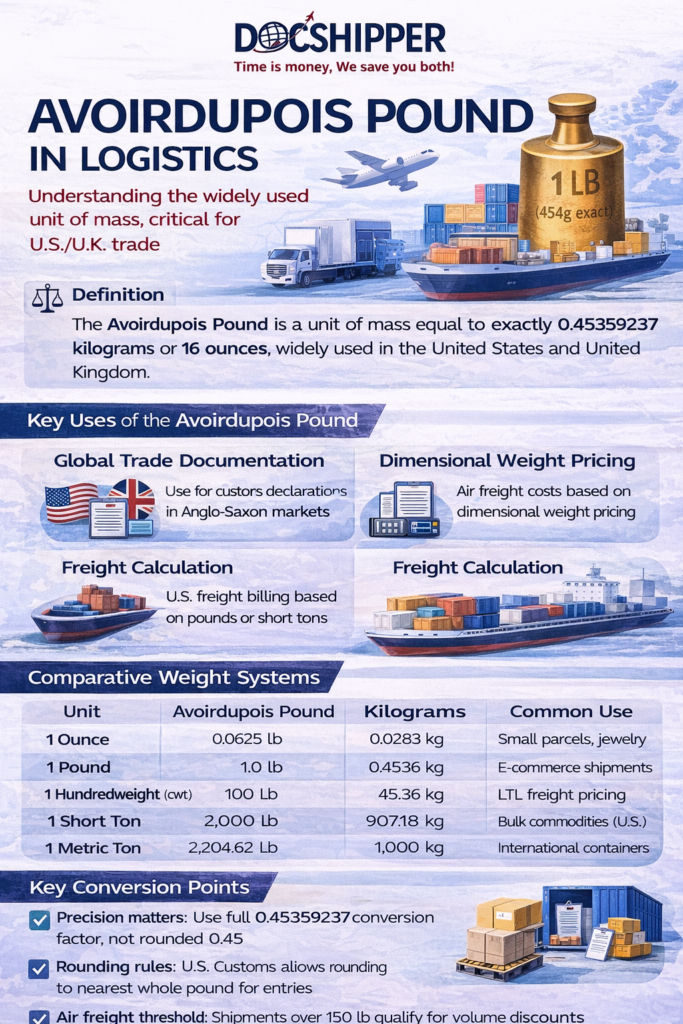
The Avoirdupois Pound is a unit of mass equal to exactly 0.45359237 kilograms or 16 ounces, widely used in the United States and United Kingdom for commercial weight measurement. This standardized weight system forms the foundation of international trade documentation, shipping calculations, and customs declarations across Anglo-Saxon markets.
Introduction
Confusion between pounds, kilograms, and tons causes thousands of shipping errors annually. Incorrect weight conversions lead to customs delays, freight cost miscalculations, and container loading mistakes.
The Avoirdupois Pound remains essential in international logistics despite global metrication. U.S. and U.K. markets—representing over $5 trillion in annual imports—require precise pound-based documentation for customs clearance and freight billing.
Key characteristics of the Avoirdupois system:
- Legal definition: Exactly 0.45359237 kg by international agreement since 1959
- Commercial dominance: Standard for U.S. and U.K. trade documentation
- Subdivision structure: 16 ounces per pound, 2,000 pounds per short ton
- Customs requirement: Mandatory for U.S. import declarations and bills of lading
- Freight calculation: Used for dimensional weight pricing in North American logistics
Understanding & Technical Expertise
The Avoirdupois system derives from medieval French commerce (“avoir du poids” meaning “goods of weight”). It became standardized in 1824 with the British Imperial Weights and Measures Act, distinguishing it from Troy pounds used for precious metals.
The international pound definition was unified in 1959 when English-speaking nations adopted the exact conversion: 1 lb = 0.45359237 kg. This precision eliminates ambiguity in international contracts and customs documentation.
For air freight calculations, the pound system introduces complexity. Airlines use dimensional weight (length × width × height ÷ 166 for inches) versus actual weight. Shippers must convert metric measurements to pounds or risk billing surprises.
The short ton versus metric ton distinction creates frequent errors. The U.S. short ton equals 2,000 pounds (907.18 kg), while the metric ton equals 2,204.62 pounds. Ocean freight contracts must specify which ton applies to avoid disputes.
Customs valuation in the United States requires net weight declarations in pounds on entry forms. The Harmonized Tariff Schedule bases duties on pound measurements for many commodity categories, making accurate conversion legally mandatory.
At DocShipper, we systematically verify weight conversions on all U.S.-bound shipments to prevent customs holds and ensure accurate freight quotes from carriers.
For authoritative conversion standards, consult the National Institute of Standards and Technology (NIST) guidelines on mass units.
Practical Examples & Data
Understanding pound conversions through real scenarios prevents costly logistics mistakes. The following data demonstrates common shipment calculations.
Comparative Weight Systems
| Unit | Avoirdupois Pounds | Kilograms | Common Use |
|---|---|---|---|
| 1 Ounce | 0.0625 lb | 0.0283 kg | Small parcels, jewelry |
| 1 Pound | 1.0 lb | 0.4536 kg | E-commerce shipments |
| 1 Hundredweight (cwt) | 100 lb | 45.36 kg | LTL freight pricing |
| 1 Short Ton | 2,000 lb | 907.18 kg | Bulk commodities (U.S.) |
| 1 Metric Ton | 2,204.62 lb | 1,000 kg | International containers |
Use Case: Electronics Shipment to New York
Scenario: A manufacturer ships 500 laptop units from Shenzhen to New York. Each laptop weighs 2.3 kg.
Calculation steps:
- Total metric weight: 500 units × 2.3 kg = 1,150 kg
- Conversion to pounds: 1,150 kg ÷ 0.45359237 = 2,535.28 lb
- Customs declaration: 2,535 lb (rounded to nearest pound)
- Freight class determination: Under 2,500 lb qualifies for LTL rates
- Dimensional weight check: 48″ × 40″ × 60″ ÷ 166 = 694 lb (actual weight governs)
Outcome: Accurate pound conversion saved $340 in freight charges by confirming actual weight pricing versus dimensional weight. Customs clearance proceeded without delays due to correct weight declaration.
DocShipper Platform
Cut logistics costs. Not corners.
See exactly where your logistics costs are bleeding — and how to fix it. Book your expert demo.

Key Conversion Points
- Precision matters: Use full 0.45359237 conversion factor, not rounded 0.45
- Rounding rules: U.S. Customs allows rounding to nearest whole pound for entries
- Air freight threshold: Shipments over 150 lb qualify for volume discounts
- Container maximums: 20ft containers limited to 44,000 lb; 40ft to 58,000 lb
- Documentation consistency: Match weight units across invoice, packing list, and BOL
Conclusion
Mastering Avoirdupois Pound conversions ensures accurate customs declarations, prevents freight billing errors, and maintains compliance across U.S. and U.K. supply chains. Precision in weight documentation directly impacts logistics costs and delivery timelines.
Need expert assistance with international weight conversions and shipping documentation? Contact DocShipper for comprehensive freight forwarding support.
📚 Quiz
Test Your Knowledge: Avoirdupois Pound
1. What is the exact value of one Avoirdupois Pound in kilograms, as standardized by international agreement in 1959?
2. A shipper declares a cargo weight using a U.S. short ton. How many pounds does this represent — and how does it differ from a metric ton?
3. A manufacturer ships 500 laptops from Shenzhen to New York, each weighing 2.3 kg. Which approach correctly converts the total weight for U.S. customs declaration?
🎯 Your Result
📞 Free Quote in 24hFAQ | Avoirdupois Pound: Definition, Calculation & Practical Examples
One Avoirdupois Pound equals exactly 0.45359237 kilograms by international definition. This precise conversion was standardized in 1959 and applies to all commercial and customs documentation.
The United States retains the Avoirdupois system due to established infrastructure, legal frameworks, and commercial practices. The Metric Conversion Act of 1975 made metrication voluntary, not mandatory, preserving pound-based commerce.
For air freight, multiply length × width × height (in inches), then divide by 166. For ocean freight, divide by 139. Compare this dimensional weight to actual weight—carriers charge whichever is greater.
A short ton (U.S. ton) equals 2,000 pounds or 907.18 kg. A metric ton equals 2,204.62 pounds or 1,000 kg. Always verify which ton your freight contract specifies to avoid billing disputes.
Yes. U.S. Customs and Border Protection requires net weight declarations in pounds on entry documentation. Metric weights must be converted using the official 0.45359237 conversion factor.
U.S. Customs allows rounding to the nearest whole pound for entry forms. However, freight carriers often require precise weights to one decimal place for billing accuracy. Check carrier requirements before rounding.
A hundredweight (cwt) equals 100 pounds in U.S. freight pricing. LTL carriers quote rates per hundredweight, making it essential to convert total shipment weight to cwt for cost calculations.
Standard 20-foot containers have a maximum payload of approximately 44,000 pounds (20,000 kg). 40-foot containers max at 58,000 pounds (26,300 kg). Exceeding these limits violates road safety regulations and carrier contracts.
No. Troy pounds (used for precious metals) equal 0.3732 kg, while Avoirdupois pounds equal 0.4536 kg. Commercial shipping always uses Avoirdupois measurements unless dealing with gold, silver, or gemstones.
Incorrect weight declarations can trigger customs examinations, penalty fees, and shipment delays. Significant discrepancies may result in fines up to the value of the goods or criminal charges for intentional fraud.
Professional freight forwarders use certified scales and standardized conversion software to ensure accuracy. At DocShipper, we verify all weight conversions against original manufacturer specifications and reweigh shipments when discrepancies appear.
Online calculators work for estimates, but official customs and freight documentation requires conversions using the exact 0.45359237 factor. Use verified tools or consult your freight forwarder to ensure compliance with legal standards.
Need Help with
Logistics or Sourcing ?
First, we secure the right products from the right suppliers at the right price by managing the sourcing process from start to finish. Then, we simplify your shipping experience - from pickup to final delivery - ensuring any product, anywhere, is delivered at highly competitive prices.


Fill the Form
Prefer email? Send us your inquiry, and we’ll get back to you as soon as possible.
Contact us




