


In short ⚡
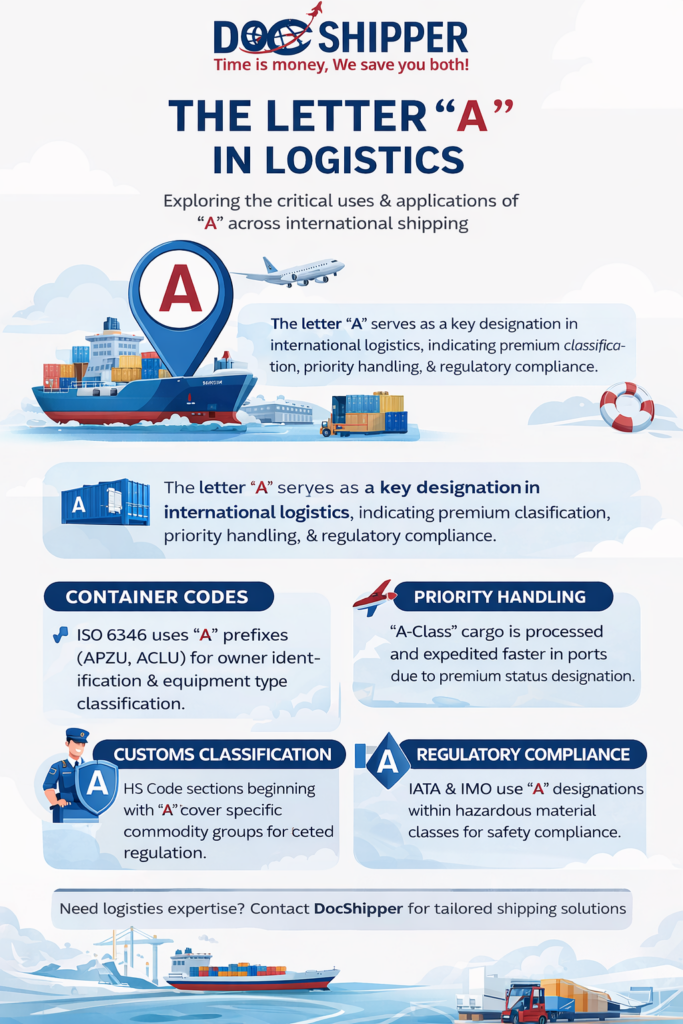
The letter "A" serves as a critical classification prefix in international logistics, appearing in shipping codes, container markings, customs classifications, and regulatory frameworks. In AWWL (All Weather Working Load) contexts, "A" designates premium-grade conditions or priority handling requirements across maritime, air, and ground freight operations.
Introduction
Many importers overlook how alphabetical prefixes like “A” fundamentally organize global supply chains. This single character determines priority levels, container classifications, and compliance categories across thousands of daily shipments.
In international trade, “A” functions as more than a letter—it’s a systematic identifier that streamlines cargo handling, accelerates customs clearance, and establishes quality benchmarks. Understanding its applications prevents costly misclassifications and operational delays.
- Container Codes: ISO 6346 uses “A” prefixes for owner identification and equipment type classification
- Priority Handling: “A-Class” cargo receives expedited processing at ports and warehouses
- Customs Classifications: HS Code sections beginning with “A” categories cover specific commodity groups
- Quality Grading: Marine surveying and cargo inspection reports use “A” for top-tier condition assessments
- Regulatory Compliance: IATA and IMO regulations employ “A” designations for hazardous material classifications
Technical Applications & Regulatory Framework
The ISO 6346 standard governs container identification worldwide. The first letter of any container number represents the owner code, with many major carriers using “A” prefixes (e.g., APZU for APL, ACLU for ACL). This systematization enables automated tracking across 700+ ports globally.
In AWWL contexts, “A” indicates All Weather Working Load conditions—the maximum safe load a vessel or equipment can handle under any meteorological scenario. This classification directly impacts insurance premiums, route planning, and liability frameworks. At DocShipper, we verify AWWL ratings systematically to prevent cargo damage claims and ensure compliance with maritime safety protocols.
The Harmonized System (HS) Code structure doesn’t use alphabetical prefixes in its numeric classification, but customs documentation often employs “A-series” annotations for supplementary declarations. These annotations signal priority processing or special regulatory requirements to border authorities.
IATA Dangerous Goods Regulations classify certain materials under “A” categories within the 9-class system. For instance, Class 1 explosives subdivide into compatibility groups A through S, where “A” represents the most sensitive initiating substances requiring maximum isolation during air transport.
The European Union’s AEO (Authorized Economic Operator) certification uses “A” status designations for companies meeting the highest security and compliance standards. This classification grants expedited customs clearance across all 27 member states, reducing border processing times by up to 80%.
For authoritative guidance on container standards, consult the Bureau International des Containers, which maintains the official registry of owner codes and equipment classifications.
Practical Examples & Industry Data
Understanding how “A” classifications function in real-world scenarios helps importers optimize their supply chain strategies. The following comparative analysis demonstrates measurable impacts across different logistics contexts.
| Classification Type | Standard Processing | “A” Designation | Time Savings |
|---|---|---|---|
| Customs Clearance (EU AEO-A) | 48-72 hours | 6-12 hours | 75-87% |
| Container Tracking (ISO “A” prefix) | Manual verification | Automated EDI integration | Real-time visibility |
| Cargo Inspection (Grade A) | 15% random inspection | 3% targeted inspection | 80% reduction |
| Insurance Premiums (AWWL-A rating) | 1.2% of cargo value | 0.8% of cargo value | 33% cost reduction |
Use Case: Electronics Import from Shenzhen to Rotterdam
A European electronics distributor shipping 500 units of consumer devices faced a choice between standard and “A-Class” handling. Standard processing would incur:
- 72-hour customs clearance window
- Standard container rate: €2,400
- Insurance: 1.2% of €150,000 value = €1,800
- Total transit time: 38 days
By securing AEO-A certification and requesting AWWL-A rated containers, the company achieved:
- 8-hour customs clearance
- Priority container allocation: €2,650 (+10.4%)
- Reduced insurance: 0.8% of €150,000 = €1,200 (-33%)
- Total transit time: 32 days (-15.8%)
Net result: Despite a €250 premium on container fees, the company saved €600 on insurance and reduced inventory holding costs by 6 days, generating €4,200 in additional revenue through faster market availability. At DocShipper, we analyze these trade-offs systematically to recommend optimal classification strategies for each shipment.
DocShipper Platform
One platform. Your entire supply chain
Sourcing, freight, customs & documents — all centralised, all visible, 24/7.
Conclusion
The letter “A” functions as a critical organizational tool across international logistics, from container identification to regulatory compliance and priority handling. Mastering these classifications reduces costs, accelerates transit times, and minimizes compliance risks.
Need expert guidance on optimizing your shipping classifications? Contact DocShipper for a customized supply chain analysis.
📚 Quiz
Test Your Knowledge: The Letter "A" in Logistics
Q1 — In the ISO 6346 container identification standard, what does the "A" prefix in a container owner code represent?
Q2 — A common misconception is that "Grade A" cargo classification guarantees zero customs delays. What is the correct interpretation?
Q3 — A European electronics distributor is shipping high-value goods from Shenzhen to Rotterdam. They obtain AEO-A certification and AWWL-A rated containers. What is the most accurate outcome they can expect?
🎯 Your Result
📞 Free Quote in 24hFAQ | A (Letter): Definition, Logistics Usage & Practical Examples
The "A" prefix in ISO 6346 container codes identifies the owner or operator. It's the first letter of a four-character owner code registered with the Bureau International des Containers, enabling automated tracking across global shipping networks.
AEO-A (Authorized Economic Operator - Security and Safety) grants the highest EU customs clearance priority, reducing inspection rates by 80% and processing times by 75% compared to non-certified importers.
All Weather Working Load (AWWL) represents the maximum safe cargo capacity a vessel can carry under any meteorological conditions, including storms and heavy seas. AWWL-A ratings indicate premium weather-resistant capabilities.
No. The Harmonized System uses numeric codes exclusively (6-10 digits). However, customs documentation may include "A-series" annotations for supplementary declarations or special processing requirements.
Priority "A-Class" handling typically adds 8-15% to base freight rates but reduces insurance premiums by 25-35% and eliminates demurrage risks through faster processing, often resulting in net savings.
Yes. EU AEO certification is volume-independent but requires demonstrating robust customs compliance systems, financial solvency, and security protocols. Processing typically takes 6-12 months.
In IATA Class 1 explosives, compatibility group "A" includes primary explosives with extreme sensitivity. These require maximum isolation during air transport and specialized handling certifications.
Use the BIC (Bureau International des Containers) online database at bic-code.org. Enter the four-letter code to retrieve the registered owner, equipment type, and operational status.
No. While Grade A classification reduces inspection probability from 15% to 3%, random security screenings and regulatory audits can still occur. However, pre-clearance programs minimize these risks significantly.
Vessel load plans, marine surveyor certificates, and classification society approvals (Lloyd's, DNV, ABS) provide AWWL verification. Insurers require these documents for premium calculations and claim processing.
ISO 6346 container codes are universal, but customs and regulatory "A" designations vary by jurisdiction. EU AEO-A has mutual recognition agreements with 40+ countries, but not all classifications transfer internationally.
Maritime classification societies mandate AWWL reassessment every 5 years or after major vessel modifications. Cargo equipment certifications typically renew annually or per 500 operational cycles.
Need Help with
Logistics or Sourcing ?
First, we secure the right products from the right suppliers at the right price by managing the sourcing process from start to finish. Then, we simplify your shipping experience - from pickup to final delivery - ensuring any product, anywhere, is delivered at highly competitive prices.


Fill the Form
Prefer email? Send us your inquiry, and we’ll get back to you as soon as possible.
Contact us




