In short ⚡
Additional charges are supplementary fees applied beyond the base freight cost in international shipping. These include customs duties, terminal handling charges, fuel surcharges, storage fees, and documentation costs. Understanding these expenses is crucial for accurate budgeting and avoiding unexpected costs during import/export operations.Introduction
Many importers face unpleasant surprises when their shipment costs exceed initial quotes by 30% or more. This discrepancy stems from additional charges—fees that appear throughout the supply chain but often remain hidden in initial pricing.
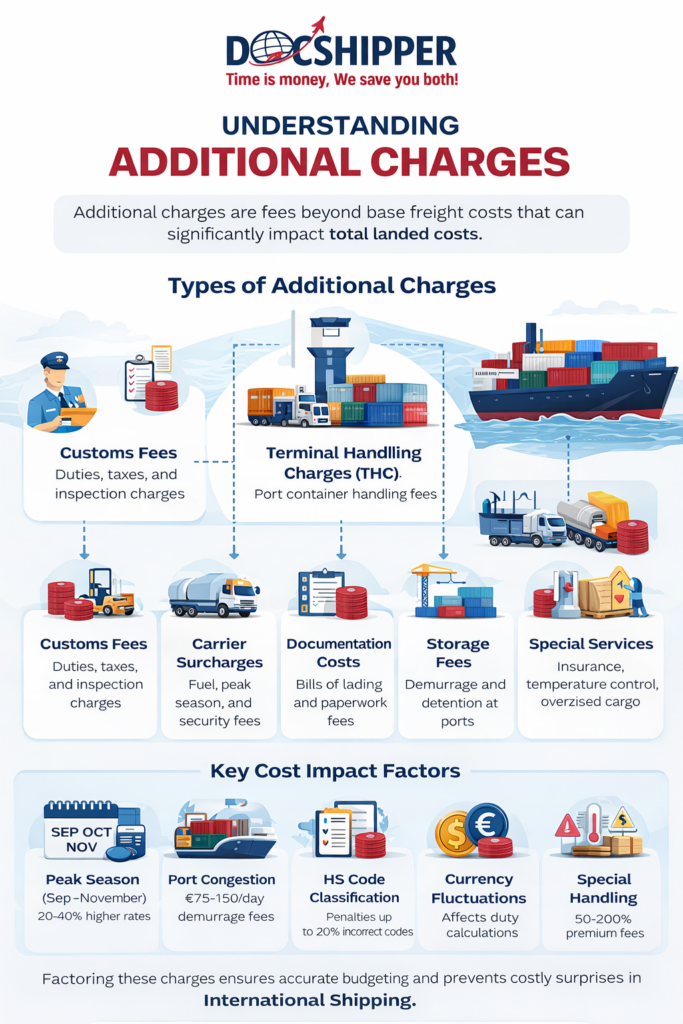
In international logistics, additional charges represent every cost beyond the basic ocean or air freight rate. These fees can significantly impact total landed costs and profit margins if not properly anticipated.
- Customs-related fees: Duties, taxes, inspection charges, and broker fees
- Terminal charges: Container handling, storage, and port operations
- Carrier surcharges: Fuel adjustments, peak season fees, security charges
- Documentation costs: Bill of lading fees, certificate charges, amendment fees
- Ancillary services: Insurance, packaging, special handling requirements
In-Depth Analysis & Expert Insights
Additional charges emerge at multiple touchpoints across the logistics chain. Understanding their legal basis and calculation methods prevents disputes and enables accurate cost forecasting.
Customs duties and taxes constitute the most significant category. Import duties are calculated based on the Harmonized System (HS) code classification, product origin, and destination country regulations. VAT or GST applies to the CIF value plus duties in most jurisdictions. According to World Customs Organization standards, proper classification is the importer’s legal responsibility.
Terminal handling charges (THC) cover container movements within port facilities. These fees vary significantly by port and can range from €50 to €300 per container. Origin THC is typically included in freight rates, while destination THC appears as a separate line item.
Fuel surcharges (BAF/CAF) fluctuate with oil prices. Carriers adjust these monthly based on bunker fuel costs. The Bunker Adjustment Factor for ocean freight or Fuel Surcharge for air cargo can add 10-25% to base rates during high fuel price periods.
Demurrage and detention fees penalize delays. Demurrage applies when containers remain at the terminal beyond free time (typically 5-7 days). Detention charges accrue when empty containers aren’t returned promptly. Rates escalate daily, reaching €100+ per container per day after the grace period.
At DocShipper, we provide detailed cost breakdowns before shipment, ensuring clients understand every charge component and can budget accordingly. Our customs clearance team verifies HS codes and duty rates to eliminate surprises at destination.
Concrete Examples & Data
Real-world scenarios illustrate how additional charges accumulate and impact total costs. These examples demonstrate the importance of comprehensive cost analysis.
Comparative Cost Breakdown: Shanghai to Rotterdam (20ft Container)
| Charge Type | Amount (€) | Notes |
|---|---|---|
| Base Ocean Freight | 1,200 | Port-to-port rate only |
| BAF (Bunker Adjustment) | 180 | 15% fuel surcharge |
| Origin THC | 85 | Shanghai terminal handling |
| Destination THC | 150 | Rotterdam terminal handling |
| Documentation Fee | 45 | Bill of lading issuance |
| Customs Clearance | 120 | Broker service fee |
| Import Duty (example) | 350 | Varies by HS code |
| VAT (21%) | 420 | Applied on CIF + duties |
| Total Landed Cost | 2,550 | 112% above base freight |
Use Case: Electronics Import from China to USA
A US retailer imports $50,000 worth of consumer electronics (HS code 8517.62). The shipment travels by air freight from Shenzhen to Los Angeles.
- Air freight (100kg): $850 base rate
- Fuel surcharge: $170 (20% of base)
- Security screening fee: $45
- Import duty (0% under HS 8517.62): $0
- Merchandise Processing Fee (0.3464%): $173
- Harbor Maintenance Fee (0.125%): $63
- Customs broker fee: $125
- Total additional charges: $576 (68% above base freight)
This example demonstrates that even duty-free products incur substantial additional charges. The actual shipping cost becomes $1,426—not the quoted $850.
Key Cost Variables
- Seasonality: Peak season surcharges (September-November) add 20-40% to Asia-Europe routes
- Port congestion: Delays trigger demurrage averaging €75-150 per day
- Product classification: Incorrect HS codes result in penalties up to 20% of cargo value
- Currency fluctuations: Exchange rate changes affect duty calculations on non-local currency invoices
- Special handling: Hazardous goods, temperature control, or oversized cargo incur 50-200% premium charges
Conclusion
Additional charges represent a critical component of international shipping costs, often doubling the initial freight quote. Proper identification and calculation of these fees ensures accurate budgeting and prevents cash flow disruptions.
Need expert guidance on managing additional charges for your shipments? Contact DocShipper for transparent pricing and comprehensive logistics support.
📚 Quiz
Test Your Knowledge: Additional Charges
Q1 — What are "additional charges" in international shipping?
Q2 — A shipment is delayed and the loaded container stays at the port terminal for 10 days beyond the free time. Which charge applies?
Q3 — A US retailer imports $50,000 of electronics by air. The carrier quotes a base rate of $850. What is the realistic total shipping cost after additional charges?
🎯 Your Result
📞 Free Quote in 24hFAQ | Additional Charges: Definition, Calculation & Concrete Examples
The most frequent charges include Terminal Handling Charges (THC), Bunker Adjustment Factor (BAF), container cleaning fees, documentation charges, and customs clearance costs. These typically add 40-70% to the base freight rate.
BAF is calculated as a percentage of the base freight rate, adjusted monthly based on global bunker fuel prices. Carriers publish BAF tables showing the percentage applied according to current fuel costs, typically ranging from 10-30%.
Some charges like base freight and certain surcharges can be negotiated with high-volume shippers. However, government-mandated fees (customs duties, taxes) and third-party charges (port fees) are non-negotiable.
Demurrage applies when loaded containers remain at the port terminal beyond free time. Detention charges accrue when empty containers aren't returned to the carrier within the allowed period after cargo removal.
No. Terminal handling charges, storage fees, and local surcharges vary significantly between ports based on infrastructure, labor costs, efficiency, and local regulations. Major hub ports often have lower per-unit costs.
Request a detailed all-inclusive quote specifying every fee component. Clarify responsibilities (FOB, CIF terms), verify HS code classifications before shipping, and ensure accurate documentation to prevent amendment fees or penalties.
Documentation fees cover the issuance of shipping documents like Bills of Lading, certificates of origin, and commercial invoices. These typically range from $25-75 per shipment depending on document complexity.
Not necessarily. While air freight has different charge structures, it includes fuel surcharges, security fees, handling charges, and customs costs. The total percentage of additional charges is often similar to ocean freight.
Import duties are calculated by multiplying the customs value (usually CIF) by the duty rate assigned to the product's HS code. Rates vary by product category and country of origin, ranging from 0% to over 30%.
Peak season surcharges (PSS) are temporary fees applied during high-demand periods, typically before major holidays. These can add $300-1,000 per container on popular routes during peak months.
VAT-registered businesses can typically reclaim import VAT through their regular VAT returns, subject to local tax regulations. However, customs duties and other fees are generally non-recoverable costs.
Refusing to pay legitimate additional charges results in cargo detention at the port or warehouse. The carrier or customs authority will hold your goods until all fees are settled, with daily storage charges accumulating.
Need Help with Logistics or Sourcing ?
First, we secure the right products from the right suppliers at the right price by managing the sourcing process from start to finish. Then, we simplify your shipping experience - from pickup to final delivery - ensuring any product, anywhere, is delivered at highly competitive prices.
Fill the Form
Prefer email? Send us your inquiry, and we’ll get back to you as soon as possible.
Contact us