


In short ⚡
The Balanced Scorecard is a strategic management framework that translates an organization's vision into actionable objectives across four perspectives: financial, customer, internal processes, and learning & growth. It enables businesses to measure performance beyond traditional financial metrics, ensuring alignment between operational activities and long-term strategic goals.
Introduction
Many logistics companies struggle with a common challenge: measuring success solely through financial reports. This narrow focus misses critical operational inefficiencies, customer satisfaction gaps, and employee development needs.
In international trade and logistics, the Balanced Scorecard provides a comprehensive view of organizational health. It connects daily warehouse operations to strategic expansion goals, ensuring every team member understands how their work contributes to company success.
- Multi-dimensional assessment: Evaluates performance across four interconnected perspectives rather than finance alone
- Strategic alignment: Links operational KPIs directly to long-term business objectives
- Cause-and-effect relationships: Reveals how improvements in one area drive results in others
- Communication tool: Translates complex strategy into understandable metrics for all organizational levels
- Continuous improvement mechanism: Facilitates regular review cycles and adaptive strategy refinement
Strategic Framework & Implementation Expertise
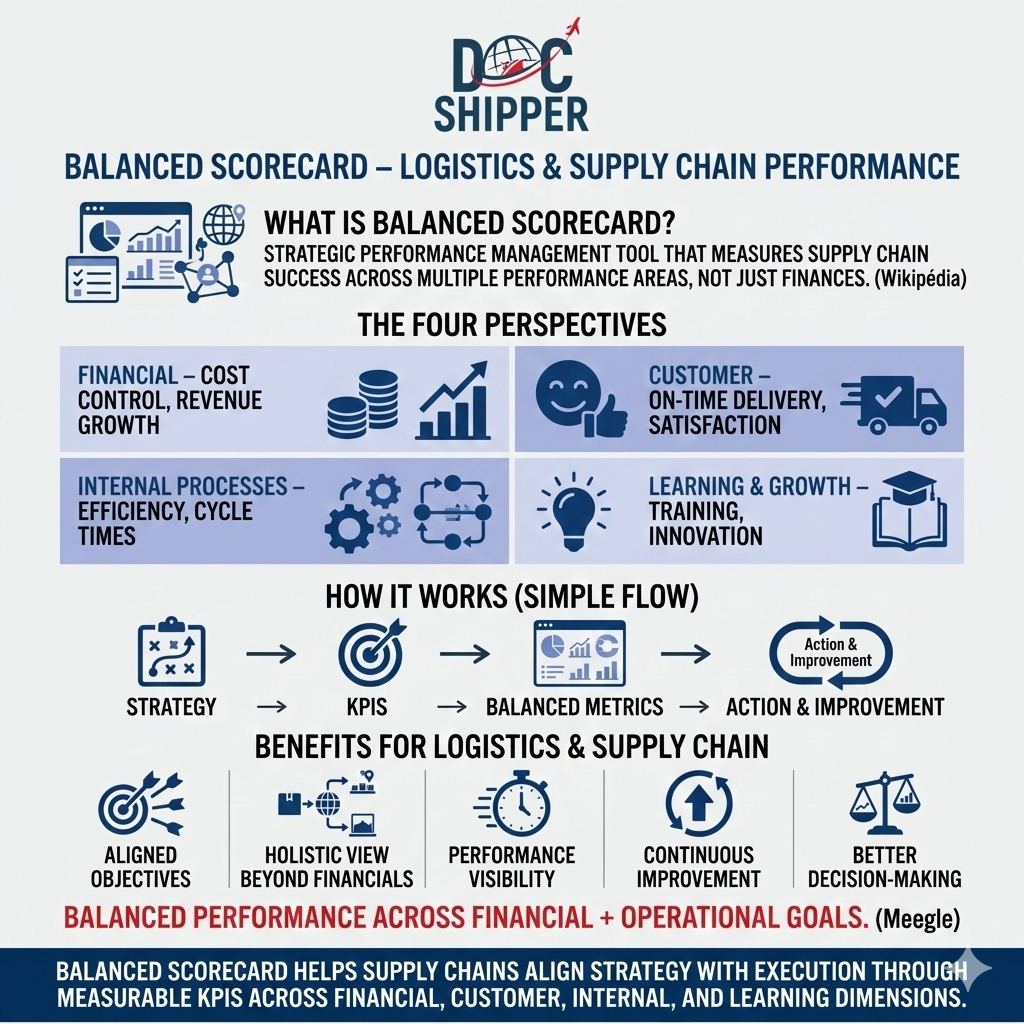
The Balanced Scorecard operates on four fundamental perspectives that create a holistic performance measurement system. Each perspective addresses specific strategic questions while maintaining interdependence.
Financial Perspective answers “How do we look to shareholders?” Traditional metrics like revenue growth, profit margins, and return on investment remain essential. In logistics, this includes cost per shipment, revenue per customer, and working capital efficiency. These indicators validate whether strategic initiatives translate into economic value.
Customer Perspective examines “How do customers see us?” Metrics include on-time delivery rates, customer satisfaction scores, complaint resolution time, and market share within target segments. For freight forwarders, tracking Net Promoter Score (NPS) and customer retention rates reveals competitive positioning beyond price considerations.
Internal Process Perspective investigates “What must we excel at?” This focuses on operational excellence—warehouse throughput rates, customs clearance times, documentation accuracy, and supply chain visibility. At DocShipper, we systematically monitor these process metrics to identify bottlenecks before they impact customer deliveries, ensuring seamless international shipments.
Learning & Growth Perspective addresses “Can we continue to improve and create value?” Employee training hours, technology adoption rates, innovation pipeline strength, and organizational culture indicators fall here. Logistics companies investing in customs compliance training and digital platform proficiency demonstrate commitment to sustainable competitive advantage.
Implementation requires establishing cause-and-effect linkages between perspectives. For example, investing in employee training (Learning & Growth) improves documentation accuracy (Internal Process), which reduces customs delays, enhancing on-time delivery (Customer), ultimately increasing customer retention and revenue (Financial). According to the Balanced Scorecard Institute, organizations using this framework report 30% higher strategic goal achievement rates compared to traditional management approaches.
Practical Examples & Performance Data
A mid-sized freight forwarder implemented the Balanced Scorecard to address stagnant growth despite acceptable profit margins. Their strategic map revealed disconnects between operational efficiency and customer satisfaction.
| Perspective | Key Metric | Baseline | 12-Month Target | Actual Result |
|---|---|---|---|---|
| Financial | Revenue Growth | 2.5% | 12% | 14.3% |
| Customer | On-Time Delivery Rate | 87% | 95% | 96% |
| Internal Process | Customs Clearance Time | 4.2 days | 2.5 days | 2.3 days |
| Learning & Growth | Employee Training Hours/Year | 12 hours | 40 hours | 45 hours |
Use Case Analysis: The company identified that customs delays stemmed from incomplete documentation. By investing in employee training on harmonized tariff codes and regulatory compliance (Learning & Growth), documentation accuracy improved from 82% to 97%. This reduced customs clearance times by 45%, directly improving on-time delivery rates. Satisfied customers increased order frequency, driving revenue growth beyond initial projections.
Key Implementation Insights:
- Strategic theme alignment: All metrics connected to the core theme “Operational Excellence Drives Customer Loyalty”
- Leading vs. lagging indicators: Training hours (leading) predicted future delivery performance (lagging)
- Review frequency: Monthly operational reviews, quarterly strategic assessments
- Technology integration: Dashboard software automated data collection from TMS and CRM systems
- Cultural shift: Department heads became accountable for cross-functional outcomes, not just siloed targets
Industry data shows logistics companies using Balanced Scorecards achieve 18% higher customer retention rates and 22% better employee engagement scores compared to peers relying solely on financial metrics. The framework’s strength lies in making strategy tangible and measurable at every organizational level.
DocShipper Platform
Optimize Your Global Logistics with Cutting-Edge Solutions
Enhance efficiency, cut costs, and gain 24/7 visibility 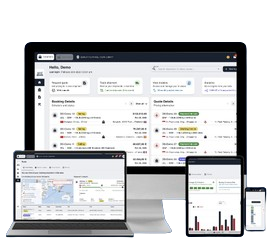 over your entire supply chain.
- Cut your shipping costs and maximize your margins
- Manage sourcing, freight, & customs on one platform
- Get real-time tracking and analytics
Conclusion
The Balanced Scorecard transforms strategic planning from abstract vision into measurable action. For logistics providers navigating complex international markets, it ensures operational decisions consistently support long-term competitive positioning.
Need expert guidance implementing performance management systems for your supply chain operations? Contact DocShipper for tailored solutions that align your logistics strategy with business objectives.
📚 Quizz
Test Your Knowledge: Balanced Scorecard
Q1 — What is the primary purpose of the Balanced Scorecard?
Q2 — A logistics company invests heavily in customs compliance training for its staff. According to the Balanced Scorecard's cause-and-effect logic, which chain of outcomes best describes the expected result?
Q3 — A freight forwarder notices that reducing delivery times improves customer satisfaction but temporarily raises operational costs. How does the Balanced Scorecard handle this conflict?
🎯 Your Result
📞 Free Quote in 24hFAQ | Balanced Scorecard: Definition, Implementation & Concrete Examples
Traditional systems focus primarily on financial outcomes, while the Balanced Scorecard integrates customer satisfaction, internal process efficiency, and organizational learning. This multi-dimensional approach prevents short-term financial optimization at the expense of long-term strategic health.
Best practice recommends 4-7 metrics per perspective, totaling 16-28 measures organization-wide. Too many metrics dilute focus, while too few miss critical performance dimensions. Prioritize metrics with clear cause-and-effect relationships to strategic objectives.
Absolutely. Small firms often implement simplified versions with 10-12 core metrics. The framework scales effectively, helping growing companies establish performance discipline before complexity overwhelms intuitive management approaches.
Operational metrics (internal processes, customer) warrant monthly review, while strategic indicators (financial, learning & growth) typically receive quarterly assessment. Annual reviews should evaluate whether metrics still align with evolving strategic priorities.
Software platforms automate data collection, visualization, and reporting, reducing manual effort by 60-70%. However, technology serves the strategy—successful implementation depends on clear objectives and organizational buy-in, not sophisticated dashboards alone.
The framework explicitly maps trade-offs through strategy maps. For example, reducing delivery times (customer perspective) may temporarily increase costs (financial perspective). Leadership uses these maps to make informed resource allocation decisions aligned with strategic priorities.
Frequent mistakes include selecting too many metrics, failing to establish cause-and-effect linkages, treating the scorecard as an IT project rather than strategic initiative, and neglecting regular review cycles. Successful implementations treat it as an ongoing management process, not a one-time exercise.
By including compliance metrics in the Internal Process perspective—such as customs documentation accuracy, regulatory training completion rates, and audit findings—companies proactively manage compliance risks before they escalate into penalties or shipment delays.
Yes. Many logistics providers align Balanced Scorecard metrics with ISO 9001 quality objectives, creating unified performance frameworks. The scorecard's strategic focus complements ISO's process-oriented approach, providing context for why specific quality standards matter.
Initial setup typically requires 40-80 hours of management time for strategy mapping and metric selection, plus potential software costs ($2,000-$15,000 annually depending on organization size). The primary investment is cultural—committing to data-driven decision-making and cross-functional accountability.
Modern implementations incorporate environmental and social metrics across all four perspectives. Carbon emissions per shipment (Internal Process), customer sustainability ratings (Customer), green investment ROI (Financial), and employee diversity training (Learning & Growth) integrate ESG commitments into core strategy.
Strategy maps visually depict cause-and-effect relationships between objectives across the four perspectives, showing how achieving one goal enables others. The Balanced Scorecard translates these objectives into specific, measurable KPIs with targets and initiatives. Maps provide the "why," scorecards deliver the "what" and "how much."
Need Help with
Logistics or Sourcing ?
First, we secure the right products from the right suppliers at the right price by managing the sourcing process from start to finish. Then, we simplify your shipping experience - from pickup to final delivery - ensuring any product, anywhere, is delivered at highly competitive prices.


Fill the Form
Prefer email? Send us your inquiry, and we’ll get back to you as soon as possible.
Contact us




