


In short ⚡
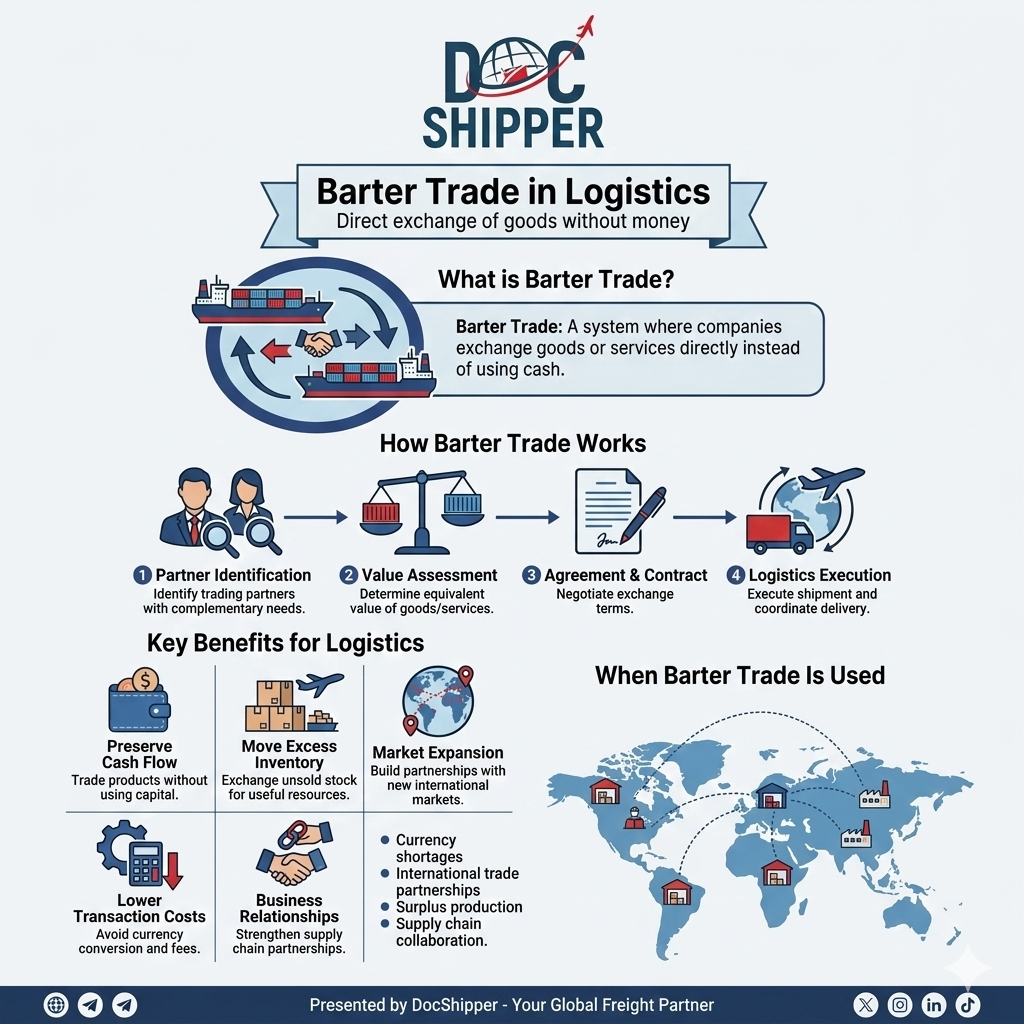
Barter is a direct exchange of goods or services between parties without using monetary currency. In international trade, barter enables countries and companies to transact when currency shortages, sanctions, or trade imbalances exist, creating alternative pathways for cross-border commerce outside traditional financial systems.Introduction
Many businesses assume international trade requires hard currency. This misconception overlooks barter—one of humanity’s oldest commercial practices still thriving in modern global commerce. When financial systems fail, currencies fluctuate wildly, or political sanctions restrict monetary transfers, barter becomes essential.
In import/export operations, barter addresses critical challenges. Companies facing liquidity constraints can acquire needed goods. Nations under economic sanctions maintain trade relationships. Emerging markets overcome foreign exchange shortages.
Key characteristics of modern barter transactions include:
- Direct exchange of goods/services without cash intermediation
- Valuation agreements establishing equivalent worth between traded items
- Documentation requirements for customs and tax authorities
- Contractual frameworks defining delivery terms and quality standards
- Risk mitigation through escrow mechanisms or third-party verification
Mechanisms & Legal Framework
Barter transactions in international trade operate through structured agreements that establish equivalency values between exchanged goods. Unlike simple swaps, modern barter requires detailed contracts specifying quantities, quality standards, delivery schedules, and dispute resolution mechanisms.
The valuation process represents the critical challenge. Parties must agree on fair market values for dissimilar goods. This typically involves independent appraisals, reference to international commodity prices, or established industry benchmarks. Without monetary exchange, determining “fair value” becomes both an economic and negotiation exercise.
From a customs perspective, barter transactions require special documentation. Most jurisdictions mandate declaring the commercial value of bartered goods for duty calculation purposes. The World Customs Organization provides guidelines on valuing non-monetary transactions, emphasizing transaction value principles even when no cash changes hands.
Tax implications vary significantly by jurisdiction. Many countries treat barter as taxable events equivalent to sales, requiring companies to report the fair market value of received goods as revenue. Double taxation can occur when both parties report income without corresponding cash flow to pay taxes.
The legal framework governing international barter draws from multiple sources: bilateral trade agreements, the Vienna Convention on Contracts for the International Sale of Goods (CISG), and domestic contract law. Parties must carefully structure agreements to address jurisdiction, applicable law, and enforcement mechanisms.
At DocShipper, we assist clients in structuring barter agreements to ensure customs compliance, proper valuation documentation, and risk mitigation throughout the exchange process. Our experience shows that successful barter requires meticulous planning beyond simple product swaps.
Practical Examples & Data
Barter remains prevalent in specific trade corridors and industries. Understanding real-world applications demonstrates its continued relevance in modern commerce.
Comparative Scenarios
| Scenario | Context | Barter Structure | Key Advantage |
|---|---|---|---|
| Oil-for-Goods | Sanctioned nation needs consumer products | Crude oil exchanged for machinery, food, pharmaceuticals | Bypasses financial sanctions |
| Counter-purchase | Aircraft manufacturer selling to emerging market | Aircraft delivered; seller agrees to purchase local agricultural products | Facilitates sale when buyer lacks hard currency |
| Offset agreements | Defense contractor winning government contract | Military equipment exchanged for technology transfer and local sourcing commitments | Meets local content requirements |
| Commodity swap | Mining companies in different regions | Copper from South America swapped for rare earth metals from Africa | Reduces shipping costs and currency risk |
DocShipper Platform
Optimize Your Global Logistics with Cutting-Edge Solutions
Enhance efficiency, cut costs, and gain 24/7 visibility  over your entire supply chain.
- Cut your shipping costs and maximize your margins
- Manage sourcing, freight, & customs on one platform
- Get real-time tracking and analytics
Quantified Case Study
Scenario: European pharmaceutical company exchanges €2 million worth of medical equipment with Brazilian coffee exporter.
- Equipment value: €2 million (10 MRI machines at €200,000 each)
- Coffee equivalent: 500 metric tons premium Arabica at €4,000/ton
- Customs duties saved: Brazil avoids 18% import duty on equipment (€360,000)
- Currency risk eliminated: No exposure to EUR/BRL fluctuations (historically 15-20% annual volatility)
- Documentation required: Barter agreement, independent valuation certificates, customs declarations showing “goods in exchange”
This arrangement allowed the Brazilian company to modernize production facilities without foreign exchange expenditure, while the European firm secured premium coffee supply at favorable terms. Both parties avoided currency conversion costs (typically 2-3% of transaction value) and reduced payment risk.
Industry data suggests barter and countertrade account for 15-20% of global trade volume, particularly concentrated in aerospace, defense, energy, and agricultural sectors. The practice peaks during periods of currency instability or geopolitical tension.
Conclusion
Barter represents a sophisticated alternative to monetary transactions in international trade, particularly valuable when traditional financial channels prove inadequate. Successful implementation requires rigorous valuation, comprehensive legal agreements, and thorough customs compliance.
Need assistance structuring a barter transaction or navigating customs requirements for non-monetary exchanges? Contact DocShipper for expert guidance tailored to your specific trade situation.
📚 Quiz
Barter in International Trade
Q1. What is the defining characteristic of a barter transaction in international trade?
Q2. A company receives €2 million worth of coffee through a barter deal. Does this create a tax obligation?
Q3. A defense contractor wins a government contract in an emerging market and agrees to source components locally and transfer technology in return for the deal. Which barter structure does this best illustrate?
🎯 Your Result
📞 Free Quote in 24hFAQ | Barter in International Trade: Definition, Mechanisms & Practical Examples
Yes, barter is legal in most jurisdictions. However, it requires proper documentation for customs and tax purposes. Parties must declare the fair market value of exchanged goods and comply with import/export regulations applicable to the specific commodities involved.
Customs typically require declaration of the transaction value—the fair market price the goods would command in an arm's-length sale. Independent appraisals, commodity market prices, or comparable sales data establish this value for duty calculation purposes.
Key risks include valuation disputes, quality discrepancies, delivery timing mismatches, and tax complications. Without cash flow, resolving disagreements becomes more complex. Comprehensive contracts with clear specifications and dispute resolution mechanisms mitigate these risks.
Absolutely. Service barter is common in international trade—engineering services exchanged for raw materials, consulting for technology transfer, or logistics services for manufactured goods. Valuation and documentation principles remain the same.
Barter involves direct, simultaneous exchange of goods. Countertrade encompasses broader arrangements including counter-purchase (separate contracts with reciprocal obligations), offset agreements (conditional purchasing commitments), and buyback arrangements (payment in resultant products). Barter is the simplest form of countertrade.
Most tax authorities treat barter as taxable events. Companies must report the fair market value of received goods as revenue, potentially creating tax liability without corresponding cash to pay taxes. Consult tax professionals familiar with barter treatment in relevant jurisdictions.
Aerospace, defense, energy, agriculture, and commodities sectors lead barter usage. These industries often involve large-value transactions, government procurement, or trade with countries facing currency constraints—conditions where barter provides strategic advantages.
Independent third-party appraisals, reference to published commodity prices, industry benchmarks, and recent comparable transactions establish fair values. Contractual provisions allowing for periodic revaluation or adjustment mechanisms protect both parties from market fluctuations.
Most modern trade agreements focus on tariff reductions and monetary transactions but don't prohibit barter. The Vienna Convention on Contracts for the International Sale of Goods (CISG) applies to barter transactions, providing legal framework for contract formation and performance.
Yes. Barter reduces entry barriers in markets with currency restrictions or limited access to foreign exchange. It demonstrates commitment to local economies, facilitates relationship building, and enables transactions that would otherwise be financially impossible.
Critical documents include: detailed barter agreement specifying goods/services, quantities, quality standards, and delivery terms; independent valuation certificates; customs declarations showing exchange nature; transport documents; and certificates of origin. Proper documentation ensures customs clearance and tax compliance.
Barter eliminates cash outflows for purchases but also removes cash inflows from sales. Companies must carefully manage inventory, as received goods may not convert to cash immediately. Successful barter requires strategic planning to align received goods with business needs or resale opportunities.
Need Help with
Logistics or Sourcing ?
First, we secure the right products from the right suppliers at the right price by managing the sourcing process from start to finish. Then, we simplify your shipping experience - from pickup to final delivery - ensuring any product, anywhere, is delivered at highly competitive prices.


Fill the Form
Prefer email? Send us your inquiry, and we’ll get back to you as soon as possible.
Contact us




