In short ⚡
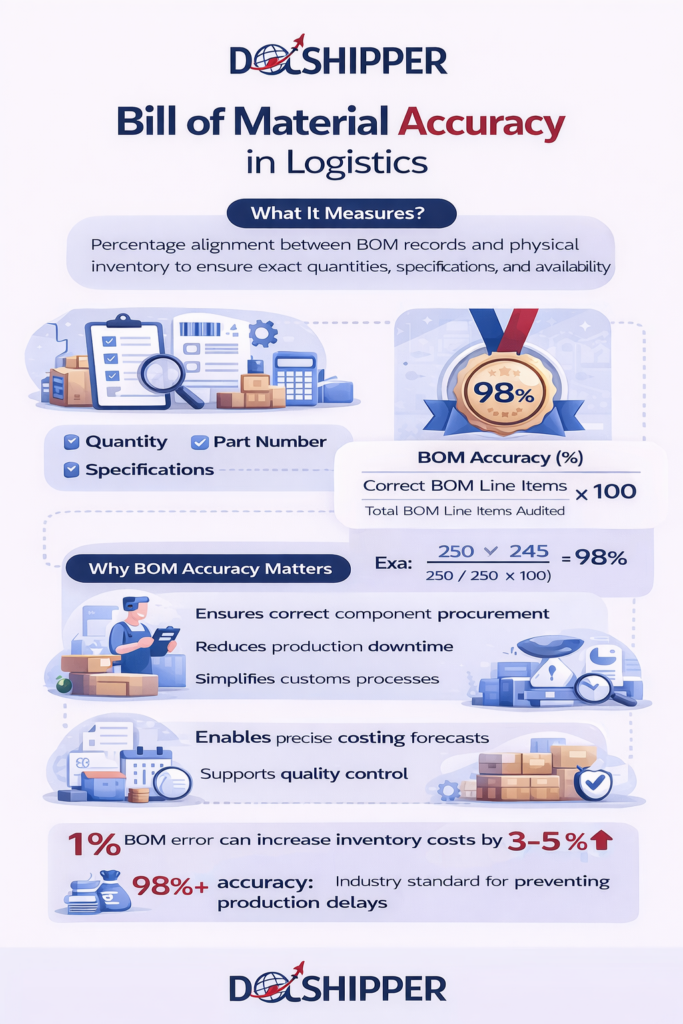
Bill of Material Accuracy is a key performance indicator measuring the precision between physical inventory components and BOM records. It represents the percentage of materials correctly listed in quantities, specifications, and availability, directly impacting production efficiency and supply chain reliability.
Introduction
Manufacturing delays, production halts, and costly expedited shipments often stem from a single overlooked issue: inaccurate Bills of Material. When component lists don’t match physical inventory, entire production lines can grind to a halt.
In international trade and manufacturing, BOM accuracy determines whether shipments arrive complete, customs clearances proceed smoothly, and production schedules remain intact. This metric directly affects lead times, inventory costs, and customer satisfaction.
- Ensures correct component procurement and prevents stockouts
- Reduces production downtime caused by material mismatches
- Facilitates accurate customs declarations for imported materials
- Enables precise costing and financial forecasting
- Supports quality control and regulatory compliance
Technical Framework & Operational Impact
Bill of Material Accuracy measures the conformity rate between documented component requirements and actual inventory availability. This metric encompasses quantity precision, part number correctness, specification alignment, and lead time accuracy.
The calculation methodology typically compares audited BOM line items against physical counts. Organizations establish tolerance thresholds—commonly 98% or higher for critical manufacturing operations. Below this threshold, production risks escalate exponentially.
Inventory reconciliation cycles determine measurement frequency. High-volume manufacturers conduct daily cycle counts on critical components, while lower-volume operations may perform weekly or monthly audits. Advanced ERP systems automate variance detection through real-time tracking.
The regulatory dimension becomes crucial in international logistics. Customs authorities require precise material declarations. Inaccurate BOMs can trigger inspections, delays, or penalties. The World Customs Organization Harmonized System mandates detailed component listings for tariff classification.
Cost implications extend beyond immediate production. Inaccurate BOMs generate excess safety stock, obsolete inventory, and emergency procurement premiums. Studies indicate that 1% BOM inaccuracy can increase total inventory costs by 3-5%.
At DocShipper, we systematically verify BOM accuracy before international shipments to prevent customs complications and ensure complete order fulfillment across global supply chains.
Calculation Methods & Concrete Examples
The standard formula for Bill of Material Accuracy is:
BOM Accuracy (%) = (Correct BOM Line Items / Total BOM Line Items Audited) × 100
A line item is considered correct only when quantity, part number, unit of measure, and specifications match physical inventory exactly. Partial matches count as errors.
Comparative Accuracy Scenarios
| Scenario | Line Items Audited | Correct Items | Accuracy Rate | Operational Impact |
|---|---|---|---|---|
| Electronics Assembly | 250 | 247 | 98.8% | Acceptable – Minor adjustments |
| Automotive Parts | 180 | 171 | 95.0% | Critical – Production delays likely |
| Medical Devices | 420 | 418 | 99.5% | Excellent – Regulatory compliant |
| Consumer Goods | 310 | 289 | 93.2% | Problematic – Immediate action required |
Practical Use Case: International Shipment Verification
Scenario: A European manufacturer ships electronic components to an assembly facility in Vietnam.
- BOM lists 85 component types across 12 product variants
- Physical audit reveals: 82 components match exactly, 2 have quantity discrepancies, 1 has incorrect part revision
- Calculation: (82 / 85) × 100 = 96.5% accuracy
- Consequence: The 3.5% error rate delays customs clearance by 4 days, incurring $2,800 in demurrage charges
- Corrective action: Implement pre-shipment BOM verification, increasing accuracy to 99.1% within two months
Key Performance Thresholds
- 99%+ accuracy: World-class performance, minimal disruption risk
- 95-98% accuracy: Acceptable for low-complexity products, improvement needed for critical operations
- 90-95% accuracy: Problematic, significant production and cost risks
- Below 90%: Critical failure, immediate system overhaul required
- Industry benchmark: Leading manufacturers maintain 98-99.5% BOM accuracy consistently
Conclusion
Bill of Material Accuracy directly determines production reliability, inventory optimization, and international logistics efficiency. Maintaining precision above 98% prevents costly disruptions and ensures regulatory compliance.
Need expert support managing BOM accuracy in your international supply chain? Contact DocShipper for comprehensive logistics solutions.
📚 Quiz
Test Your Knowledge: Bill of Material Accuracy
Q1 — What does Bill of Material Accuracy measure?
Q2 — A BOM line item is audited: the part number matches, but the quantity is slightly off. How should this be counted in the BOM Accuracy calculation?
Q3 — A European manufacturer ships 85 component types to Vietnam. A pre-shipment audit finds 82 exact matches, 2 quantity discrepancies, and 1 wrong part revision. What is the BOM accuracy rate, and what is the most likely consequence?
🎯 Your Result
📞 Free Quote in 24hFAQ | Bill of Material Accuracy: Definition, Calculation & Practical Examples
Industry standards typically require 98% or higher for manufacturing operations. Critical industries like aerospace or medical devices often mandate 99%+ accuracy to meet regulatory requirements and prevent safety issues.
High-volume manufacturers conduct daily cycle counts on critical components. Mid-volume operations typically perform weekly audits, while low-volume facilities may measure monthly. Frequency depends on production complexity and inventory turnover rates.
Common causes include manual data entry errors, engineering change orders not updated in systems, supplier substitutions without documentation, unit of measure discrepancies, and outdated ERP records during component sourcing transitions.
ERP systems track changes and flag discrepancies, but cannot guarantee accuracy alone. Physical cycle counts, barcode scanning, RFID tracking, and regular audits remain essential to verify system data against actual inventory.
Inaccurate BOMs create mismatches between declared shipment contents and physical goods, triggering inspections, delays, or penalties. Customs authorities require precise component listings for tariff classification and trade compliance verification.
BOM accuracy measures correctness of component lists for production, while inventory accuracy measures physical stock levels against records. Both metrics are interconnected—poor inventory accuracy often causes BOM discrepancies.
Engineering change orders (ECOs) modify component specifications, quantities, or substitutions. Without synchronized updates across procurement, production, and inventory systems, ECOs create immediate BOM inaccuracies affecting multiple production runs.
Accurate BOMs enable precise material cost calculations, labor allocation, and overhead distribution. Inaccuracies cause budget overruns, incorrect pricing, and flawed profitability analysis, particularly in make-to-order manufacturing environments.
Blockchain creates immutable records of component sourcing, specifications, and changes across supply chain partners. This transparency reduces discrepancies in multi-tier manufacturing networks, though implementation costs remain significant for many organizations.
JIT systems require near-perfect BOM accuracy since minimal buffer inventory exists. Even 1-2% inaccuracy can halt production immediately, making 99%+ accuracy essential for lean manufacturing operations.
Studies show 1% BOM inaccuracy increases total inventory costs by 3-5% through excess safety stock, expedited shipping, production downtime, and obsolete materials. Annual costs can reach hundreds of thousands for mid-sized manufacturers.
Multi-level BOMs contain sub-assemblies with their own component lists. Errors propagate through levels—a 2% inaccuracy at level 3 can create 6-8% discrepancies at the finished product level, requiring hierarchical audit approaches.
Need Help with Logistics or Sourcing ?
First, we secure the right products from the right suppliers at the right price by managing the sourcing process from start to finish. Then, we simplify your shipping experience - from pickup to final delivery - ensuring any product, anywhere, is delivered at highly competitive prices.
Fill the Form
Prefer email? Send us your inquiry, and we’ll get back to you as soon as possible.
Contact us