


In short ⚡
COGSA (Carriage of Goods by Sea Act) is a United States federal law enacted in 1936 that governs the rights and liabilities of shippers and carriers during ocean freight transport. It establishes the minimum liability standards for cargo damage, loss, or delay, limiting carrier responsibility to $500 per package unless higher value is declared and paid for.Introduction
Every year, thousands of importers face unexpected losses when cargo arrives damaged, only to discover their compensation is capped at $500 per package under COGSA. This 1936 federal statute remains the cornerstone of maritime liability law in the United States, yet many shippers misunderstand its application until it’s too late.
COGSA applies to all contracts for ocean carriage to or from U.S. ports, creating a standardized legal framework between shippers and carriers. Understanding this legislation is essential for anyone involved in international trade, as it directly impacts insurance requirements, cargo valuation, and claim procedures.
Key characteristics of COGSA include:
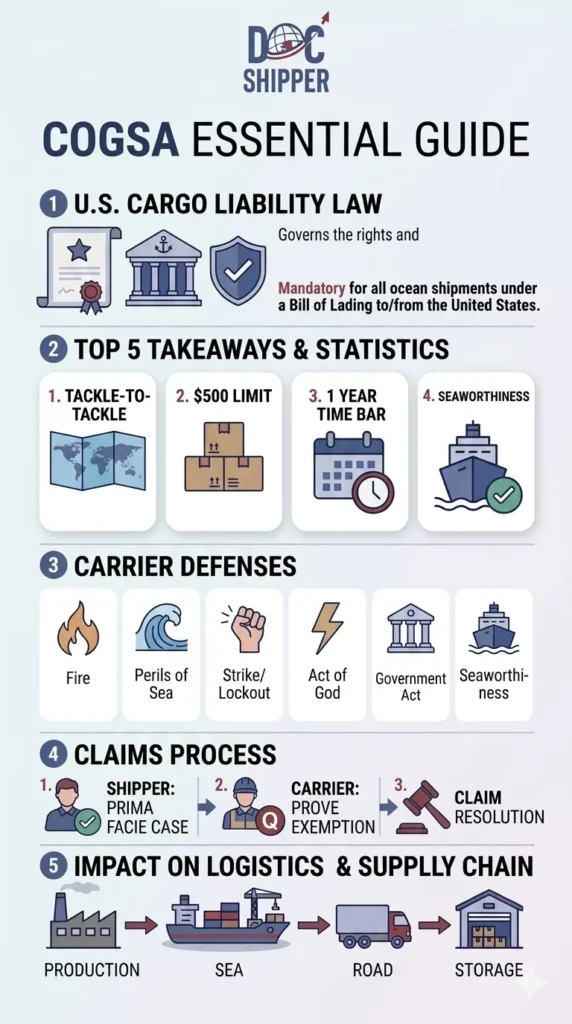
- Liability limitation: Default cap of $500 per package or customary freight unit
- Mandatory application: Cannot be waived by carriers for lower liability
- Time-bar provision: Claims must be filed within one year of delivery or expected delivery date
- Carrier responsibilities: Duty to provide seaworthy vessel, properly load, handle, stow, carry, and care for cargo
- Excepted perils: Specific circumstances where carriers are not liable (Act of God, perils of the sea, war, strikes)
Legal Framework & Carrier Obligations
COGSA establishes a balanced liability regime that protects both carriers and cargo interests. The law applies from the time goods are loaded onto the vessel until they are discharged, a period known as “tackle-to-tackle” coverage. This timeframe is critical because different liability rules may apply before loading and after discharge.
Under COGSA, carriers must exercise due diligence to make the vessel seaworthy before and at the beginning of the voyage. This includes ensuring proper manning, equipment, and fitness for cargo. However, carriers are not absolute insurers of the cargo. They can invoke excepted perils as defenses against liability claims.
The package limitation remains the most controversial aspect of COGSA. Courts have extensively litigated what constitutes a “package” versus a “customary freight unit.” Containers complicate this definition—if a container holds 100 boxes but the bill of lading lists only “1 container,” the $500 limit may apply to the entire container rather than each box.
Shippers can overcome the limitation by declaring a higher value in the bill of lading and paying additional freight charges. At DocShipper, we systematically advise clients on cargo valuation strategies to ensure adequate protection against loss or damage during ocean transit.
The law also mandates specific notice requirements. For visible damage, notice must be given before or at the time of removal. For concealed damage, notice must be provided within three days of delivery. Failure to comply with these timelines can forfeit the right to claim compensation.
According to the U.S. Code Title 46, COGSA’s provisions cannot be contracted away to reduce carrier liability below the statutory minimum, ensuring a baseline level of protection for cargo interests.
Practical Examples & Liability Scenarios
Understanding COGSA’s application requires examining real-world scenarios where liability calculations directly impact financial outcomes. These examples illustrate how the $500 per package limitation functions in practice and when shippers should consider declaring higher values.
| Scenario | Cargo Details | Default COGSA Liability | With Declared Value |
|---|---|---|---|
| Electronics shipment | 50 laptops ($1,000 each) in 1 container | $500 total (if BOL says “1 container”) | $50,000 (full replacement cost) |
| Textile goods | 200 boxes of fabric ($200 each) | $100,000 (200 packages × $500) | $40,000 (actual value) |
| Machinery parts | 1 crate containing 10 components ($5,000 each) | $500 (if crate is the “package”) | $50,000 (itemized declaration) |
| Automotive parts | FCL with 500 units ($100 each) | $250,000 (500 packages × $500) | $50,000 (actual commercial value) |
Case Study: High-Value Electronics
A U.S. importer shipped 100 smartphones worth $800 each from China. The bill of lading listed “1 × 40′ container.” During transit, the container fell overboard. Without declared value, COGSA limited recovery to $500 total. With proper declaration and additional premium ($200), the importer would have recovered the full $80,000 loss.
Key takeaways for shippers:
- Always itemize cargo in the bill of lading rather than listing “1 container”
- Calculate declaration costs versus potential loss exposure
- Maintain proper documentation including commercial invoices and packing lists
- File claims promptly within the one-year statute of limitations
- Consider marine cargo insurance as a complement to carrier liability
At DocShipper, we help clients navigate these complexities by reviewing bills of lading, advising on cargo valuation strategies, and coordinating with insurance providers to ensure comprehensive protection throughout the ocean freight journey.
Conclusion
COGSA remains the fundamental legal framework governing ocean carrier liability in U.S. trade, establishing both protections and limitations that every importer must understand. The $500 per package limitation can result in significant financial exposure if cargo value is not properly declared.
Need expert guidance on cargo valuation and liability management? Contact DocShipper for comprehensive freight forwarding solutions tailored to your shipping needs.
📚 Quiz
Test Your Knowledge: COGSA
Q1 — What is the default liability cap established by COGSA for cargo loss or damage?
Q2 — A shipper lists "1 × 40' container" on the bill of lading without itemizing the 100 boxes inside. Under COGSA, what is the maximum carrier liability if the entire container is lost?
Q3 — A U.S. importer receives a shipment with concealed water damage. Under COGSA, by when must the importer provide written notice to the carrier to preserve their right to claim compensation?
🎯 Your Result
📞 Free Quote in 24hFAQ | COGSA: Definition, Application & Practical Examples in Shipping
COGSA stands for Carriage of Goods by Sea Act, a 1936 U.S. federal law that regulates carrier liability for ocean freight shipments to and from American ports.
No, COGSA applies exclusively to ocean transportation. Air freight is governed by the Montreal Convention, while trucking falls under the Carmack Amendment to the Interstate Commerce Act.
No, COGSA establishes a mandatory minimum liability. Carriers cannot contractually reduce their responsibility below $500 per package or customary freight unit.
A package is typically defined as a physical shipping unit. If a container is listed as "1 container" without itemization, courts may treat the entire container as one package, limiting recovery to $500 total.
Claims must be filed within one year from the date of delivery or the date when goods should have been delivered. This statute of limitations is strictly enforced.
COGSA applies only during the "tackle-to-tackle" period—from loading onto the vessel until discharge. Different liability rules govern inland transportation before and after ocean transit.
Excepted perils are circumstances where carriers are not liable, including Act of God, perils of the sea, war, public enemies, inherent defect of goods, strikes, and riots.
It depends on cargo value versus declaration cost. For high-value goods, declaring full value is advisable. For low-value bulk commodities, the default COGSA limit may suffice.
Yes, COGSA provides only limited liability protection. Marine cargo insurance offers comprehensive coverage including excepted perils and pre/post-shipment exposure.
Yes, parties can contractually extend COGSA's application to cover inland transportation through "Clause Paramount" provisions in bills of lading.
COGSA still applies to ocean carriage contracts even without a formal bill of lading, though proving the terms of carriage becomes more difficult.
COGSA applies only when shipments originate from or are destined to U.S. ports. International shipments between foreign ports are governed by other conventions like the Hague-Visby Rules.
Need Help with
Logistics or Sourcing ?
First, we secure the right products from the right suppliers at the right price by managing the sourcing process from start to finish. Then, we simplify your shipping experience - from pickup to final delivery - ensuring any product, anywhere, is delivered at highly competitive prices.


Fill the Form
Prefer email? Send us your inquiry, and we’ll get back to you as soon as possible.
Contact us




