


In short ⚡
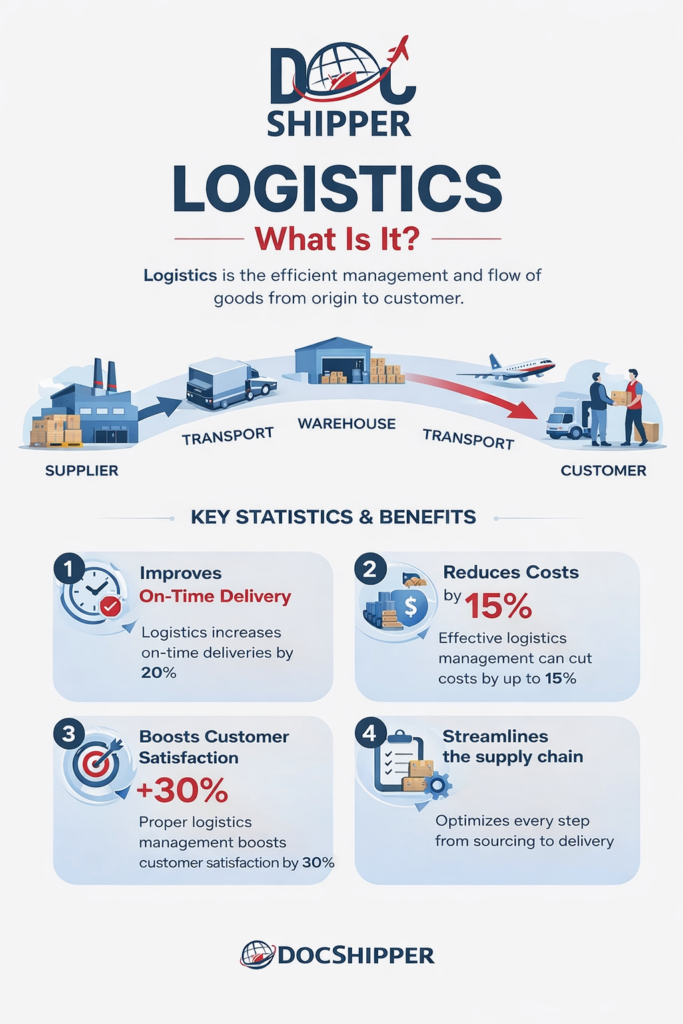
Business logistics is the strategic management of the flow of goods, information, and resources from origin to final consumption. It encompasses procurement, transportation, warehousing, inventory management, and distribution to optimize costs while meeting customer demands efficiently within the supply chain.
Introduction
Many companies struggle with delayed shipments, excess inventory costs, and customer dissatisfaction. These problems stem from poor logistics coordination. In today’s global marketplace, business logistics determines competitive advantage.
Effective logistics management directly impacts profitability. It reduces operational expenses while improving delivery performance. For import/export operations, mastering logistics means controlling the entire supply chain.
Key characteristics of modern business logistics include:
- End-to-end visibility: Real-time tracking from supplier to customer
- Cost optimization: Balancing service levels with transportation and storage expenses
- Risk management: Anticipating disruptions and maintaining contingency plans
- Regulatory compliance: Navigating customs, safety standards, and trade agreements
- Technology integration: Leveraging software for planning, execution, and analytics
Core Components & Strategic Framework
Business logistics operates through five interconnected pillars. Each element requires specialized expertise and coordination.
Procurement logistics manages supplier relationships and raw material acquisition. This includes vendor selection, purchase order management, and inbound quality control. Companies must balance cost savings against supply reliability.
Production logistics ensures materials reach manufacturing facilities precisely when needed. Just-in-time systems minimize inventory holding costs. Production schedules synchronize with material availability to prevent bottlenecks.
Distribution logistics handles finished goods movement to customers. This encompasses order processing, warehouse operations, and last-mile delivery. Route optimization algorithms reduce fuel consumption and delivery times.
Reverse logistics manages returns, repairs, and recycling. This growing field addresses sustainability concerns and warranty obligations. Efficient reverse flows recover value from defective or unwanted products.
Information logistics provides the data infrastructure connecting all activities. Enterprise resource planning systems integrate procurement, inventory, and shipping data. Real-time analytics enable proactive decision-making.
International operations add complexity through customs procedures and cross-border regulations. The WTO Trade Facilitation Agreement standardizes many processes, but country-specific requirements vary significantly.
At DocShipper, we coordinate all logistics components for seamless international trade. Our expertise covers documentation, customs clearance, and multimodal transportation to eliminate supply chain friction.
Real-World Applications & Data
Understanding business logistics requires examining concrete scenarios. The following examples illustrate cost impacts and operational decisions.
Comparative Transportation Analysis
| Mode | Transit Time | Cost per Container | Best Use Case |
|---|---|---|---|
| Ocean Freight | 25-35 days | $2,500-$4,000 | High-volume, non-urgent goods |
| Air Freight | 3-7 days | $8,000-$15,000 | Time-sensitive, high-value items |
| Rail Freight | 15-20 days | $3,500-$5,500 | Continental routes, balanced speed/cost |
| Road Transport | 1-5 days | $1,500-$3,000 | Regional distribution, door-to-door |
Inventory Management Case Study
An electronics importer faced $180,000 annual holding costs for safety stock. Analysis revealed:
- Demand variability: 30% fluctuation across quarters
- Lead time: 45 days average from Asian suppliers
- Storage costs: $12 per cubic meter monthly
- Capital tied up: $850,000 in excess inventory
- Obsolescence risk: 8% annual product lifecycle turnover
Implementation of demand forecasting software reduced safety stock by 40%. The company shifted to consolidated biweekly shipments instead of monthly bulk orders. Total logistics costs decreased by $95,000 annually while maintaining 98.5% order fulfillment rates.
DocShipper Platform
Cut logistics costs. Not corners.
See exactly where your logistics costs are bleeding — and how to fix it. Book your expert demo.
Cross-Border Logistics Simulation
A furniture manufacturer shipping from Vietnam to Germany faces these decision points:
- Incoterm selection: FOB requires managing ocean freight and insurance; DDP includes all costs to destination
- Consolidation strategy: Full container load (FCL) at $3,200 versus less-than-container (LCL) at $180/m³
- Customs valuation: Proper HS code classification affects duty rates (0-8% range for furniture categories)
- Warehouse location: Hamburg port storage at €8/pallet/day versus inland facility at €5/pallet/day with €150 drayage
- Documentation timing: Early submission reduces demurrage charges averaging €75/day per container
Choosing FCL with DDP terms and pre-cleared customs documentation saved 6 days transit time and €420 in storage fees per shipment.
Conclusion
Business logistics transforms operational efficiency into competitive advantage. Mastering its components reduces costs while improving customer satisfaction. Strategic logistics management is essential for sustainable international trade success.
Need expert guidance on optimizing your logistics operations? Contact DocShipper for comprehensive supply chain solutions tailored to your business requirements.
📚 Quiz
Test Your Knowledge: Business Logistics
Q1 — Which of the following best defines business logistics?
Q2 — A company claims that "logistics" and "supply chain management" are the same thing. Is this correct?
Q3 — A furniture manufacturer ships goods from Vietnam to Germany. To save on storage fees and reduce transit time, which combination of logistics decisions proved most effective?
🎯 Your Result
📞 Free Quote in 24hFAQ | Business Logistics: Definition, Components & Practical Examples
Logistics focuses on transportation, warehousing, and distribution execution. Supply chain management encompasses broader strategy including supplier relationships, demand planning, and product lifecycle coordination across multiple organizations.
Total logistics costs include transportation, warehousing, inventory carrying costs, packaging, order processing, and reverse logistics. Industry benchmarks range from 8-15% of revenue depending on sector and geographic complexity.
Technology enables real-time tracking, predictive analytics, automated warehousing, and digital documentation. Transportation management systems optimize routes while warehouse management systems streamline inventory control and order fulfillment processes.
Small businesses should consolidate shipments, negotiate volume discounts with carriers, implement inventory management software, outsource non-core logistics functions to third-party providers, and establish clear performance metrics.
Major challenges include customs regulations variability, documentation errors, currency fluctuations, political instability, infrastructure limitations in emerging markets, and coordinating multiple transportation modes across borders.
Logistics directly affects delivery speed, order accuracy, product condition, and return processing. Studies show 70% of customers won't reorder after poor delivery experiences, making logistics critical for retention.
Optimal inventory balances service levels against holding costs. Most businesses target 95-98% fill rates while maintaining 30-60 days of stock. The exact level depends on demand variability and supply lead times.
Freight forwarders consolidate shipments, negotiate carrier rates, manage customs clearance, provide cargo insurance, handle documentation, and offer multimodal transportation solutions that individual shippers cannot access cost-effectively.
Sustainable logistics includes electric vehicle fleets, route optimization to reduce emissions, recyclable packaging, carbon offset programs, reverse logistics for circular economy models, and warehouse energy efficiency improvements.
Preparation involves diversifying suppliers and carriers, maintaining safety stock, developing contingency plans, investing in supply chain visibility tools, establishing alternative transportation routes, and regularly stress-testing logistics networks.
Key performance indicators include on-time delivery rate, order accuracy, inventory turnover, transportation cost per unit, warehouse capacity utilization, perfect order percentage, and cash-to-cash cycle time.
E-commerce requires faster fulfillment, smaller shipment sizes, direct-to-consumer delivery capabilities, flexible return policies, and distributed warehouse networks closer to end customers rather than centralized distribution centers.
Need Help with
Logistics or Sourcing ?
First, we secure the right products from the right suppliers at the right price by managing the sourcing process from start to finish. Then, we simplify your shipping experience - from pickup to final delivery - ensuring any product, anywhere, is delivered at highly competitive prices.


Fill the Form
Prefer email? Send us your inquiry, and we’ll get back to you as soon as possible.
Contact us




