


In short ⚡
A Capesize vessel is a bulk carrier exceeding 150,000 DWT, too large to transit the Panama or Suez Canals, requiring routing around the Cape of Good Hope or Cape Horn. These ships primarily transport iron ore, coal, and grains on long-haul routes, representing the largest dry bulk segment in global maritime trade.
Introduction
Many importers and logistics professionals encounter confusion when selecting vessel types for bulk cargo shipments. The choice between vessel sizes directly impacts freight costs, port accessibility, and delivery timelines.
Capesize vessels dominate the iron ore and coal trades between major mining regions and industrial centers. Understanding their operational characteristics proves essential for optimizing supply chain decisions in raw material imports.
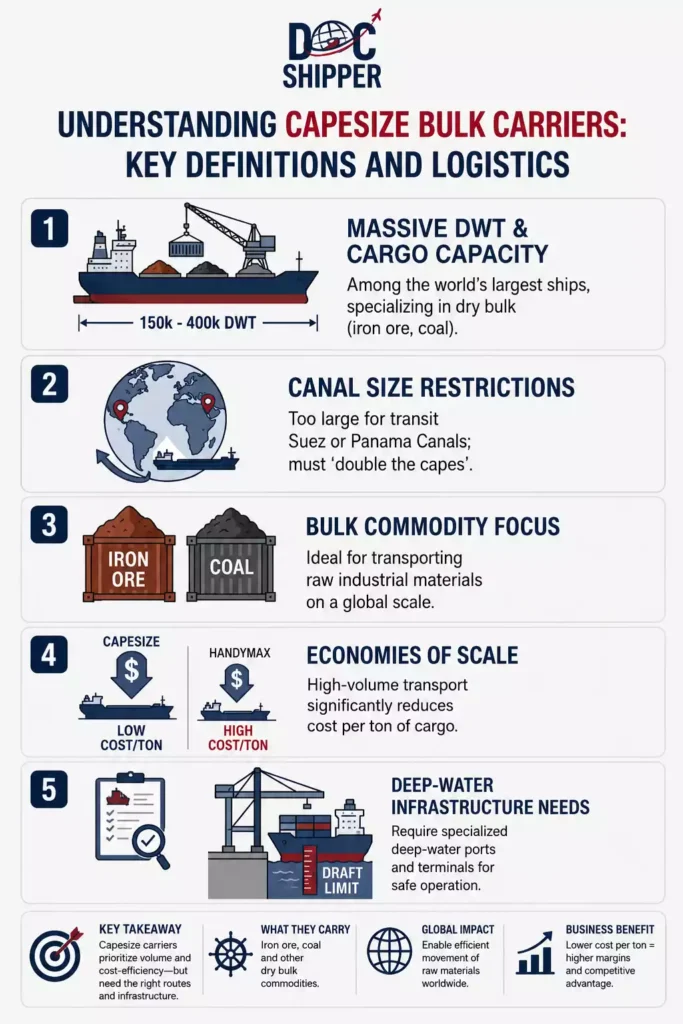
- Deadweight capacity: Typically 150,000 to 400,000 DWT
- Primary cargoes: Iron ore (65%), coal (25%), grain (10%)
- Route restrictions: Cannot transit Panama or Suez Canals
- Port requirements: Deep-water terminals with specialized infrastructure
- Market indicator: Baltic Capesize Index (BCI) tracks daily charter rates
Technical Specifications & Operational Framework
The defining characteristic of Capesize vessels stems from their beam width exceeding 32.3 meters, the maximum for Panama Canal transit. This physical limitation necessitates routing around continental capes, adding 3,000 to 5,000 nautical miles to certain voyages.
Cargo hold configuration typically features seven to nine holds with hydraulic hatch covers. Modern vessels incorporate self-unloading systems or rely on shore-based grab cranes. Loading rates reach 10,000 to 15,000 tons per hour at equipped terminals.
Draft limitations present critical operational constraints. Fully laden Capesize vessels draw 18 to 23 meters, restricting access to fewer than 100 ports worldwide. Brazil’s Tubarão terminal, Australia’s Port Hedland, and China’s Qingdao represent primary loading and discharge points.
The ballast water management system becomes particularly complex on these vessels. Empty return voyages require 40,000 to 60,000 tons of ballast water, subject to strict IMO BWM Convention regulations governing discharge and treatment.
Fuel consumption patterns differ significantly from smaller bulk carriers. A Capesize vessel burns 50 to 80 tons of heavy fuel oil daily at service speed (14-15 knots), making voyage optimization and slow steaming strategies financially critical during low-rate markets.
At DocShipper, we assess vessel suitability during the shipment planning phase, ensuring Capesize nominations align with cargo volume, port infrastructure, and cost-efficiency targets for our clients’ bulk commodity imports.
Market Data & Comparative Analysis
The global Capesize fleet comprises approximately 1,800 vessels with combined capacity exceeding 350 million DWT. China accounts for 45% of global Capesize demand, primarily importing Australian and Brazilian iron ore.
| Vessel Type | DWT Range | Typical Route | Daily Charter Rate (2024) | Canal Transit |
|---|---|---|---|---|
| Capesize | 150,000-400,000 | Brazil-China (iron ore) | $15,000-$35,000 | No |
| Panamax | 60,000-80,000 | US Gulf-Japan (grain) | $12,000-$22,000 | Yes (original locks) |
| Handymax | 40,000-60,000 | Regional trades | $10,000-$18,000 | Yes |
Use Case: Iron Ore Import Optimization
A European steel manufacturer requires 2.4 million tons of iron ore annually from Brazil. Comparing vessel options:
- Capesize option: 12 voyages × 200,000 tons = freight cost $42/ton (via Cape of Good Hope)
- Panamax option: 30 voyages × 80,000 tons = freight cost $58/ton (via Panama Canal)
- Savings: $16/ton × 2.4M tons = $38.4M annually using Capesize vessels
- Trade-off: Requires dedicated deep-water terminal investment ($150M) amortized over 15 years
- Break-even: Infrastructure cost recovered in 4.2 years through freight savings
The Baltic Capesize Index (BCI) demonstrates extreme volatility. In 2020, rates dropped to $3,000/day during pandemic disruptions, then surged to $45,000/day in 2021 amid post-lockdown demand. This 15-fold variance underscores the importance of strategic contract timing.
Environmental regulations increasingly impact Capesize economics. The IMO 2020 sulfur cap added $2-3 million annually in fuel costs per vessel. Upcoming carbon intensity regulations (CII ratings) may require speed reductions or fleet renewals, potentially tightening vessel supply by 2025-2027.
Conclusion
Capesize vessels represent the most cost-efficient solution for high-volume bulk commodity trades when port infrastructure permits. Their operational constraints require careful route planning and terminal coordination, but economies of scale deliver substantial freight savings on major trade lanes.
Need expert guidance on vessel selection for your bulk cargo imports? Contact DocShipper for tailored logistics solutions.
📚 Quiz
Test Your Knowledge: Capesize Vessel
Q1 — What is the defining characteristic that classifies a vessel as "Capesize"?
Q2 — Following the 2016 expansion of the Panama Canal, can modern Capesize vessels now transit it?
Q3 — A European steel manufacturer needs to import 2.4 million tons of iron ore annually from Brazil. Which approach delivers the greatest freight cost savings?
🎯 Your Result
📞 Free Quote in 24hFAQ | Capesize Vessel: Definition, Specifications & Practical Examples
Vessels exceeding 150,000 DWT are classified as Capesize, though operational definitions vary. The Baltic Exchange uses 172,000 DWT as the standard reference for index calculations, while some classifications begin at 120,000 DWT for "mini-Capesize" variants.
No. The expanded locks (opened 2016) accommodate vessels up to 49 meters beam and 366 meters length. Capesize vessels typically measure 45-65 meters in beam, exceeding these limits. Only Post-Panamax and New Panamax vessels can use the expanded canal.
Strong positive correlation exists (0.7-0.8 coefficient). When iron ore prices rise, steel production increases, driving demand for Capesize tonnage. A $10/ton increase in iron ore typically adds $2,000-3,000 to daily charter rates within 30-45 days.
Approximately 75% of seaborne iron ore moves on Capesize vessels. The Brazil-China route (accounting for 40% of global iron ore trade) relies almost exclusively on Capesize tonnage due to voyage economics and cargo volumes.
Port Hedland (Australia) to Qingdao (China) requires 12-14 days at 14 knots service speed, covering approximately 3,400 nautical miles. Including loading (2 days) and discharge (3 days), the round voyage totals 30-35 days.
Economic lifespan averages 25-30 years, though technical life can extend to 35 years with proper maintenance. Vessels over 20 years face increasing survey costs, insurance premiums, and charter rate discounts of 15-25% compared to modern tonnage.
Yes. Officers need endorsements for vessels over 3,000 GT, and many flag states require specific bulk carrier training. Chinese and Brazilian ports mandate local pilot certifications. Crew sizes typically range from 20-25 personnel.
Advanced weather routing saves 0.5-1.5 days per voyage by avoiding heavy seas and adverse currents. On a Brazil-China route, this translates to $7,500-22,500 in fuel savings and improved schedule reliability, reducing demurrage risks.
Demurrage rates range from $18,000 to $35,000 per day depending on charter party terms and market conditions. Loading/discharge rates of 50,000-80,000 tons per day are standard at equipped terminals. Delays beyond laytime trigger these charges immediately.
No. Capesize vessels are purpose-built bulk carriers lacking container cell guides, lashing points, and the structural reinforcement required for stacked containers. Their hold design optimizes for loose bulk commodities, not unitized cargo.
Newbuilding prices in 2024 range from $55-65 million for a standard 180,000 DWT vessel. Five-year-old secondhand vessels trade at $35-45 million, while 15-year-old units sell for $15-22 million, reflecting depreciation and technological obsolescence.
Ballast bonus compensates owners for positioning empty vessels to load ports. Typical bonuses range from $100,000 to $500,000 depending on distance and market conditions. For a vessel ballasting 8,000 nautical miles, this offsets 60-70% of positioning costs.
Need Help with
Logistics or Sourcing ?
First, we secure the right products from the right suppliers at the right price by managing the sourcing process from start to finish. Then, we simplify your shipping experience - from pickup to final delivery - ensuring any product, anywhere, is delivered at highly competitive prices.


Fill the Form
Prefer email? Send us your inquiry, and we’ll get back to you as soon as possible.
Contact us




