


In short ⚡
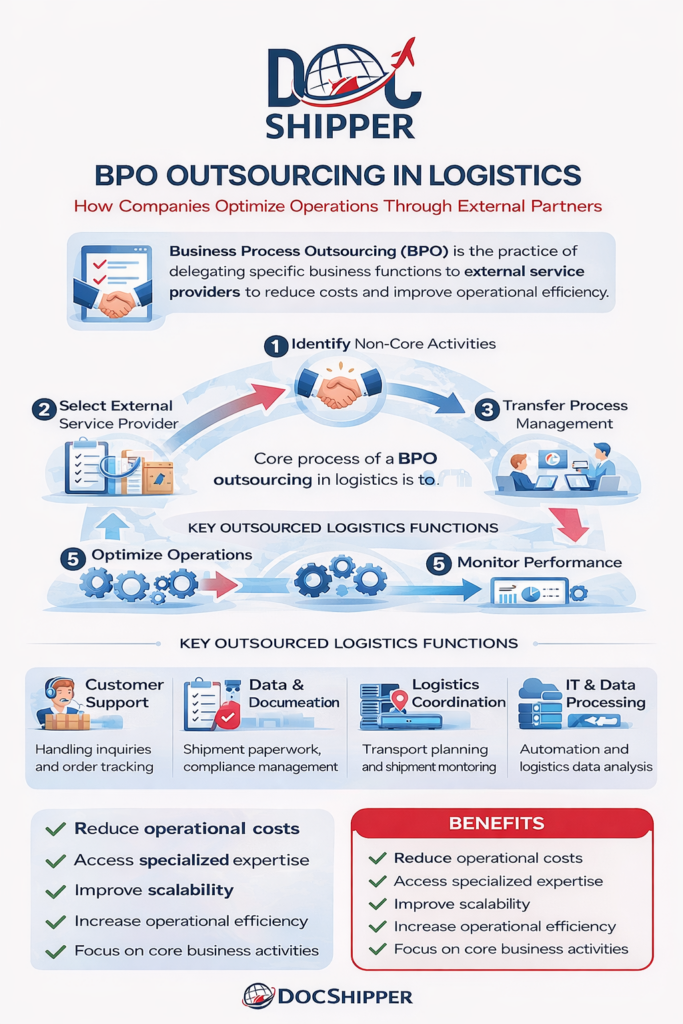
Business Process Outsourcing (BPO) is the practice of contracting specific business operations and responsibilities to third-party service providers. Companies delegate non-core functions such as customer service, accounting, logistics coordination, or data entry to specialized external vendors, allowing them to focus on strategic activities while reducing operational costs and improving efficiency.
Introduction
Many businesses struggle with balancing operational efficiency and cost control while maintaining focus on core competencies. Business Process Outsourcing addresses this challenge by transferring routine or specialized functions to external experts.
In international trade and logistics, BPO has become essential for companies managing complex supply chains. From customs documentation to freight tracking, outsourcing these processes reduces errors and accelerates delivery times.
Key characteristics of effective BPO include:
- Cost reduction: Lower labor and infrastructure expenses through economies of scale
- Specialized expertise: Access to professionals with niche skills and industry knowledge
- Scalability: Flexible capacity adjustment based on business volume fluctuations
- Focus enhancement: Internal teams concentrate on revenue-generating activities
- Risk mitigation: Compliance management by vendors familiar with regulatory frameworks
BPO Mechanisms & Strategic Expertise
BPO operates through structured service agreements defining scope, performance metrics, and accountability. Providers typically offer offshore (distant countries with lower costs), nearshore (neighboring regions), or onshore (same country) solutions depending on client requirements.
The two primary categories are front-office BPO (customer-facing operations like call centers) and back-office BPO (internal processes such as payroll or IT support). In logistics, back-office BPO dominates through customs brokerage, documentation management, and freight audit services.
Contract structures vary from transactional pricing (per-unit fees) to outcome-based models where vendors share performance risks. Service Level Agreements (SLAs) establish measurable targets for quality, response time, and accuracy. According to U.S. International Trade Administration, properly structured SLAs reduce operational disputes by 40%.
Technology integration is critical. Modern BPO providers use cloud-based platforms for real-time data sharing, automation tools for repetitive tasks, and analytics dashboards for performance monitoring. These systems ensure transparency and enable clients to maintain oversight without direct management.
At DocShipper, we systematically verify that our outsourced customs documentation meets all regulatory standards before submission, eliminating delays caused by incomplete or incorrect paperwork. This proactive approach demonstrates how BPO partners add value beyond simple task execution.
Legal considerations include data protection compliance (GDPR for EU operations), intellectual property safeguards, and liability clauses for service failures. Contracts must clearly define ownership of work products and confidentiality obligations to protect sensitive business information.
Concrete Examples & Industry Data
BPO impact varies significantly across industries and functions. The following table compares typical cost savings and efficiency gains:
| Function | Average Cost Reduction | Processing Time Improvement | Common BPO Location |
|---|---|---|---|
| Customer Service | 30-50% | 20-35% | Philippines, India |
| Accounting/Finance | 25-40% | 30-45% | India, Poland |
| Logistics Coordination | 20-35% | 25-40% | Vietnam, Mexico |
| IT Support | 35-55% | 15-30% | India, Ukraine |
| Data Entry/Processing | 40-60% | 35-50% | Bangladesh, Kenya |
Use Case: A European electronics importer handling 500 monthly shipments from Asia faced mounting customs clearance delays. By outsourcing documentation preparation and regulatory compliance checks to a specialized BPO provider, they reduced clearance time from 4.2 days to 1.8 days—a 57% improvement. Annual savings reached €180,000 through reduced demurrage fees and faster inventory turnover.
Industry research shows that logistics BPO adoption increased 28% between 2020-2023 as supply chain disruptions highlighted the need for flexible capacity. Companies outsourcing freight audit functions recover an average of 3-8% in billing errors, directly improving bottom-line profitability.
Key performance indicators for successful BPO partnerships include:
- First-contact resolution rate: Percentage of issues resolved without escalation (target: 85%+)
- Process accuracy: Error-free transaction rate (target: 98%+)
- Turnaround time: Average completion duration versus internal baseline (improvement: 30%+)
- Cost per transaction: Total service fees divided by volume (reduction: 25%+ versus in-house)
- Client satisfaction score: Regular feedback surveys (target: 4.5/5 or higher)
Geographic selection impacts results significantly. Nearshore BPO to neighboring countries offers cultural alignment and minimal time zone differences, while offshore BPO maximizes cost savings but may require stronger governance frameworks.
DocShipper Platform
Optimize Your Global Logistics with Cutting-Edge Solutions
Enhance efficiency, cut costs, and gain 24/7 visibility 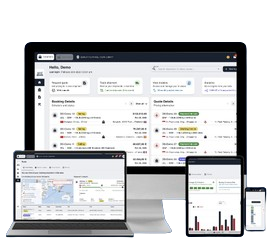 over your entire supply chain.
- Cut your shipping costs and maximize your margins
- Manage sourcing, freight, & customs on one platform
- Get real-time tracking and analytics
Conclusion
Business Process Outsourcing transforms operational efficiency by combining cost reduction with specialized expertise. For logistics-intensive businesses, strategic BPO partnerships eliminate bottlenecks and enhance supply chain agility.
Need expert guidance on outsourcing your logistics operations? Contact DocShipper for tailored solutions that streamline your international trade processes.
📚 Quiz
Test Your Knowledge: Business Process Outsourcing (BPO)
Q1 — What is the primary definition of Business Process Outsourcing (BPO)?
Q2 — A common misconception about BPO is that it means simply hiring temporary workers who remain under the client's direct supervision. What actually distinguishes BPO from traditional staffing?
Q3 — A European electronics importer handling 500 monthly shipments from Asia wants to reduce customs clearance delays and cut operational costs. Which approach best reflects a strategic BPO solution for this scenario?
🎯 Your Result
📞 Free Quote in 24hFAQ | Business Process Outsourcing (BPO): Definition, Benefits & Practical Examples
Repetitive, high-volume tasks with standardized procedures work best—such as data entry, customer support, payroll processing, and logistics documentation. Processes requiring minimal strategic decision-making but demanding accuracy and consistency yield the highest BPO value.
BPO transfers entire process ownership to the vendor, including technology, management, and performance accountability. Traditional staffing provides personnel who remain under client supervision, while consulting offers advisory services without operational execution responsibility.
Reputable providers implement encryption protocols, access controls, regular security audits, and compliance certifications (ISO 27001, SOC 2). Contracts should mandate non-disclosure agreements and specify data handling procedures aligned with GDPR or other applicable regulations.
Simple processes like data entry can transition within 4-6 weeks. Complex functions involving system integration or regulatory compliance may need 3-6 months. Phased rollouts reduce risk by validating performance before full-scale deployment.
Yes, through detailed SLAs defining quality metrics, regular performance reviews, and audit rights. Technology platforms provide real-time monitoring dashboards showing transaction accuracy, response times, and error rates, enabling proactive intervention when standards slip.
Focusing solely on cost rather than capability, inadequate due diligence on vendor stability, vague contract terms, and insufficient transition planning. Successful partnerships require clear communication protocols, defined escalation paths, and cultural compatibility assessments.
Transparent communication about strategic rationale minimizes resistance. Positioning outsourcing as eliminating tedious tasks—allowing staff to focus on higher-value work—preserves morale. Retraining programs for affected employees demonstrate commitment to workforce development.
Common models include per-transaction pricing (fixed fee per unit), FTE-based (monthly rate per dedicated employee), outcome-based (payment tied to results), and hybrid approaches. Selection depends on process predictability and desired risk-sharing arrangements.
Calculate total cost savings (labor, infrastructure, technology) minus service fees and transition expenses. Factor in productivity gains, error reduction, and opportunity costs of redirected internal resources. Typical payback periods range from 6-18 months depending on process complexity.
Jurisdiction clauses determine governing law and dispute resolution venues. Data localization requirements may restrict cross-border information transfer. Tax implications, intellectual property ownership, and force majeure provisions require careful negotiation to protect both parties' interests.
Quality providers offer flexible capacity models accommodating volume fluctuations without penalty fees. Contracts should include scalability clauses defining ramp-up timelines, volume discount tiers, and procedures for adding new processes as business needs evolve.
Automation tools handle routine tasks, AI-powered analytics identify process improvements, and cloud platforms enable seamless collaboration. Leading providers invest heavily in robotic process automation (RPA) and machine learning to continuously enhance speed and accuracy while reducing costs.
Need Help with
Logistics or Sourcing ?
First, we secure the right products from the right suppliers at the right price by managing the sourcing process from start to finish. Then, we simplify your shipping experience - from pickup to final delivery - ensuring any product, anywhere, is delivered at highly competitive prices.


Fill the Form
Prefer email? Send us your inquiry, and we’ll get back to you as soon as possible.
Contact us




