


In short ⚡
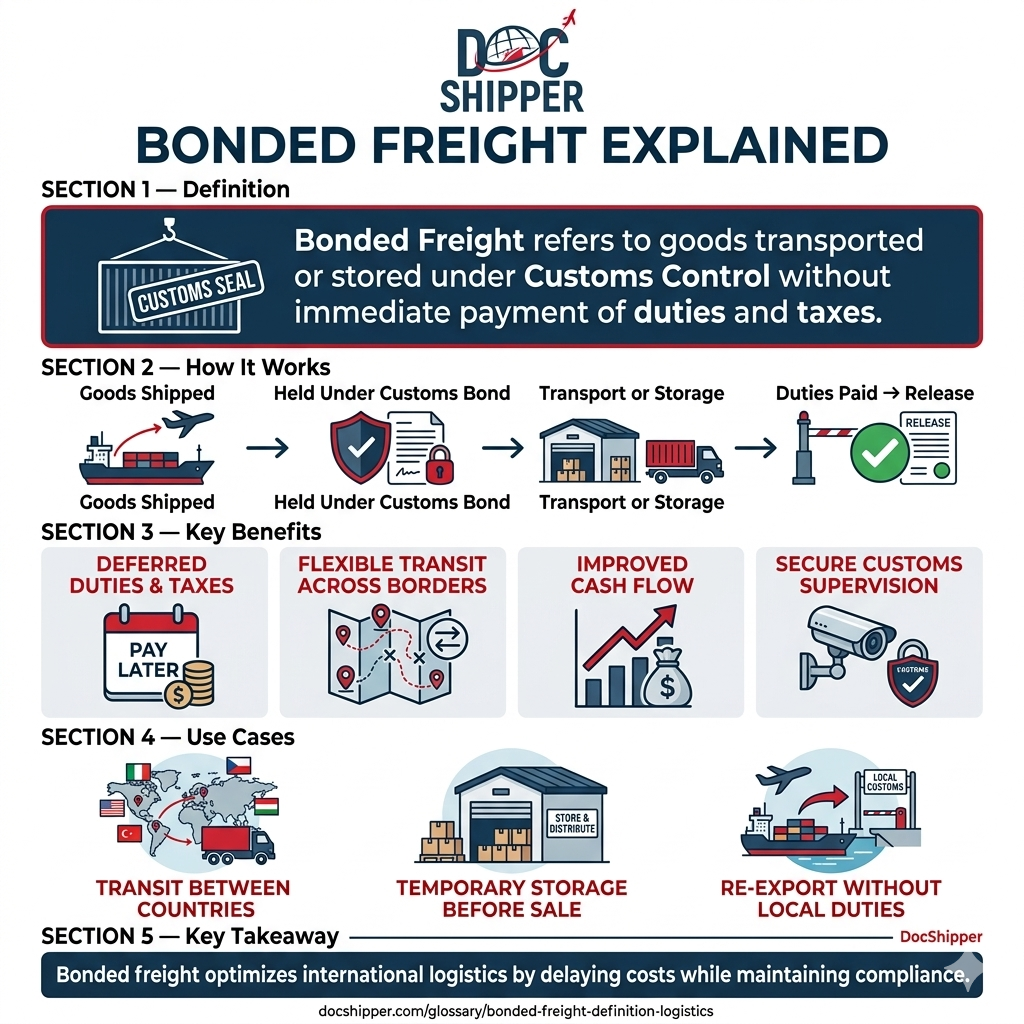
Bonded freight refers to imported goods stored in a customs-bonded warehouse where duties and taxes are deferred until the merchandise is released for domestic consumption. This mechanism allows businesses to delay payment obligations while maintaining inventory flexibility and cash flow optimization.
Introduction
Many importers face a critical challenge: paying customs duties immediately upon arrival, even when goods aren’t ready for sale. This creates unnecessary cash flow pressure and limits operational flexibility.
Bonded freight systems address this issue by creating a legal framework where imported goods remain under customs supervision without triggering immediate tax obligations. This mechanism is fundamental to modern supply chain management, particularly for businesses managing seasonal inventory, re-export operations, or manufacturing processes.
Key characteristics of bonded freight include:
- Duty deferral: Taxes remain suspended until goods enter domestic commerce
- Customs supervision: Goods stored in authorized secure facilities
- Re-export flexibility: Merchandise can leave without ever incurring duties
- Value-added operations: Limited processing permitted under bond
- Time limitations: Maximum storage periods defined by customs regulations
Bonded Freight Mechanisms & Regulations
The bonded warehouse system operates through a legal guarantee between the warehouse operator and customs authorities. This bond ensures duty payment if goods are improperly released or disappear. Warehouse operators must meet stringent security, record-keeping, and facility standards.
Five primary warehouse types exist under international customs frameworks. Type I warehouses are operated by the importer for their exclusive use. Type II facilities serve multiple clients as public storage. Type III warehouses specialize in bulk commodities. Type IV operations focus on manufacturing and processing. Type V warehouses handle display and retail activities.
The entry documentation process requires specific customs forms declaring goods entering bond status. In the United States, this involves CBP Form 7501 with special codes indicating bonded status. The European Union employs the T1 transit document for similar purposes. Documentation must precisely describe goods, quantities, and values.
According to U.S. Customs and Border Protection, goods may remain in bond for up to five years, though extensions are possible under specific circumstances. This timeframe varies internationally—the EU typically allows three years under the Union Customs Code.
Permitted activities under bond include repackaging, labeling, sorting, and minor assembly operations that don’t substantially transform the product. Manufacturing that changes tariff classification generally requires special authorization. Destruction of defective goods is permitted with customs supervision and proper documentation.
At DocShipper, we manage bonded warehouse entry procedures across 50+ countries, ensuring your goods enter bond status correctly while maintaining full compliance with local customs regulations and maximizing your duty deferral benefits.
Practical Scenarios & Cost Analysis
Understanding bonded freight through real-world applications demonstrates its financial impact. Consider these comparative scenarios across different business models.
| Scenario | Immediate Duty Payment | Bonded Storage | Savings |
|---|---|---|---|
| Electronics Importer $500K goods, 6-month storage | $50K duties paid upfront + $3K financing cost | $2K warehouse fees Duties paid at sale | $51K cash flow advantage |
| Re-export Operation $200K machinery transiting | $30K duties + refund process 6-month wait | $800 bonded storage Zero duty liability | $29.2K avoided + faster processing |
| Seasonal Retailer $1M inventory, 4-month hold | $80K immediate duties + inventory carrying cost | $5K warehouse fees Staggered duty payments | $75K working capital preserved |
Manufacturing use case: A textile company imports $300,000 worth of fabric from Asia. Under bonded warehouse rules, they store material for gradual production over eight months. Only finished garments entering domestic market trigger duty payment. Defective fabric (12% of shipment) is destroyed under customs supervision with no duty liability. The company saves $4,320 in duties on rejected material plus defers $32,000 in payments across the production cycle.
E-commerce distribution model: An online retailer uses bonded warehouses near major ports to stock inventory before confirming final destination. When 40% of goods are ultimately shipped to Canada rather than sold domestically, those items never incur U.S. duties. The remaining 60% pays duties only upon warehouse withdrawal for domestic fulfillment. This strategy reduces total duty burden by 40% while maintaining rapid delivery capabilities.
Key financial metrics for bonded freight decisions:
- Break-even storage period: Typically 45-60 days when duty rate exceeds 8%
- Opportunity cost calculation: Compare duty payment timing against investment returns
- Re-export probability: Above 25% makes bonded storage highly advantageous
- Inventory turnover rate: Slower turnover increases bonded warehouse value
- Duty drawback complexity: Bonded storage simpler than refund claims for re-exports
According to World Bank trade facilitation data, businesses utilizing bonded warehouses report average working capital improvements of 18-25% compared to immediate duty payment models. The impact multiplies for companies managing multiple product lines with varying demand cycles.
DocShipper Platform
Optimize Your Global Logistics with Cutting-Edge Solutions
Enhance efficiency, cut costs, and gain 24/7 visibility 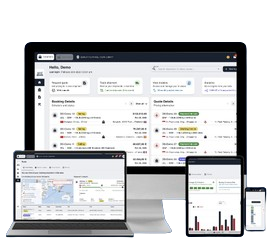 over your entire supply chain.
- Cut your shipping costs and maximize your margins
- Manage sourcing, freight, & customs on one platform
- Get real-time tracking and analytics
Conclusion
Bonded freight represents a strategic financial tool that transforms import operations from rigid payment obligations into flexible, cash-optimized processes. Proper utilization requires understanding regulatory frameworks, warehouse types, and cost-benefit analysis specific to your supply chain.
Need expert guidance on implementing bonded warehouse strategies for your international shipments? Contact DocShipper for customized solutions that maximize your duty deferral benefits while ensuring full customs compliance.
📚 Quiz
Test Your Knowledge: Bonded Freight
Q1 — What is the primary purpose of bonded freight?
Q2 — A company stores $200,000 worth of machinery in a bonded warehouse and ultimately re-exports 100% of it to a foreign buyer. How much in U.S. import duties does the company owe?
Q3 — An online retailer wants to stock inventory near a U.S. port before deciding whether to sell domestically or ship to Canada. Which strategy best fits this scenario?
🎯 Your Result
📞 Free Quote in 24hFAQ | Bonded Freight: Definition, Process & Practical Examples
Perishable items with short shelf life, hazardous materials requiring special permits, and goods subject to immediate consumption taxes (alcohol, tobacco in some jurisdictions) typically face restrictions. Explosive materials and items violating import prohibitions are categorically excluded.
United States allows five years with possible extensions. European Union permits three years under standard rules. Countries like Singapore offer two-year periods. Exceeding limits triggers automatic duty assessment or requires goods removal under customs supervision.
Domestic sales require formal customs entry and duty payment before release. However, sales to foreign buyers can occur directly from bond without incurring duties, making bonded warehouses ideal for international distribution centers.
The warehouse operator's bond covers duty liability for lost or stolen merchandise. Damaged goods can be destroyed under customs supervision without duty payment if proper documentation and witness procedures are followed. Insurance typically covers commercial value separately.
No universal limits exist, though individual warehouse capacity and bond amounts create practical constraints. High-value shipments may require additional security measures or increased bond coverage. Minimum storage fees sometimes make bonded warehousing uneconomical for very small shipments.
Bonded warehouses defer duties but don't change tariff classification. Foreign Trade Zones (FTZ) allow manufacturing that can reduce duties through tariff engineering. FTZs offer broader operational flexibility but require more complex authorization and compliance procedures.
Yes, through in-bond transportation procedures. Goods move under customs supervision using specific transit documents (IT/IE forms in U.S., T1 documents in EU). This allows strategic repositioning without triggering duty payment or formal customs clearance.
Formal customs entry declaration, commercial invoice, packing list, and duty payment proof. Some countries require warehouse keeper's certificate confirming goods identity. Electronic systems now streamline this process, often completing withdrawal authorization within hours.
Storage fees typically depend on space occupied, handling complexity, and duration rather than product type. High-value goods may incur additional insurance costs. Temperature-controlled or security-intensive products command premium rates reflecting specialized facility requirements.
Yes, under customs supervision. Quality control, sampling, and buyer inspections are permitted activities. Some warehouses offer dedicated examination areas. Extensive testing requiring product alteration may need special authorization depending on jurisdiction.
Standard marine cargo insurance typically covers goods in bonded storage. Policy language should explicitly include warehouse periods. Duty liability coverage differs from commercial value coverage—warehouse operator's bond protects customs, while your insurance protects business interests.
Unauthorized removal triggers immediate duty assessment plus penalties ranging from 20-100% of duty value depending on intent. Repeated violations can result in bond revocation, facility closure, and criminal charges for deliberate smuggling. Proper record-keeping and compliance systems prevent most issues.
Need Help with
Logistics or Sourcing ?
First, we secure the right products from the right suppliers at the right price by managing the sourcing process from start to finish. Then, we simplify your shipping experience - from pickup to final delivery - ensuring any product, anywhere, is delivered at highly competitive prices.


Fill the Form
Prefer email? Send us your inquiry, and we’ll get back to you as soon as possible.
Contact us




