In short ⚡
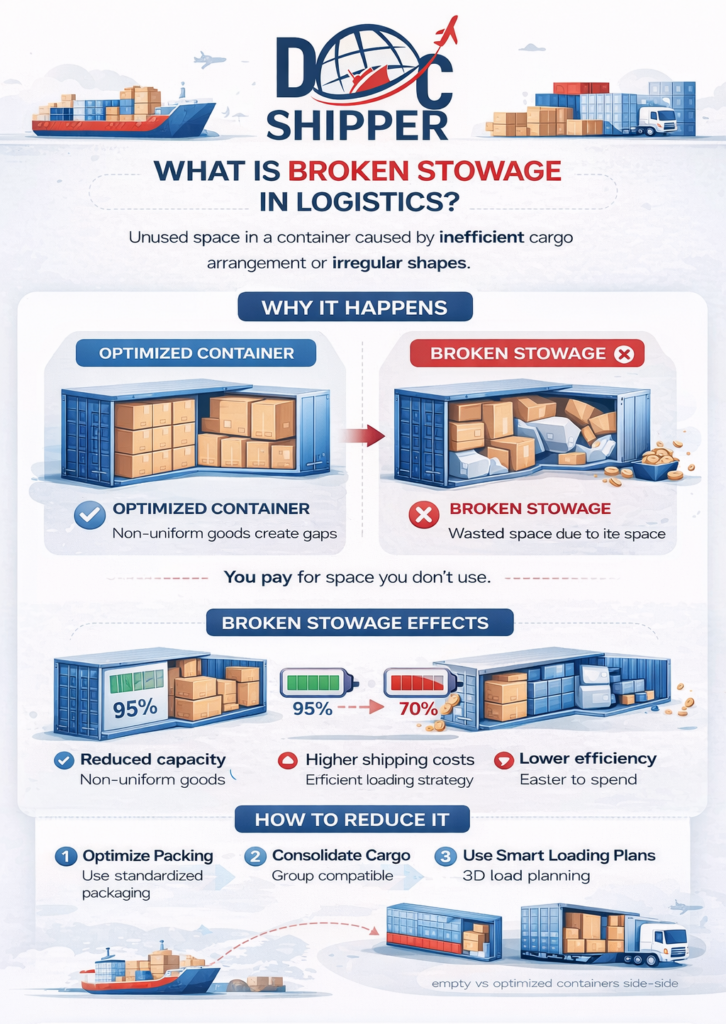
Broken stowage refers to the unused or wasted space within a shipping container or vessel caused by irregular cargo shapes, inadequate packing, or gaps between items. This inefficiency reduces cargo capacity, increases shipping costs per unit, and impacts overall logistics profitability in international trade operations.Introduction
One of the most overlooked cost drivers in container shipping is the space you pay for but cannot use. Shippers often focus on freight rates while ignoring how cargo arrangement directly impacts their bottom line. Poor stowage planning can waste 15-30% of container capacity.
In international logistics, broken stowage represents the financial and operational gap between theoretical container capacity and actual usable space. Understanding this concept is essential for optimizing cargo loads, reducing transportation costs, and improving supply chain efficiency.
- Volume inefficiency: Irregular shapes create unavoidable gaps between cargo units
- Weight distribution: Safety requirements may prevent full capacity utilization
- Packaging limitations: Standard pallets or boxes may not perfectly fit container dimensions
- Mixed cargo challenges: Combining different product types increases wasted space
- Cost multiplication: Every cubic meter of broken stowage increases per-unit shipping expenses
Technical Mechanisms & Optimization Strategies
Broken stowage occurs through three primary mechanisms: geometric incompatibility between cargo dimensions and container interior, load distribution requirements mandated by maritime safety regulations, and consolidation inefficiencies when combining shipments from multiple suppliers.
The stowage factor (cubic meters per metric ton) determines how cargo volume relates to weight capacity. High stowage factor goods like furniture or cotton create more broken stowage than dense products like metals or machinery. Container utilization rates typically range from 70% to 95% depending on cargo characteristics.
International shipping regulations, particularly the IMO Code of Safe Practice for Cargo Stowage, impose strict weight distribution requirements. These rules often prevent shippers from filling every available cubic centimeter, creating mandatory broken stowage for safety compliance.
Optimization strategies include custom packaging design, cargo pre-planning software, and mixed-dimension stacking systems. At DocShipper, we analyze cargo specifications before shipment to recommend optimal container configurations and minimize wasted space through strategic packing plans.
Advanced techniques involve three-dimensional load planning algorithms that calculate ideal placement for each item. These systems account for weight limits, center of gravity, fragility, and unloading sequence. Professional freight forwarders can reduce broken stowage by 12-18% compared to manual loading approaches.
Practical Examples & Cost Impact Data
Consider a standard 40-foot high-cube container with 76.3 cubic meters of internal volume. Shipping cylindrical drums creates significant broken stowage due to circular shapes leaving triangular gaps. A typical scenario demonstrates the financial impact:
| Container Type | Theoretical Volume | Usable Volume | Broken Stowage % | Cost Impact |
|---|---|---|---|---|
| 40′ HC (rectangular boxes) | 76.3 m³ | 72.1 m³ | 5.5% | +$165 per container |
| 40′ HC (cylindrical drums) | 76.3 m³ | 63.8 m³ | 16.4% | +$492 per container |
| 40′ HC (mixed cargo) | 76.3 m³ | 58.4 m³ | 23.5% | +$705 per container |
Real-world case study: A furniture manufacturer shipping from Vietnam to Germany faced 28% broken stowage using standard packaging. By redesigning carton dimensions to match container width precisely and implementing nested stacking, they reduced broken stowage to 9%, saving $1,847 per container across 240 annual shipments—totaling $443,280 in annual freight cost reduction.
Industry data reveals that e-commerce shipments average 19% broken stowage due to varied product sizes, while automotive parts achieve 7-8% through standardized packaging. Liquid bulk cargo in flexitanks typically maintains under 3% broken stowage, representing optimal space utilization.
The financial impact extends beyond direct freight costs. Higher broken stowage increases the number of containers required, multiplying customs clearance fees, terminal handling charges, and inland transportation expenses. A 15% broken stowage rate on a 100-container shipment effectively wastes 15 containers worth of capacity—approximately $45,000 in additional logistics costs at current market rates.
DocShipper’s cargo optimization service has helped clients reduce broken stowage by an average of 11.3% through pre-shipment planning, custom packaging consultation, and strategic consolidation. This translates to measurable ROI for businesses shipping regular volumes internationally.
Conclusion
Broken stowage represents a hidden profit leak in international shipping that directly impacts competitiveness. Reducing wasted space through strategic planning, optimized packaging, and professional cargo management delivers immediate cost savings and improved supply chain efficiency.
Need expert guidance on minimizing broken stowage for your shipments? Contact DocShipper for a customized cargo optimization assessment and discover how we can reduce your shipping costs through smarter stowage planning.
📚 Quiz
Test Your Knowledge: Broken Stowage
Q1. What does "broken stowage" refer to in container shipping?
Q2. Which of the following cargo types typically generates the HIGHEST broken stowage rate?
Q3. A shipper loads 58.4 m³ of cargo into a 40' HC container with 76.3 m³ of internal volume. What is the broken stowage percentage, and what is the most effective action to reduce it?
🎯 Your Result
📞 Free Quote in 24hFAQ | Broken Stowage: Definition, Calculation & Practical Examples
Industry averages range from 8-15% for standard cargo. Irregular shapes or mixed shipments can reach 20-30%, while optimized loads achieve 3-7% broken stowage through strategic planning.
Divide wasted space by total container volume, then multiply by 100. Formula: (Container Volume - Actual Cargo Volume) / Container Volume × 100 = Broken Stowage Percentage.
Yes. Air freight uses volumetric weight calculations (length × width × height ÷ 6000), making broken stowage more expensive per cubic centimeter due to premium air rates versus ocean shipping.
Advanced 3D load planning software can reduce broken stowage by 10-18% through algorithmic optimization that calculates ideal placement for each item based on dimensions, weight, and stacking rules.
Cylindrical containers, irregular furniture, automotive parts with odd shapes, and mixed-SKU e-commerce shipments generate the highest broken stowage rates, often exceeding 20% without optimization.
Indirectly—higher broken stowage increases container count, multiplying per-container customs processing fees, terminal handling charges, and documentation costs even though duty rates remain based on cargo value.
No. Dead freight refers to paying for booked space not used (contractual penalty), while broken stowage is physical wasted space within containers due to packing inefficiency.
Custom carton dimensions matching container interior width, collapsible packaging, modular sizing systems, and nested stacking designs reduce gaps. Standard pallet optimization (40×48 inches) also improves efficiency.
LCL (Less than Container Load) typically experiences 15-25% broken stowage because freight forwarders consolidate multiple shippers' cargo with varying dimensions, creating more gaps than single-shipper FCL loads.
For businesses shipping 50+ containers yearly, reducing broken stowage from 18% to 8% typically saves $25,000-$75,000 annually depending on routes and freight rates, plus reduced customs and handling fees.
Choosing appropriate container types (standard, high-cube, open-top, flat-rack) based on cargo dimensions significantly impacts efficiency. High-cube containers reduce broken stowage for tall items by 8-12%.
Yes. Excessive broken stowage increases movement during transit, raising damage risk. Insurers may scrutinize packing quality during claims investigations, potentially affecting settlement amounts for improperly secured cargo.
Need Help with Logistics or Sourcing ?
First, we secure the right products from the right suppliers at the right price by managing the sourcing process from start to finish. Then, we simplify your shipping experience - from pickup to final delivery - ensuring any product, anywhere, is delivered at highly competitive prices.
Fill the Form
Prefer email? Send us your inquiry, and we’ll get back to you as soon as possible.
Contact us