


In short ⚡
Brokerage is a professional intermediation service where a licensed broker facilitates transactions between buyers and sellers in international trade, handling customs clearance, documentation, and regulatory compliance. Brokers earn commission-based fees for connecting parties and ensuring smooth cross-border operations without taking ownership of goods.Introduction
Many importers struggle with complex customs regulations, tariff classifications, and documentation requirements when shipping internationally. A single error in customs forms can delay shipments for weeks and trigger costly penalties.
Brokerage services solve this critical challenge by providing specialized expertise in navigating international trade regulations. Professional brokers act as essential intermediaries between importers, exporters, carriers, and customs authorities.
Key characteristics of brokerage services include:
- Regulatory compliance – Ensuring adherence to customs laws and import/export regulations
- Documentation management – Preparing and filing required commercial invoices, certificates of origin, and customs declarations
- Tariff classification – Determining correct HS codes to calculate duties and taxes accurately
- Risk mitigation – Preventing delays, fines, and shipment seizures through proper procedures
- Commission-based model – Brokers typically charge 1-3% of shipment value or flat fees per transaction
Brokerage Mechanisms & Professional Expertise
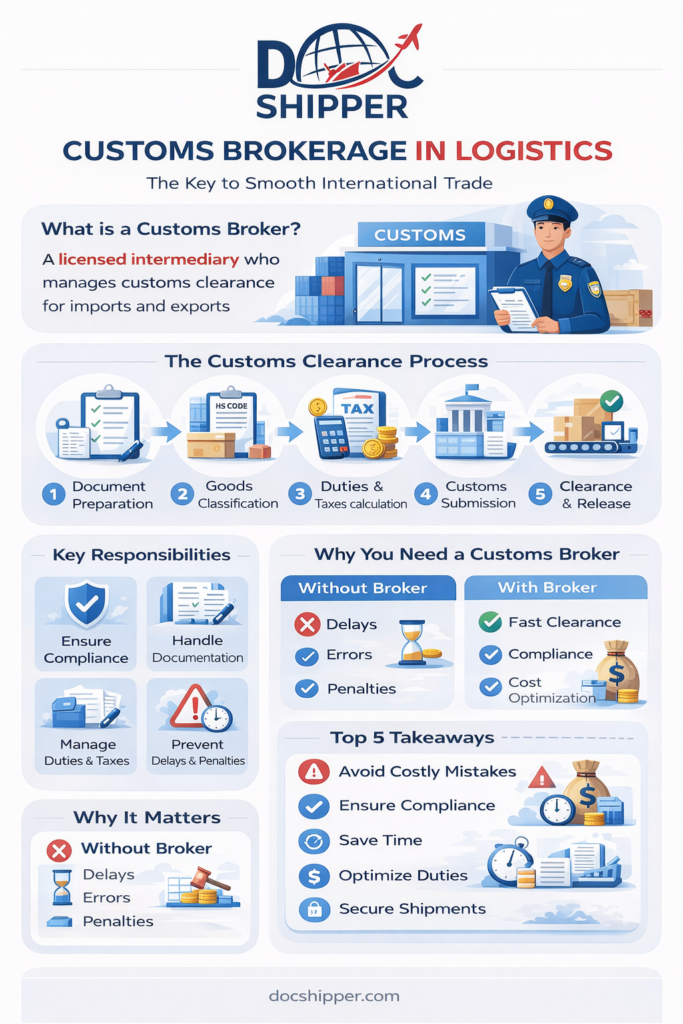
The brokerage process operates through a structured framework of legal authorization and specialized knowledge. Licensed customs brokers must pass rigorous government examinations and maintain compliance with national trade authorities.
In the United States, customs brokers are regulated by U.S. Customs and Border Protection (CBP) under Title 19 of the Code of Federal Regulations. The European Union requires brokers to hold Authorized Economic Operator (AEO) status for enhanced clearance privileges. According to the CBP official guidelines, brokers serve as the importer’s representative and are legally responsible for the accuracy of all submitted documentation.
Core brokerage functions encompass five critical areas:
Customs clearance coordination involves submitting entry documentation to authorities before goods arrive at the port. Brokers prepare the CBP Form 7501 (Entry Summary) or EU Single Administrative Document, calculating applicable duties based on harmonized tariff schedules.
Classification expertise requires determining the correct 6-10 digit HS code for each product. Misclassification represents one of the most common compliance errors, potentially resulting in duty underpayment penalties of up to 40% of the shipment value plus interest.
Duty and tax calculation involves applying country-specific rates, free trade agreement benefits, and special programs like duty drawback. Brokers must stay current with constantly changing tariff schedules and trade policy updates.
License and permit acquisition covers restricted commodities requiring FDA approval, USDA certificates, or export licenses. Brokers coordinate with multiple government agencies to secure necessary authorizations before shipment arrival.
Post-clearance support includes responding to customs audits, filing protests for incorrect duty assessments, and maintaining records for the legally required retention period (typically 5 years).
At DocShipper, we maintain direct relationships with licensed customs brokers in 30+ countries, ensuring your shipments clear customs efficiently while remaining fully compliant with local regulations. Our team verifies all documentation accuracy before submission to prevent costly delays.
Practical Examples & Industry Data
Understanding brokerage costs and procedures becomes clearer through real-world scenarios. The following cases illustrate typical brokerage applications across different trade situations.
Comparative Brokerage Fee Structures
| Shipment Type | Typical Fee Range | Additional Costs | Processing Time |
|---|---|---|---|
| Express courier (under $2,500) | $50-$150 flat fee | Included in courier service | Same day |
| Standard ocean freight (FCL) | $125-$250 per container | ISF filing: $25-$75 | 2-3 business days |
| Air freight (commercial value) | 1.5-2.5% of shipment value | Bond fees: $50-$500 | 1-2 business days |
| High-value luxury goods | $300-$800 minimum | Inspection fees: $100-$300 | 3-5 business days |
| FDA-regulated products | $200-$500 base + hourly | Prior notice filing: $35-$75 | 3-7 business days |
DocShipper Platform
Cut logistics costs. Not corners.
See exactly where your logistics costs are bleeding — and how to fix it. Book your expert demo.

Use Case: Electronics Importer Scenario
A U.S. retailer imports 500 smartphones from China valued at $150,000. The shipment requires proper classification under HS code 8517.12.00, with applicable duty rate of 0% under normal trade relations but subject to Section 301 tariffs.
Brokerage service breakdown:
- Entry filing and customs clearance: $185 flat fee
- ISF (Importer Security Filing): $50
- Continuous bond (annual): $400 for importers with annual duties under $50,000
- Tariff engineering consultation: $150 (one-time assessment for potential duty savings)
- Total brokerage cost: $785 (0.52% of shipment value)
Without professional brokerage, this importer risks misclassifying products, missing potential duty exemptions, or failing to file required advance documentation, which could result in cargo holds costing $200-$500 per day in demurrage charges.
Key industry statistics:
- 67% of first-time importers experience customs delays due to documentation errors (World Bank Trade Facilitation Report)
- Average cost of customs non-compliance: $15,000 per incident in penalties and corrections
- Professional brokerage reduces clearance time by 40-60% compared to self-filing
- Proper tariff classification can save 5-15% in duties through preferential trade agreements
- Broker-assisted shipments have 95% first-time clearance success rate versus 62% for self-managed entries
Conclusion
Brokerage services represent an essential investment in supply chain efficiency and compliance, protecting importers from regulatory penalties while accelerating customs clearance. Professional brokers provide specialized expertise that most businesses cannot economically maintain in-house.
Need expert guidance on customs brokerage for your international shipments? Contact DocShipper for comprehensive support across all aspects of import/export operations.
📚 Quiz
Test Your Knowledge: Brokerage
Q1 — Which of the following best defines brokerage in international trade?
Q2 — A common misconception about customs brokers is that they are interchangeable with freight forwarders. What is the key distinction?
Q3 — A U.S. retailer imports $150,000 worth of smartphones from China. Which scenario best illustrates the value of hiring a customs broker for this shipment?
🎯 Your Result
📞 Free Quote in 24hFAQ | Brokerage: Definition, Role & Practical Examples in International Trade
A freight forwarder arranges transportation and logistics, while a customs broker specifically handles customs clearance, documentation, and regulatory compliance. Many freight forwarders partner with licensed brokers or employ them in-house to provide complete service.
Not legally required for all shipments, but highly recommended for commercial imports. Personal shipments under de minimis value ($800 in the U.S.) may clear without broker assistance, but commercial entries benefit significantly from professional representation.
Fees range from $50-$150 for small express shipments to $125-$500 for standard commercial entries, with complex or high-value shipments costing more. Many brokers charge percentage-based fees (1-3% of shipment value) for large transactions.
Yes, importers can self-file customs entries, but this requires obtaining an importer number, posting a customs bond, understanding tariff classifications, and assuming full legal responsibility for accuracy. Most businesses find professional brokerage more cost-effective.
Typically required: commercial invoice, packing list, bill of lading or airway bill, certificate of origin (if claiming preferential duty rates), and any product-specific licenses or permits. Brokers will provide a complete checklist based on your specific shipment.
Standard clearance takes 1-3 business days for routine shipments with complete documentation. Express services can achieve same-day release. Complex shipments requiring inspections or additional permits may take 5-10 days.
A continuous bond is a year-long guarantee covering all your imports, required if your annual duties exceed $2,500 or if importing regulated goods. Single-entry bonds cover individual shipments. Most regular importers benefit from continuous bonds ($400-$500 annually).
Yes, through proper tariff classification, identifying applicable free trade agreements, utilizing duty drawback programs, and advising on first-sale valuation methods. Experienced brokers often save clients 5-20% on duty payments through legitimate optimization strategies.
Licensed brokers carry errors and omissions insurance and are legally responsible for filing accuracy. If an error causes penalties, the broker typically corrects the issue and may cover associated costs, though importers remain ultimately liable to customs authorities.
Verify active licensing with national customs authorities, check industry experience in your product category, request client references, confirm insurance coverage, and compare fee structures. Established brokers with port-specific expertise typically provide superior service.
Yes, brokers assist with export compliance including EEI filing through AES, export license applications, restricted party screening, and destination control statements. Export brokerage ensures compliance with both origin country and destination country regulations.
Importer Security Filing (ISF or "10+2") is mandatory advance cargo information submitted to CBP 24 hours before ocean shipment loading. Customs brokers typically handle ISF filing as part of their service, with fees ranging from $25-$75 per filing.
Need Help with
Logistics or Sourcing ?
First, we secure the right products from the right suppliers at the right price by managing the sourcing process from start to finish. Then, we simplify your shipping experience - from pickup to final delivery - ensuring any product, anywhere, is delivered at highly competitive prices.


Fill the Form
Prefer email? Send us your inquiry, and we’ll get back to you as soon as possible.
Contact us




