


In short ⚡
Bunker Charge is a surcharge applied by shipping carriers to cover fluctuating fuel costs for maritime transport. Also called Bunker Adjustment Factor (BAF) or Fuel Surcharge, it compensates for volatile oil prices and ensures freight rate stability regardless of market conditions.
Introduction
International shippers frequently encounter unexpected cost variations in ocean freight quotes. The culprit? Bunker charges that fluctuate weekly based on global fuel markets.
This surcharge directly impacts landed costs for importers and exporters. Understanding how carriers calculate and apply bunker charges prevents budget overruns and enables accurate cost forecasting.
Key characteristics of bunker charges include:
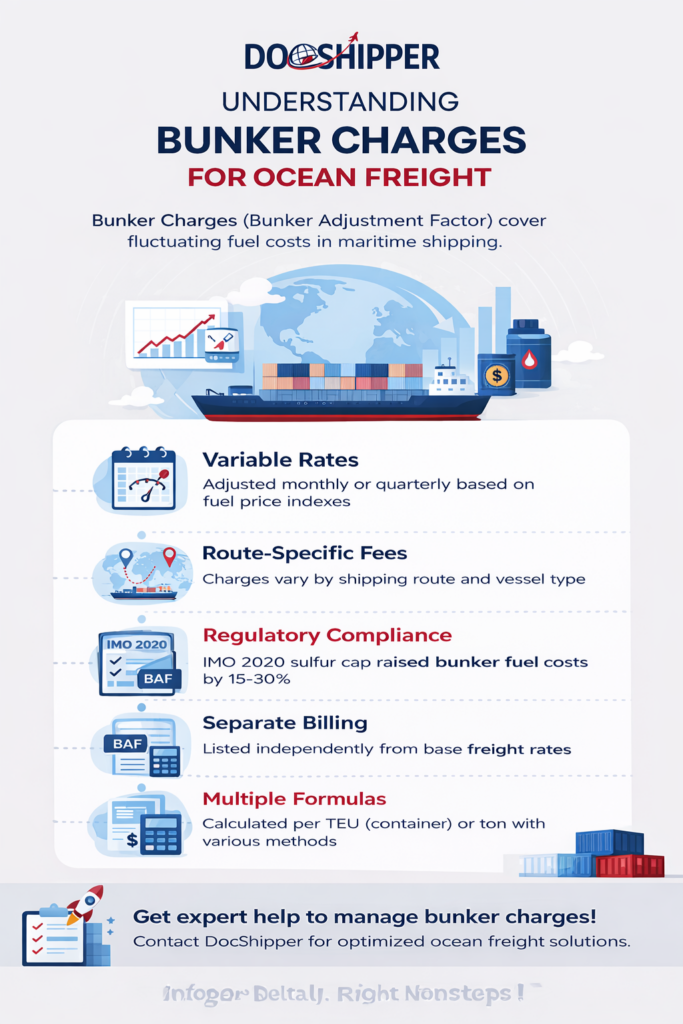
- Variable pricing – Adjusted monthly or quarterly based on fuel indexes
- Route-specific rates – Different charges apply per trade lane and vessel type
- Regulatory compliance – IMO 2020 sulfur cap regulations increased bunker costs significantly
- Separate billing – Listed independently from base ocean freight rates
- Non-negotiable – Carriers apply standardized formulas across all customers
Understanding Bunker Charge Mechanics & Regulations
Bunker charges emerged in the 1970s when oil price volatility made fixed freight rates unsustainable. Carriers separated fuel costs from base rates to protect margins during price spikes.
The International Maritime Organization (IMO) 2020 regulation mandated a maximum 0.5% sulfur content in marine fuels, replacing the previous 3.5% limit. This environmental measure forced carriers to use cleaner, more expensive fuel or install scrubber systems. Consequently, bunker charges increased 15-30% industry-wide.
Carriers reference benchmark fuel indexes like the Rotterdam Bunker Index or Singapore Fuel Oil Price to calculate charges. Most shipping lines publish their bunker formulas on official tariff pages, though transparency varies by carrier.
The Bunker Adjustment Factor (BAF) typically appears as a dollar amount per TEU (Twenty-foot Equivalent Unit) or per freight ton. Some carriers use percentage-based calculations tied to base freight rates instead of flat fees.
Contractual implications matter significantly. Service contracts may include bunker caps, floors, or fixed bunker components for rate stability. Spot market shipments always face current bunker rates without protection.
At DocShipper, we monitor bunker trends across all major trade lanes to provide accurate cost projections. Our procurement team negotiates favorable bunker terms within annual shipping contracts for high-volume clients. Learn more about IMO 2020 regulations.
Calculation Methods & Real-World Examples
Bunker charge calculations vary by carrier and trade lane. The most common methods include fixed per-container rates, percentage-based adjustments, and tiered pricing structures.
Standard Calculation Formula
Bunker Charge = Base Bunker Rate × Container Size Factor × Route Multiplier
Comparative Example: Asia-Europe Trade Lane
| Container Type | Base Freight | Bunker Charge (Q1 2024) | Total Cost |
|---|---|---|---|
| 20′ Standard (TEU) | $1,200 | $385 | $1,585 |
| 40′ Standard (FEU) | $1,800 | $770 | $2,570 |
| 40′ High Cube | $1,900 | $770 | $2,670 |
Real-World Case Study
A European furniture importer ships 10 containers monthly from Shanghai to Hamburg. During Q4 2023, bunker charges averaged $420 per TEU. When oil prices spiked in January 2024, bunker charges increased to $485 per TEU.
Cost impact calculation:
- Previous monthly bunker cost: 10 containers × $420 = $4,200
- New monthly bunker cost: 10 containers × $485 = $4,850
- Monthly increase: $650 (15.5% higher)
- Annual additional cost: $7,800
DocShipper Platform
One platform. Your entire supply chain
Sourcing, freight, customs & documents — all centralised, all visible, 24/7.
Key Bunker Charge Variables
- Fuel type selection – VLSFO (Very Low Sulfur Fuel Oil) costs 20-25% more than traditional HFO
- Vessel efficiency – Modern eco-ships consume 15-20% less fuel, reducing bunker charges
- Seasonal fluctuations – Winter demand in Northern Hemisphere typically increases fuel prices
- Geopolitical events – Sanctions, conflicts, or refinery disruptions cause immediate price spikes
- Route distance – Longer voyages proportionally increase bunker components
DocShipper provides quarterly bunker forecasts to help clients budget accurately. Our logistics specialists analyze fuel trends and recommend optimal shipping windows to minimize surcharge exposure.
Conclusion
Bunker charges represent a significant and variable component of ocean freight costs. Understanding calculation methods and regulatory drivers enables better cost control and supplier negotiations.
Need expert guidance on managing bunker surcharges in your supply chain? Contact DocShipper for customized freight solutions and bunker cost optimization strategies.
📚 Quiz
Test Your Knowledge: Bunker Charge
1. What is the primary purpose of a Bunker Charge in ocean freight?
2. Why did bunker charges increase significantly after the IMO 2020 regulation came into effect?
3. A European importer receives two freight quotes for a 40' container from Shanghai to Hamburg. Quote A shows a base rate of $1,800 with bunker listed separately at $770. Quote B shows an "all-in" rate of $2,570 with no line items. Which statement is correct?
🎯 Your Result
📞 Free Quote in 24hFAQ | Bunker Charge: Definition, Calculation & Concrete Examples
BAF (Bunker Adjustment Factor) and bunker surcharge are identical terms. Both refer to the fuel cost component added to base ocean freight rates. Some carriers use BAF while others prefer "fuel surcharge" or "bunker charge."
Most carriers adjust bunker charges monthly or quarterly based on average fuel prices from the previous period. Some shipping lines update rates every 15 days during periods of extreme volatility.
Bunker charges are typically non-negotiable for spot shipments. However, high-volume shippers can negotiate fixed bunker components or caps within annual service contracts to protect against price spikes.
The IMO 2020 sulfur cap regulation required carriers to use low-sulfur fuel costing 20-30% more than traditional bunker fuel. This environmental compliance measure directly increased bunker surcharges industry-wide.
Bunker charges appear separately from base ocean freight in most quotes. Always request "all-in" pricing to see the complete cost including bunker, currency adjustment, and other surcharges.
Air cargo uses a similar mechanism called Fuel Surcharge or FSC (Fuel Surcharge Component). It functions identically to maritime bunker charges but references jet fuel indexes instead of marine fuel prices.
Bunker charges typically represent 20-35% of total ocean freight costs depending on trade lane, fuel prices, and vessel efficiency. On Asia-Europe routes, bunker components average 25-30% of the all-in rate.
Carriers reduce bunker charges when fuel costs decline, though adjustments lag actual price changes by 30-60 days. Some service contracts include bunker floors preventing charges from dropping below specified minimums.
No. Bunker charges scale with container size. A 40-foot container typically incurs double the bunker charge of a 20-foot container. Reefer containers often face additional bunker components due to refrigeration energy requirements.
Yes. Monitor public fuel indexes like the Rotterdam Bunker Index or Singapore Fuel Oil Price. Most major carriers publish current bunker rates on their tariff pages or customer portals.
Trucking and rail carriers use diesel surcharges similar to bunker charges. These fuel adjustments appear separately from base inland freight rates and fluctuate based on regional diesel prices.
Vessels with scrubber systems can use cheaper high-sulfur fuel while meeting emission standards. Carriers operating scrubber fleets may offer slightly lower bunker charges, though savings rarely pass fully to customers.
Need Help with
Logistics or Sourcing ?
First, we secure the right products from the right suppliers at the right price by managing the sourcing process from start to finish. Then, we simplify your shipping experience - from pickup to final delivery - ensuring any product, anywhere, is delivered at highly competitive prices.


Fill the Form
Prefer email? Send us your inquiry, and we’ll get back to you as soon as possible.
Contact us




