


In short ⚡
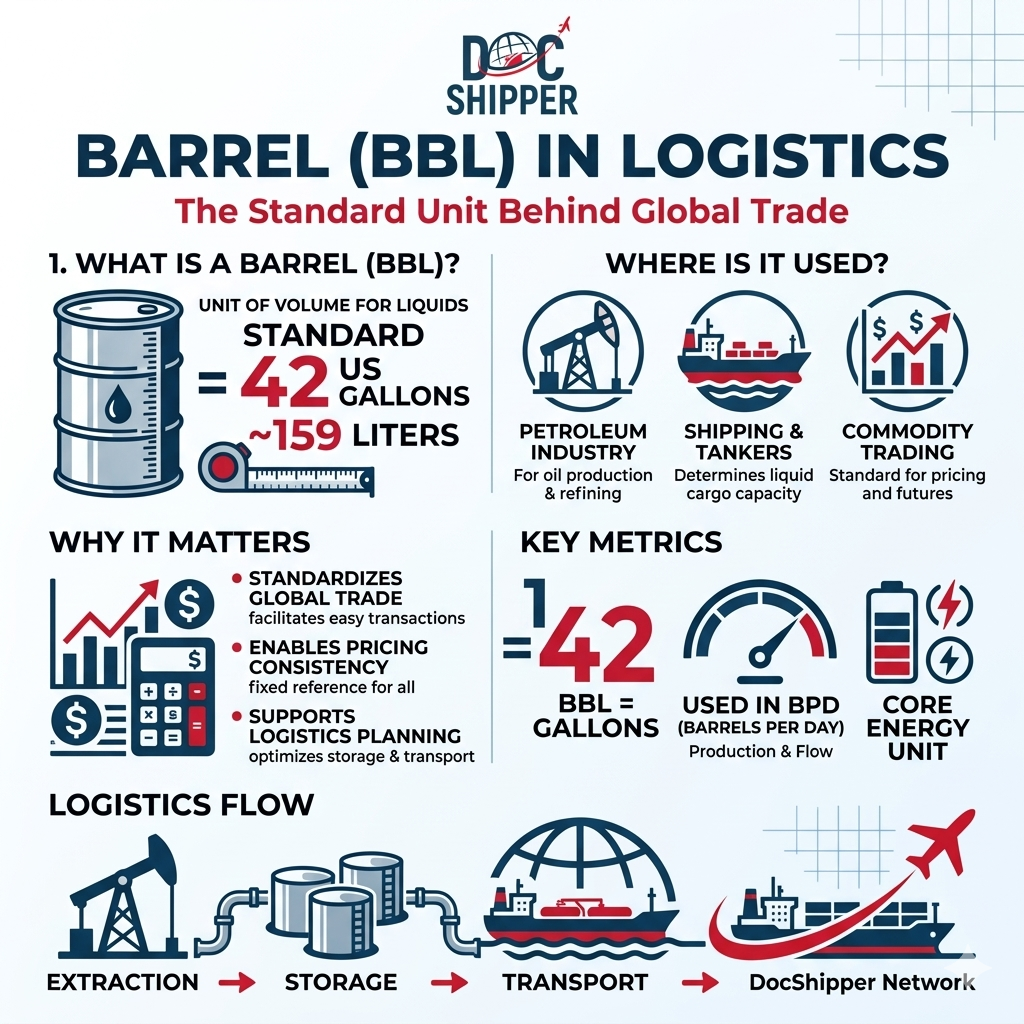
The barrel (BBL) is a volumetric unit of measurement primarily used in the petroleum and chemicals industries, standardized at 42 US gallons (approximately 159 liters). This unit serves as the global benchmark for crude oil pricing, shipping documentation, and international trade contracts.Introduction
Why does a barrel contain exactly 42 gallons when physical barrels vary in size? This standardization confusion causes frequent errors in import/export documentation and pricing calculations. Understanding the barrel unit is critical for anyone involved in petroleum product shipping, customs declarations, or energy commodity trading.
The barrel remains the dominant measurement unit despite the global shift toward metric systems. Its persistence stems from historical petroleum industry practices and its integration into international pricing mechanisms like Brent Crude and WTI benchmarks.
- Standard volume: 42 US gallons or 158.987 liters (exact)
- Primary application: Crude oil and refined petroleum products
- Legal status: Recognized in international trade agreements and customs regulations
- Conversion complexity: Different barrel definitions exist for beer, wine, and dry goods
- Documentation requirement: Mandatory specification in bills of lading and commercial invoices
Technical Standards & Industry Applications
The petroleum barrel’s standardization traces back to 1866 when Pennsylvania oil producers established the 42-gallon measure. This volume became the American Petroleum Institute (API) standard and was subsequently adopted by the International Organization for Standardization (ISO).
Regulatory framework: The barrel is defined under the US Code of Federal Regulations (Title 15, Chapter 1, Part 231) and recognized by the International Bureau of Weights and Measures (BIPM) for trade purposes. European Union customs authorities accept barrel declarations when accompanied by metric equivalents in shipping documentation.
Conversion precision matters: One barrel equals exactly 0.158987294928 cubic meters. Rounding errors in large shipments can result in significant financial discrepancies. A 100,000-barrel cargo miscalculated by even 0.1% represents approximately $8,000 in value variance at $80 per barrel.
Industry-specific variations: While petroleum uses 42 gallons, the US beer industry defines a barrel as 31 gallons, and the wine industry uses 31.5 gallons. This divergence requires careful specification in customs documentation to avoid classification errors.
Temperature correction: Petroleum volumes expand and contract with temperature. The industry standard measures barrels at 60°F (15.56°C). Shipments must include temperature correction factors, documented through Volume Correction Factor (VCF) tables published by the API.
At DocShipper, we systematically verify barrel specifications in shipping documents against applicable industry standards to prevent customs delays and ensure accurate duty calculations. For more information, visit American Petroleum Institute standards.
Practical Examples & Data
Understanding barrel measurements becomes practical through real-world shipping scenarios and conversion calculations.
Comparative Volume Analysis
| Unit | Volume (Liters) | Barrels Equivalent | Common Application |
|---|---|---|---|
| 1 Barrel (BBL) | 158.987 | 1.00 | Crude oil pricing |
| 1 Cubic Meter | 1,000 | 6.29 | ISO shipping documentation |
| 1 US Gallon | 3.785 | 0.024 | Retail fuel sales |
| 1 Imperial Gallon | 4.546 | 0.029 | UK petroleum trade |
Shipping Scenario: Middle East to Europe
Cargo: 500,000 barrels of crude oil
Volume calculation: 500,000 BBL × 158.987 L = 79,493,500 liters (79,493.5 m³)
Vessel capacity requirement: Very Large Crude Carrier (VLCC) class minimum
Documentation challenge: EU customs requires metric declaration; US origin documents use barrels
Financial impact: At $85/BBL, total cargo value = $42,500,000
A 0.5% volume discrepancy in this shipment equals 2,500 barrels or $212,500. Precise conversion and temperature-corrected measurements are therefore contractually mandatory.
DocShipper Platform
Cut logistics costs. Not corners.
See exactly where your logistics costs are bleeding — and how to fix it. Book your expert demo.

Key Calculation Points
- Freight cost basis: Ocean freight for petroleum is typically quoted per metric ton, requiring density conversion from barrels
- Density variable: Crude oil density ranges from 0.8 to 0.95 kg/L; one barrel weighs 127-151 kg depending on API gravity
- Customs valuation: Most jurisdictions require both volume (BBL) and weight (MT) declarations
- Insurance coverage: Marine cargo insurance calculates premiums on declared barrel quantities multiplied by spot prices
- Pipeline measurement: Transfer custody points use calibrated meters with barrel-per-hour flow rates
Conclusion
The barrel remains the petroleum industry’s universal language despite metric system dominance elsewhere. Accurate barrel calculations directly impact contract compliance, customs clearance speed, and financial settlement accuracy in international oil trade.
Need assistance with petroleum product imports or complex volume conversions in your shipping documentation? Contact DocShipper for expert guidance on logistics documentation and customs compliance.
📚 Quiz
Test Your Knowledge: Barrel (BBL)
Q1 — What is the standardized volume of one petroleum barrel (BBL)?
Q2 — A shipper declares a cargo of 500,000 BBL of crude oil without including metric equivalents. What is the most likely consequence when clearing EU customs?
Q3 — A customs document lists "500 barrels of product" without specifying the industry. Which interpretation is correct?
🎯 Your Result
📞 Free Quote in 24hFAQ | Barrel (BBL): Definition, Calculation & Practical Examples
Need Help with
Logistics or Sourcing ?
First, we secure the right products from the right suppliers at the right price by managing the sourcing process from start to finish. Then, we simplify your shipping experience - from pickup to final delivery - ensuring any product, anywhere, is delivered at highly competitive prices.


Fill the Form
Prefer email? Send us your inquiry, and we’ll get back to you as soon as possible.
Contact us




:%20Definition%20&%20Calculations%20in%202026)