


In short ⚡
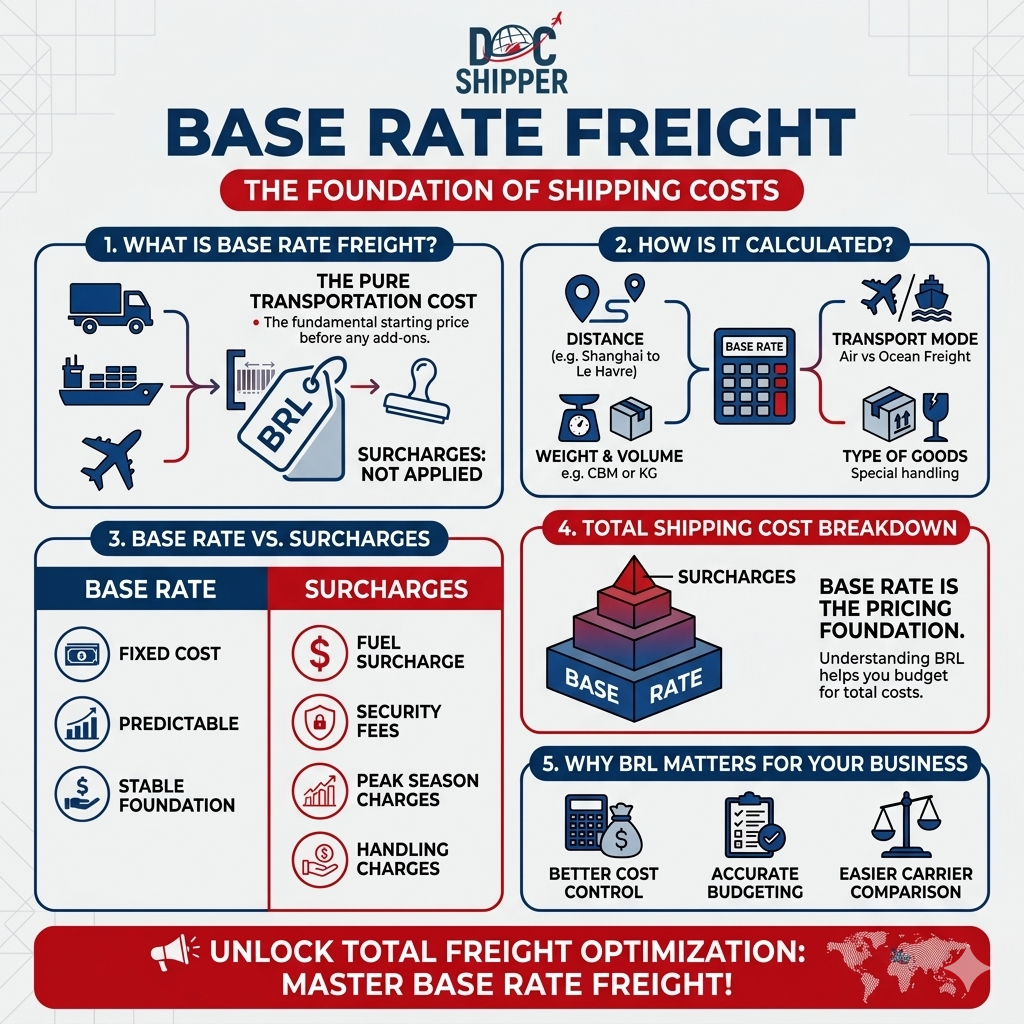
Base rate is the fundamental freight charge applied by carriers before any surcharges, accessorial fees, or adjustments. It represents the core transportation cost per unit (container, weight, or volume) and serves as the foundation for total shipping expenses in international logistics.
Introduction
Many importers struggle to understand why their final shipping invoice differs significantly from the initial quote. The confusion often stems from misunderstanding the base rate versus the all-in cost.
In international freight, the base rate is the starting point for all cost calculations. It determines your negotiating position with carriers and directly impacts your landed cost structure. Understanding this fundamental pricing element is essential for accurate budgeting and competitive sourcing.
- Pure transportation cost – excludes fuel, security, and handling fees
- Route-specific pricing – varies by origin-destination lane and trade volume
- Contract foundation – basis for carrier agreements and service level commitments
- Market-driven fluctuation – adjusts based on capacity, seasonality, and demand
- Negotiable element – subject to volume commitments and shipper-carrier relationships
Understanding Base Rate Components & Mechanisms
The base rate structure differs fundamentally between ocean freight and air cargo. For maritime shipping, carriers publish base rates per container type (20′ or 40′ standard, high cube, reefer). Air freight typically uses weight-based rates per kilogram or volume-weight calculations.
Rate determination factors include vessel capacity utilization, port infrastructure costs, transit time commitments, and competitive positioning on specific trade lanes. Carriers adjust base rates quarterly or monthly based on market conditions, though contracted rates may remain fixed for 6-12 months.
The all-in rate concept adds mandatory surcharges to the base rate: Bunker Adjustment Factor (BAF), Currency Adjustment Factor (CAF), Peak Season Surcharge (PSS), and Terminal Handling Charges (THC). Understanding this distinction prevents budget overruns and enables accurate cost forecasting.
Contract negotiation leverage depends on annual volume commitments, routing flexibility, and shipper reliability. High-volume importers typically secure 15-30% discounts from published base rates, while spot market rates can fluctuate 50-200% during capacity crunches.
At DocShipper, we systematically analyze base rate structures across multiple carriers to identify the most competitive options for each client’s specific routing requirements and volume profile.
For authoritative tariff information and regulatory frameworks, consult the U.S. Federal Maritime Commission database of filed service contracts and published tariffs.
Practical Examples & Rate Comparisons
Consider a Shanghai to Los Angeles routing for a 40′ standard container. The base rate represents only the ocean freight component, excluding all accessorial charges that typically add 40-60% to the final cost.
| Cost Component | Base Rate Scenario | All-In Rate Scenario |
|---|---|---|
| Ocean Freight (Base Rate) | $1,800 | $1,800 |
| Bunker Adjustment Factor (BAF) | — | $450 |
| Terminal Handling Charges | — | $320 |
| Documentation & Filing Fees | — | $125 |
| Peak Season Surcharge | — | $600 |
| TOTAL COST | $1,800 | $3,295 |
This 83% difference between base rate and all-in cost illustrates why transparent quoting is critical. Shippers comparing only base rates may encounter unexpected expenses during shipment execution.
Air freight base rates follow different logic. A 500 kg shipment from Hong Kong to Frankfurt might show a base rate of $3.50/kg ($1,750 total), but dimensional weight calculations, security surcharges, and fuel adjustments can push the effective rate to $5.20/kg ($2,600 total).
Volume discount structures typically apply tiered reductions to base rates:
- 1-10 containers/year: Published base rate
- 11-50 containers/year: 12% reduction on base rate
- 51-200 containers/year: 22% reduction on base rate
- 200+ containers/year: 30% reduction + dedicated account management
At DocShipper, we leverage consolidated volume across clients to negotiate base rates typically reserved for high-volume shippers, then pass those savings directly to individual importers.
DocShipper Platform
One platform. Your entire supply chain
Sourcing, freight, customs & documents — all centralised, all visible, 24/7.
Conclusion
The base rate forms the foundation of all freight cost calculations, yet represents only 50-70% of total shipping expenses. Mastering this distinction enables accurate budgeting, effective carrier negotiations, and competitive landed cost management.
Need expert guidance on freight rate analysis and carrier selection? Contact DocShipper for comprehensive logistics support tailored to your specific import/export requirements.
📚 Quiz
Test Your Knowledge: Base Rate
Q1 — What does the base rate in international freight represent?
Q2 — On a Shanghai–Los Angeles route, a carrier quotes a base rate of $1,800 for a 40' container. A shipper budgets exactly $1,800 for the shipment. What is most likely to happen?
Q3 — A small importer shipping 8 containers per year wants to negotiate a lower base rate directly with a major ocean carrier. Which statement best describes their situation?
🎯 Your Result
📞 Free Quote in 24hFAQ | Base Rate: Definition, Calculation & Practical Examples
Base rate covers only core transportation, while all-in rate includes all surcharges, fees, and accessorial charges. The all-in rate typically runs 40-80% higher than the base rate.
Spot market base rates fluctuate weekly or monthly based on capacity and demand. Contract base rates typically remain fixed for 6-12 months with quarterly review clauses.
Direct negotiation is difficult below 20 containers annually. Freight forwarders consolidate volumes to access better base rates, then distribute savings across smaller clients.
Variations reflect different vessel schedules, service reliability, alliance memberships, and strategic positioning. Premium carriers charge 15-25% higher base rates for faster transit and lower risk.
Major carriers publish indicative base rates, but actual contracted rates depend on negotiation. The Federal Maritime Commission requires tariff filing for U.S. trades, providing transparency.
Common additions include Bunker Adjustment Factor (fuel), Currency Adjustment Factor, Peak Season Surcharge, Terminal Handling Charges, and security fees. These can equal or exceed the base rate.
Air freight uses weight-based or volumetric pricing per kilogram, while ocean freight charges per container or cubic meter. Air base rates fluctuate more frequently due to capacity constraints.
No, but they can drop to near-cost levels during severe overcapacity. Carriers may offer $100-300 base rates on certain lanes while recovering costs through mandatory surcharges.
No. Base rates cover only transportation. Customs duties, brokerage fees, import taxes, and clearance charges are separate line items added to the total landed cost.
Compare quotes from 3-5 carriers or forwarders on the same routing. Check industry rate indices like the Shanghai Containerized Freight Index (SCFI) for benchmark data.
GRI is a carrier-announced base rate increase, typically $200-800 per container, implemented during peak seasons or capacity shortages. Contracted shippers may be partially protected.
Annual contracts provide budget certainty but may miss market downturns. Hybrid approaches—locking 60-70% of volume with spot market flexibility—balance risk and opportunity.
Need Help with
Logistics or Sourcing ?
First, we secure the right products from the right suppliers at the right price by managing the sourcing process from start to finish. Then, we simplify your shipping experience - from pickup to final delivery - ensuring any product, anywhere, is delivered at highly competitive prices.


Fill the Form
Prefer email? Send us your inquiry, and we’ll get back to you as soon as possible.
Contact us




